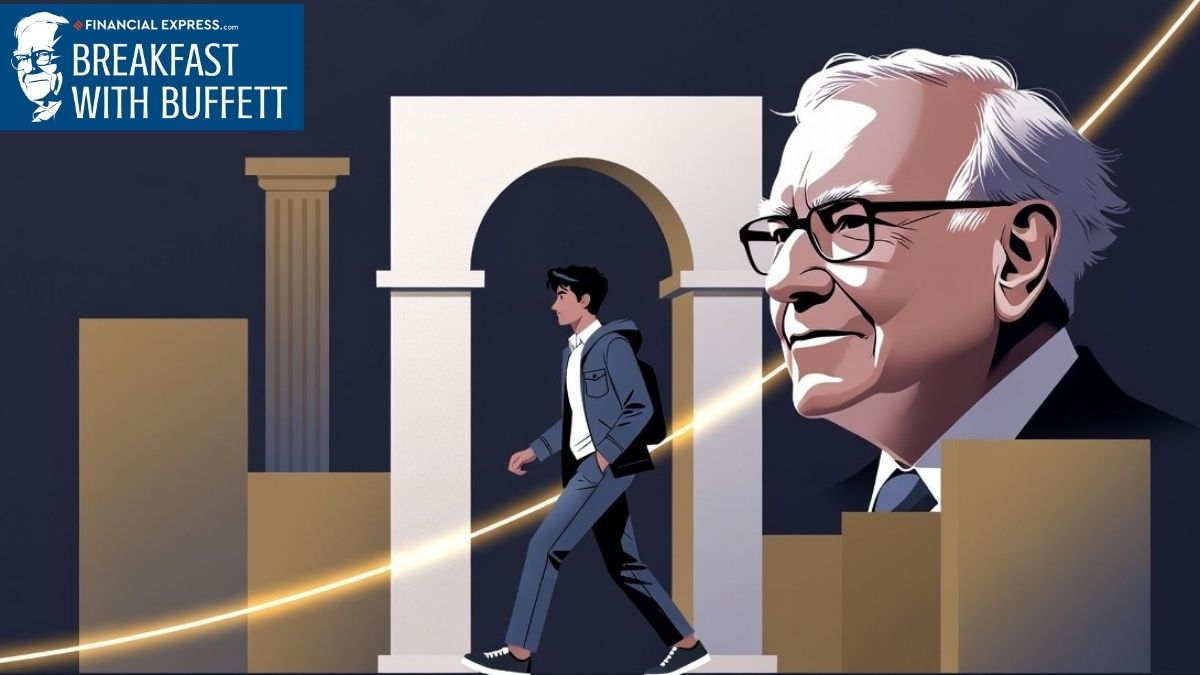
They are Leaving the Nest… And They MUST Know This
There is a strange silence in many Indian homes which just witnessed the first major milestone in their child’s life. The 10th grade results came out in May and now it is time to prepare your kids for college. The board exams are behind them. The coaching mornings, the cut-off panic, the CAP round lists coming in… But apart from all of this there is something bigger your child must know before stepping in to the adult world.
We spend years teaching our children how to score marks. We send them to the best schools and coaching classes, track every percentile, frame the rank card. But amidst all this, we rarely teach them how to live. And that is where our unlikely teacher walks in.
Warren Buffett never wrote a parenting book. He simply ran a company called Berkshire Hathaway for sixty years and, along the way, dropped little lines of wisdom. Most of them were about money. But read them again, and you realise the best ones were never really about money at all.
So as your child swaps a school uniform for new varsity jackets and high ankle sneakers, here are five Buffett lessons worth slipping into their bag.
#1 The Reputation Asset: Guarding Character in a Hyper-Connected World
“Guard Your Name Like It Is the Only Thing You Own”
Buffett once told the managers of his companies something he had been repeating for over twenty-five years. His words were blunt: a business can afford to lose money, even a lot of money, but it cannot afford to lose even a shred of reputation.
He put this in a now-famous memo to his managers in 2010. And the longer version, the one he is most quoted on, is even simpler: it takes twenty years to build a reputation and five minutes to ruin it.
College is the first place your child builds a name without you watching. Nobody in the new college knows whether they topped the class or sat at the back. They start fresh. Every promise they keep, every deadline they hit, every time they own up to a mistake instead of hiding it, they are laying a brick in something that will follow them for life.
Tell your child this plainly. In our world, word travels fast. The seniors in the college, the professor who signs their internship letter, the campus recruiter from a big firm, the uncle who knows someone who knows someone, all of them are quietly deciding one thing: can this person be trusted?
In a country where so many doors still open through reputation and reference, that answer matters more than any marksheet. It is built slowly and lost in an afternoon. Buffett built one of the richest companies on earth, and even he treated his name as the asset he could least afford to lose.
#2 Compounding Intrinsic Value: Why Skills Outlast a Degree Certificate
“The Best Money You Will Ever Spend Is on Yourself”
In a 2019 interview with Yahoo Finance, Buffett was asked about the smartest investment a young person could make. His answer had nothing to do with stocks. He said, by far, the best investment you can make is in yourself.
This is the man who has spent his whole life finding undervalued companies. And when asked for his single best tip, he pointed inward.
What does this mean for a fresher walking into college? It means the degree certificate is the smallest part of the deal. In a country where lakhs of graduates hold the same degree every year, the certificate alone no longer sets anyone apart.
The real return comes from the skills they pick up on the side. The fluent English or third language they finally master. The book they read that was nowhere on the syllabus. The coding, the design, the public speaking they were too shy to try in school and finally attempt now.
Buffett has often said he reads for hours every day, even in his nineties. He calls knowledge something that builds up like compound interest, an idea every Indian parent who has watched a recurring deposit grow will understand instantly. Your child does not need to be a genius. They just need to keep adding a little to themselves, every single day, the way a small monthly deposit quietly becomes a large sum over the years.
And here is the part that should comfort every parent who stretched the household budget for fees and rankings. This investment cannot be taxed, stolen, or wiped out in a market crash. Once your child learns something, it is theirs forever.
#3 Peer Portfolios: The Mathematical Gravity of Your Friends Circle
“Choose Your Friends the Way Buffett Chooses Companies”
Back in 2004, at a Berkshire Hathaway shareholder meeting, a fourteen-year-old boy named Justin Fong stood up and asked Buffett a question that every young person secretly wants answered: How do I become successful?
Buffett did not talk about money. He said it is better to hang out with people better than you. Pick associates whose behaviour is better than yours, he said, and you will drift in that direction.
There is no lesson on this list more useful for a teenager stepping into the adult world. In school, your child’s friends were mostly decided by chance, the same colony, the same classroom, the same school van. College is the first time they get to choose, surrounded by strangers from every strata of society. And that choice will shape them more than any lecture.
Buffett’s logic is almost mathematical. We slowly become the average of the people around us. Surround yourself with people who study, who keep their word, who treat others well, and you rise without even noticing. Surround yourself with the opposite, and you sink the same way.
His business partner Charlie Munger added a sharp note to this idea. If picking better company makes you a little unpopular with your old crowd, he said, then so be it. That is a hard thing for an eighteen-year-old to hear, when fitting in feels like everything. But it may be the most honest advice in this entire piece.
Tell your child to watch who they drift towards in those first few months. Those early choices have a way of becoming the whole story.
#4 The Circle of Competence: Embracing Intellectual Honesty
“Know What You Know, And Admit What You Do Not”
One of Buffett’s most repeated ideas is what he calls the circle of competence. The size of the circle does not matter, he has said. What matters is knowing exactly where its edges are.
In plain words: be honest about what you actually understand. He has said the real danger comes not from what you do not know, but from being sure about things you only think you know.
This is gold for a fresh college student. The first year of any course is a flood of new subjects, confident classmates, and the constant pressure to pretend you understand more than you do. In our culture, where admitting confusion in class can feel like losing face, this is harder than it sounds.
Buffett, one of the smartest financial minds alive, built his fortune partly by skipping the things he did not understand. He famously avoided technology companies for years simply because he admitted they were outside his circle.
Teach your child that raising a hand and saying “sir, can you explain that again” is not weakness. It is the exact habit that separates people who keep learning from people who quietly fall behind while pretending. The student who asks the basic doubt in the front row will, over four years, leave the one who nodded along far behind.
Confidence built on real understanding is strong. Confidence built on bluffing collapses the moment it is tested, usually in an exam hall or a job interview.
#5 Capital Preservation: Resisting the Invisible Temptations
“Spend Less Than You Earn, Even When It Is Not Much”
Buffett is worth tens of billions of dollars. He still lives in the same Omaha house he bought in 1958 for a little over thirty thousand dollars. That single fact teaches more than any lecture on budgeting.
His view on money is unglamorous and unbeatable. He has often warned against the danger of borrowing to buy things you do not need, and he and Munger built their fortune by sleeping easy without heavy debt hanging over them. Living below your means is not about being stingy. It is about being free.
Your child is about to get their first taste of handling money alone. A monthly allowance, a part-time gig, a UPI app that makes spending feel invisible, and soon, a credit card or a buy-now-pay-later offer with a frighteningly easy limit. In an age where a tap pays for anything and EMIs are offered on the smallest purchase, the temptation to overspend has never been greater. The habits they build in these years will quietly decide whether money is a tool they control or a worry that controls them.
Buffett has a lovely way of putting the value of patience. He says someone is sitting in the shade today because someone planted a tree a long time ago. Saving a small sum in college feels pointless. It is not. It is the first seed of a tree your child will rest under decades from now.
Teach them to glance at where the money goes each month, to wait a day before buying, and to never spend on showing off to people they do not even like. It is the least exciting lesson on this list. It is also the one most likely to keep them out of trouble for life.
The Real Inheritance
Notice what is missing from this list. Not one of these lessons is about getting rich. Buffett, of all people, spent his life talking less about making money and more about character, patience, and the company you keep.
That is the quiet truth every parent eventually learns. You cannot pack ambition into a suitcase. You cannot wire honesty to a bank account. The only things that truly travel with your child are the habits you helped them build and the values they choose to carry.
So, before they start college, share these five. Not as a lecture, but as a welcome gift to adulting. A good name, a curious mind, good friends, an honest sense of their own limits, and the discipline to live within their means. Buffett built an empire on these. Your child can build a life on them.
The college years go faster than anyone expects. But the lessons, like the best investments, only grow with time.
Disclaimer:
The purpose of this article is only to share interesting charts, data points, and thought-provoking opinions. It is NOT a recommendation. If you wish to consider an investment, you are strongly advised to consult your advisor. This article is strictly for educative purposes only.
Suhel Khan has been a passionate follower of the markets for over a decade. During this period, he was an integral part of a leading Equity Research organisation based in Mumbai as the Head of Sales & Marketing. Presently, he is spending most of his time dissecting the investments and strategies of the Super Investors of India