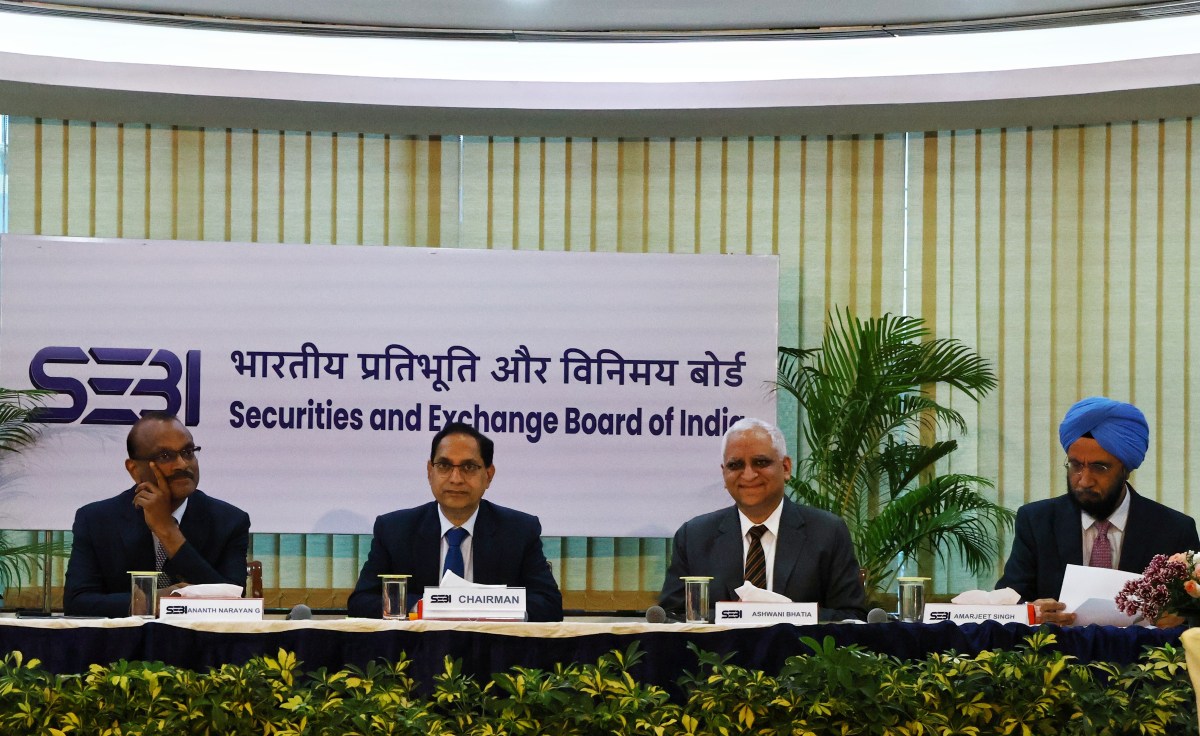
In a media conference after the board meeting, SEBI chairperson Tuhin Kanta Pandey, along with whole time members Ananth Narayan, Ashwani Bhatia, Amarjeet Singh and Kamlesh Chandra Varshney made several important observations about the regulatory posture across segments. Excerpts:
What is the current regulatory stance on speculation through F&O trading and expiry day?
Ananth Narayan (AN): The actions that were taken in October last year were specifically directed to tackle the issue of overtrading in index options on expiry date and that remains the objective for SEBI. About expiry days across exchanges, we said that we will allow each exchange to have one expiry or weekly expiry and right now we have two days of the week, which we think is comfortable.
We will come out with a white paper giving out what the impact in the market has been but very broadly our objectives have been achieved, as there has been a decline in index options trading on expiry day. So our objectives have been pretty much being met.
Should there be further clamping down of shell companies by the regulator, in cases of corporate frauds?
Tuhin Kanta Pandey: In case of corporate frauds, and particularly, where false information is provided, we won’t hesitate to take stringent action. But we are finding out methods to systemically improve that such false disclosures are discovered very early. Our previous circular provided that a clarification, but the important point is that false disclosures are made and if there is a tendency to pump. We have to, along with exchanges, find how to really curb this at a systemic level so that things do not go undetected for too long.
AN: You make disclosures, you make rights issues, you make referential issues, you split shares, you pump it and dump it. So in the past what was happening is that we caught companies when the dumping had been done. In fact, we caught firms at ‘pump’ stage, saved Rs 22,000 crore.
With the market going through a correction, unlike a steady rise for the last few years, does it pose different challenges for SEBI?
Pandey: We need to see the markets function with integrity. Of course, there are certain inherent risks with the market which we cannot backstop. So market cycles are there and market risks are there. But at the same time, over the longer term, you would realise that the returns in India have played out better, as compared to other markets.
The industry association had submitted a proposal to enhance the net limit for futures to about Rs 7,500 crore. Are you inclined to increase the limit and what is the real concern?
AN: I think out of the 850-odd responses, by and large the feedback is that we have got is very positive. On the proposed for delta or future equivalent metric, it is a better way of measuring risk than what we have currently. There are some legitimate feedback that has come in specific areas which we are looking at.
The intention is very clear. One, a better metric to express risk that’s there in the ecosystem so that all market participants are aware of the right number to look at. Two, as we mentioned in the consultation paper, we are also seeing some cases of in the single stocks futures and options, stocks being pushed into a ban category because of the artificial increase in open interest limits – something that we intend to audit.
Three, in the consultation paper, that the intent is to ensure that there is clarity positions both from a regulatory perspective and a market perspective, and of course, there are things like concentration risk and the potential for manipulation, etc.