
The Indian pharmaceutical sector has emerged as one of the strongest sectors in the past few years. Nifty Pharma index has risen over 84% in the past three years, which is more than three times the Nifty 50’s 24.7% gain over the same period, serving as a testament to its strength. (Source: NSE)
As of March 2026, the market size of the Indian pharma sector was around US$60 billion, and this is projected to reach US$ 130 billion by 2030. Currently, the Indian pharma sector is the third largest globally by volume, and 11th largest by value, so the projected increase in market size could further strengthen the position of Indian pharma companies globally.
Apart from the domestic market, Indian pharma businesses are one of the largest suppliers of pharma products globally. During FY26, total pharma exports stood at US$30.5 billion, which is a 16x increase from US$ 1.9 billion of pharma exports during FY2001.
Furthermore, Biopharma Shakti, a government initiative announced during the Union Budget 2026-27, is expected to accelerate research, development and manufacturing of pharma products in the country. (Source: PIB)
The solid sectoral growth and prospects are perhaps one of the reasons behind foreign institutional investors (FIIs) buying select pharma stocks during the first quarter of FY27 when they remained net sellers across domestic markets for the fourth quarter in a row.
So, in this piece, we will explore two pharmaceutical stocks that FIIs bought at a significant pace during Q1FY27.
#1 IOL Chemicals & Pharmaceuticals Limited: World’s largest integrated Ibuprofen producer
IOL Chemicals & Pharmaceuticals Ltd. is a leading pharma company mainly engaged in the development of Active pharmaceutical ingredients (APIs).
FIIs raised their stake by 3.15% points during Q1FY27, taking the total holding to 14.87% at the end of the quarter.
The company is the largest producer of Ibuprofen, one of the most commonly used painkillers globally, with an annual production capacity of 12,000 metric tonnes (MT). Apart from Ibuprofen, the company has a diversified API portfolio which includes metformin, pantoprazole, paracetamol, clopidogrel, fenofibrate and many other APIs.
With 11 dedicated manufacturing facilities across the country, IOL is one of the largest fully backward-integrated pharmaceutical manufacturing companies in the industry.
IOL is Diversifying Beyond Ibuprofen
While Ibuprofen is one of the main revenue contributors, the company is steadily diversifying its product base, reducing dependence on a single product. This is evident from the growing revenue share of non-ibuprofen products, from 18% during FY21 to 37% during FY26.
Apart from pharmaceuticals, IOL also deals in specialty chemicals. During FY26, 40% of the total revenue of the business came from this segment.
100+ Acre New Site
During FY26, the company spent around ₹160 crore on expansion projects. These were funded fully from its internal accruals. Already, the company has 101 acres of land on Chandigarh-Bathinda Highway for development of a new site.
This new site would add to the company’s existing facilities spanning over 180 acres. This facility is expected to be commissioned within six to eight quarters.
Management indicated that capex for FY27 would be a mix of 60% growth capex and 40% infra/land/automation capex. They have also stated that most of the capex would be dedicated to the pharma business of the company.
A 36.4% Jump in Profits
During FY26, IOL’s revenue increased to ₹2,319.1 crore, up from ₹2,079.2 crore in FY25, reflecting a 11.5% YoY growth.
Net Profit for the fiscal year stood at ₹137.7 crore, up from ₹101 crore in FY25, logging a 36.4% YoY growth.
As per management, topline growth for FY27 is expected to be around 15% to ₹2,700 crore.
The return on capital employed (ROCE) for FY26 stood at 11.3%, relatively lower than its peers, as the industry median is around 15.2%.
Having said that, the company offers a relatively higher dividend yield at 0.6% compared to the industry median of 0.08%.
Is IOL trading cheap?
The stock is trading at a price-earnings (PE) of 33.97x, slightly lower than the industry median of 34.9x. However, the price-earnings to growth (PEG) ratio is 24.8x, way higher than the industry median of 0.97x, indicating that if adjusted for growth, the stock would be relatively overpriced.
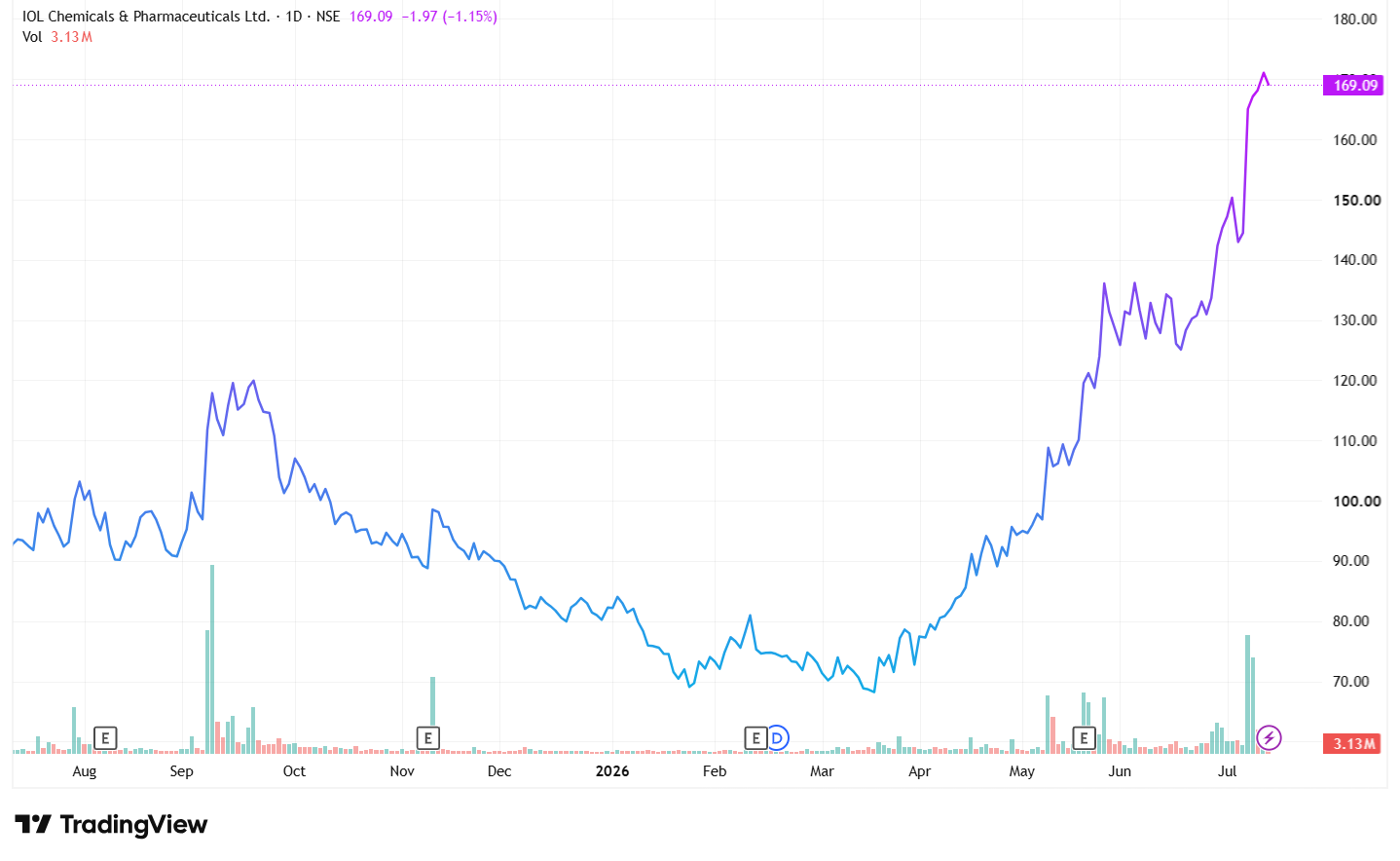
1-Year Share Price Chart of IOL Chemicals & Pharmaceuticals Limited

#2 Granules India Limited: Beyond Commoditized Generics
Granules India Ltd. is also into manufacturing APIs, along with pharmaceutical formulation intermediates (PFIs) and finished dosages as well.
FIIs increased their stake by 2.19% points, taking the total holding to 17.5% at the end of Q1FY27.
This pharma company is making a shift in its business model aligned with India’s pharma hub dreams. Granules India is deliberately reducing dependency on the usual generic medicines, and moving towards complex generics, which are witnessing an increase in global demand.
During FY26, complex generics contributed to 43% of the finished goods, up from 31% during FY25. Management is planning to increase this to above 50% over time.
The main areas where demand for complex generics is increasing include oncology, high-barrier formulations, controlled substances, attention deficit hyperactivity disorder (ADHD) and modified-release products (MUPs).
FIIs are perhaps increasing their stake in this company steadily over time, as complex generics offer ground for better pricing and lower competition, as most of the pharma companies are into commoditized generics. Given the better pricing, complex generics could translate into higher margins for the company.
Peptide CDMO As a New Growth Engine
Granules India acquired Senn Chemicals for venturing into Peptide Contract Development and Manufacturing Organisation (CDMO) business during April 2025. Senn Chemicals is a Swiss-based CDMO with over 60 years of experience in peptide synthesis.
In just a year, this segment achieved breakeven during Q4FY26 from a revenue of ₹69.9 crore. Factors driving the robust growth include TFA-free peptide chemistries for the cosmetics segment and the peptide therapeutics market expanding rapidly.
Building a 10 billion Dosage Facility
Granules India invested over ₹554.7 crore during FY26 for its Genome Valley facility, which is expected to have a manufacturing capacity of 10 billion dosages annually. The total investment for this facility stood at ₹2,310.7 crore made between FY22 and FY26. Apart from this facility, the capex would be used for the MUPs facility and a packing facility in the USA.
Management stated that for FY27, capex investment would be around a similar range of ₹600 crore, which will be used for a new API facility, digital investments, and a warehouse or distribution centre in the US.
Financials and Returns
Revenue of the company increased from ₹4,481.6 crore in FY25 to ₹5,365.6 crore in FY26, a 20% YoY rise.
Profit for the period jumped 19% YoY from ₹501.5 crore to ₹595 crore.
ROCE of the company stood at 15.46%, marginally higher than the industry median of 15.19%, while the dividend yield was 0.19%, compared to the industry median of 0.08%.
Already at a premium?
The stock is trading at a PE of 36.9x, above the industry median of 34.9x. Even the PEG ratio is at 7.1x, compared to the industry median of 0.97x, indicating that the stock is relatively expensive even when adjusted for growth.
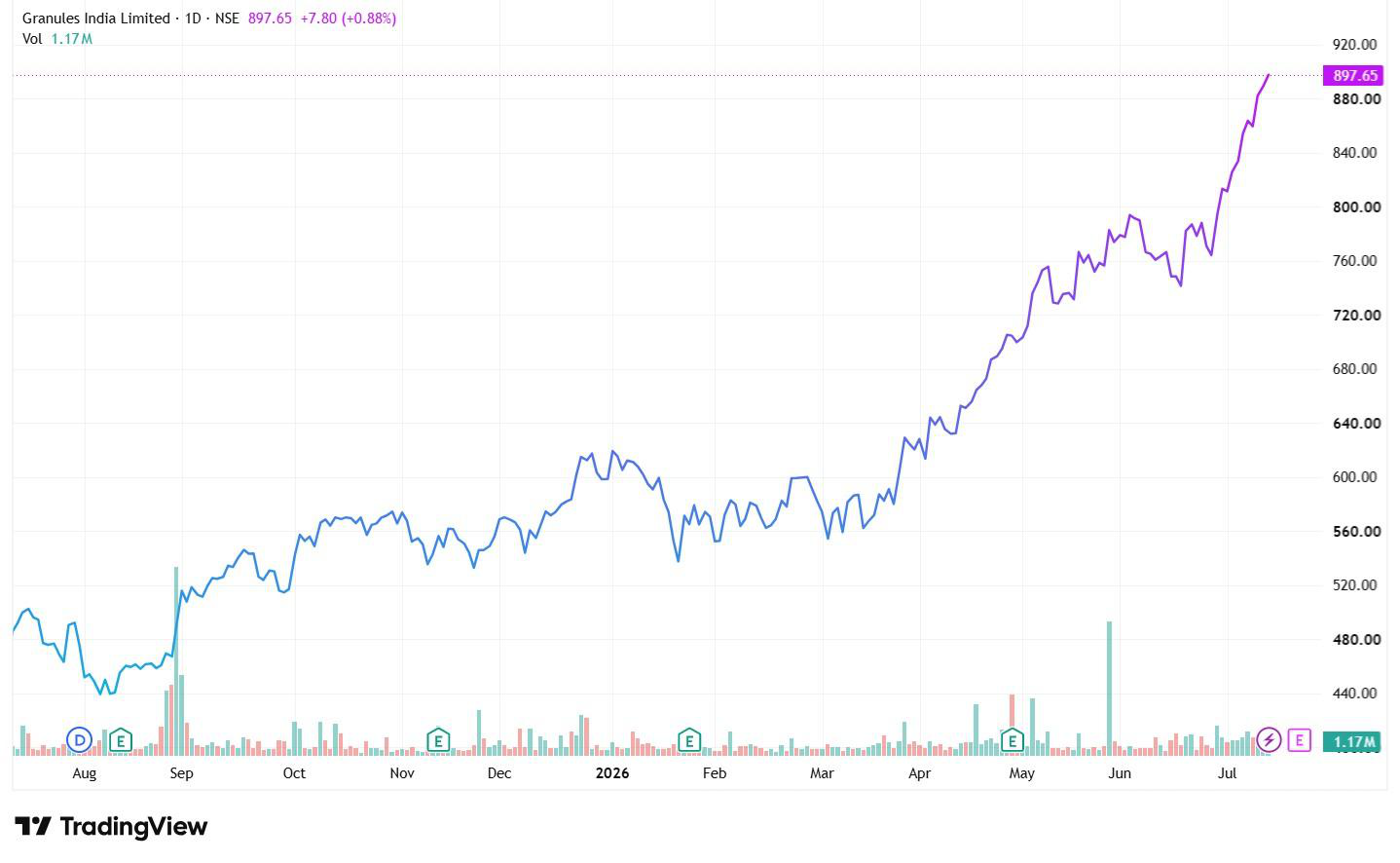
1-Year Share Price Chart of Granules India Limited

Final Thoughts
The Indian pharmaceutical sector continues to benefit from strong structural tailwinds, including rising demand for high-value APIs, growing exports, government support, and increasing opportunities in complex formulations and contract manufacturing. FIIs increasing their stake in these two pharma companies are perhaps signalling potential growth, given that both companies are making a shift into high-value APIs.
Having said that, given the volatile market scenario, it would be wise to add these stocks to your watchlist to see if FIIs’ conviction plays out in the future or not.
Disclaimer:
We have relied on data from www.Screener.in throughout this article. Only in cases where the data was not available have we used an alternate, but widely used and accepted source of information.
The purpose of this article is only to share interesting charts, data points, and thought-provoking opinions. It is NOT a recommendation. If you wish to consider an investment, you are strongly advised to consult your advisor. This article is strictly for educational purposes only.
Maumita Mitra is a seasoned writer specializing in demystifying the world of investment for a broad audience. She has a keen eye for detail and a knack for explaining complex financial concepts in the simplest manner possible.
Disclosure: The writer and her dependents do not hold the stocks discussed in this article.
The website managers, its employee(s), and contributors/writers/authors of articles have or may have an outstanding buy or sell position or holding in the securities, options on securities, or other related investments of issuers and/or companies discussed therein. The content of the articles and the interpretation of data are solely the personal views of the contributors/ writers/authors. Investors must make their own investment decisions based on their specific objectives and resources, and only after consulting such independent advisors as may be necessary.