The “Follow the Whale” Trap: Tread with Caution
Few things move a microcap faster than a famous name in its shareholding list. When Dolly Khanna or Porinju Veliyath shows up as a public shareholder, the stock often has big news before most investors have even read the filing. That is exactly why this corner of the market deserves the most caution, not the least.
But before I tell you more about who bought into what, let me be blunt about the risk. The first company has a market cap of about Rs 195 cr and the other is worth Rs 320 cr. So, both are microcaps and hence trade thin. Prices swing hard on small orders, exits get difficult when volumes dry up, and a single weak quarter can wipe out a year of gains.
Now the twist that makes this pair worth a close look. Neither superstar added shares recently. Dolly Khanna has been holding the Chennai based hotel since December 2023 quarter and Porinju Veliyath has held the other company since December 2024. But the June 2026 filings show that they have both added more to these stocks usually considered risky by the market.
Let us dive into both the companies to see if we can find a pattern.
#1 Savera Industries: The Debt-Free Hotel Hiding a Consumer Pivot
Incorporated in 1969, Savera Industries runs the 4-star Hotel Savera in Chennai, along with seven health centres under the O2 Health brand. In December 2024, it added a third leg, entering packaged drinking water through a plant set up on property leased from a related party. A hotel, a gym chain and a water business under one tiny roof, with a current market cap of Rs 195 cr.
Dolly Khanna, the famously private Chennai investor, first appeared in Savera’s shareholder list in the December 2023 quarter. The stock hit a record high the day her name showed up. As per the March 2026 filings, she held 1.2% stake in the company, which by the end of June 2026 went to 1.3%. The stake is now worth Rs 3.3 cr.
This small addition comes around the time the promoters have poured in more money into the business. After sitting near 62.8% for close to three years, the promoter group raised its holding to 64.62% in the March 2026 quarter which they maintained at the end of June 2026 as well.
The Profit Illusion: Decoding Savera’s FY26 Record Revenue
Looking at the standalone figures, FY26 was the best year in Savera’s listed history on the top line. Sales crossed Rs 100 cr for the first time, at Rs 102 cr, up 28% on FY25. Operating profit came in at Rs 18 cr and net profit at Rs 13 cr. The company declared a dividend of Rs 3 per share and is almost debt free.
| Financial Year | FY21 | FY22 | FY23 | FY24 | FY25 | FY26 | 5Y CAGR |
| Sales (Rs cr) | 20 | 32 | 61 | 72 | 80 | 102 | 39%* |
| EBITDA (Rs cr) | -1 | 2 | 14 | 13 | 15 | 18 | Turnaround |
| Net Profit (Rs cr) | -4 | -1 | 12 | 10 | 13 | 13 | Turnaround |
EBITDA here refers to operating profit before other income. Now for the asterisks. First, that 39% sales CAGR is measured from FY21, when the pandemic had shut the hotel and sales had collapsed to Rs 20 cr. Measured from pre-pandemic FY20, when sales were Rs 67cr, the six-year growth works out to a far humbler 7% a year.
Second, FY26 earnings lean on other income of Rs 6.15 cr, a large slice of the Rs 16 cr profit before tax. Strip that out and the operating business earned less than the headline suggests. The March 2026 quarter itself was soft. Net profit fell to Rs 0.70 cr, operating margin slipped to 10.15%, the tax rate spiked to 45.67%, and depreciation has nearly doubled as the new water and wellness assets hit the books.
Valuations: Is a 15% ROCE Worth the Concentration Risk?
The share price of Savera Industries was about Rs 52 in July 2021 and as on 20th July 2026 it was Rs 164, which is a jump of 215% in 5 years.

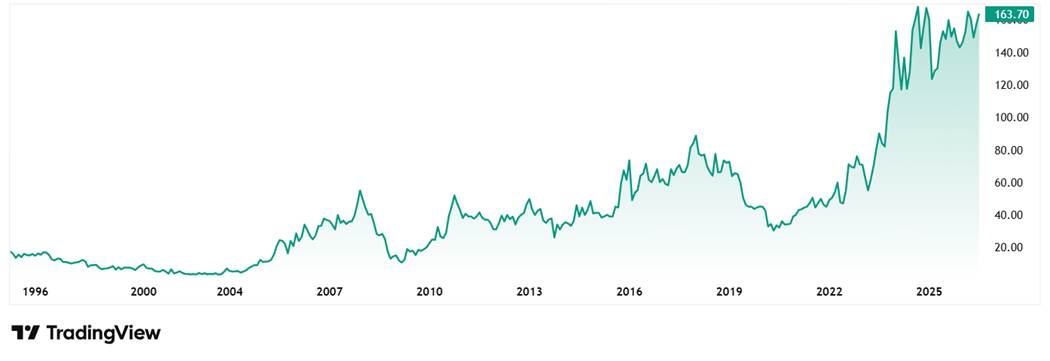
Regarding valuations, the stock trades at a PE of about 18x and the current industry median is 30x. The 10-year median PE for the company is 14x while the industry median for the same period is 33x. Large listed hotel chains routinely command multiples well above 30 times earnings, so on paper Savera looks cheap for a hotel stock.
The return on equity (ROE) has averaged just 13% over three years, the business depends on one hotel in one city, and the market is pricing that concentration in. ROCE stood at 15% in FY26 and cash from operations was a healthy Rs 14 cr, covering the operating profit fully.
One more thing investors must know is that the company has a dividend yield of close to 2% in a flat market, which is something worth considering.
#2 Sundaram Brake Linings: A TVS Legacy Play Testing Investor Patience
Incorporated in 1978, Sundaram Brake Linings manufactures asbestos free friction materials: the brake linings, pads and clutch facings that stop commercial vehicles, passenger cars, tractors, two wheelers and even trains. It is part of the T S Krishna Group within the larger TVS family, was the first Indian friction material company to go 100% asbestos free, and reaches the aftermarket through more than 140 TVS owned wholesaler outlets.
Porinju Veliyath, the Kochi fund manager who built his reputation buying unloved smallcaps through his firm Equity Intelligence, entered the disclosed list with a 1% stake in the December 2024 quarter. He then kept buying, taking his holding to 1.1% by June 2025 and 1.3% by March 2026. And as per the June 2026 filings, this stake is up to 1.7% worth Rs 5.5 cr.
Here is what makes his timing interesting. The promoter group had held a rock steady 65.54% for the better part of a decade. In the very quarter Porinju first appeared, that holding dropped to 63.93%, a cut of 1.61%, and has stayed there since. While the insiders lightened up, the outsider with the turnaround reputation was adding, into a stock that has fallen about 15% over the past year.
The Turnaround Math: When One Quarter Saves the Year
The FY26 numbers explain why the stock has been in the shadows. Sales slipped to Rs 345 cr from Rs 352 cr. The company posted losses in the June, September and December quarters, including an operating loss in the September quarter.
Then came a dramatic March 2026 quarter: sales of Rs 90.43 cr, operating profit of Rs 8.48 cr at a 9.38% margin, and net profit of Rs 7.47 cr. One quarter delivered essentially the entire year’s operating profit and pulled the full year back to a net profit of Rs 3 cr.
| Financial Year | FY21 | FY22 | FY23 | FY24 | FY25 | FY26 | 5Y CAGR |
| Sales (Rs cr) | 237 | 295 | 355 | 352 | 352 | 345 | 8% |
| EBITDA (Rs cr) | 8 | 3 | 3 | 19 | 15 | 8 | 0% |
| Net Profit (Rs cr) | 6 | 0 | -5 | 10 | 5 | 3 | Drop |
EBITDA here refers to operating profit before other income. Read that table slowly, because it is unusual. Sales grew at 8% a year but have sat on a plateau near Rs 350 cr for four years. Operating profit is exactly where it was five years ago. Profits have swung from Rs 6 cr to zero to a Rs 5 cr loss and back, which is why the profit CAGR shows a drop.
This is a thin margin operation where a couple of percentage points decide whether the year is a win or a write off. One more caution: FY26 earnings include other income of Rs 4.4 cr, more than the entire net profit.
The brighter spots are real, though. Cash from operations came in at Rs 21 cr in FY26, the best in over a decade, and free cash flow was positive at Rs 14 cr. Borrowings fell from Rs 56 cr to Rs 46 cr. And after paying nothing for years, the company resumed dividends in FY24 and has now paid for three straight years, even though a small figure.
Deep Value or Value Trap? Pricing the Insider Exits
The share price of Sundaram Brake Linings was around Rs 450 in July 2021 and as on 20th July 2026 it was Rs 813, which is a jump of 81% in 5 years.

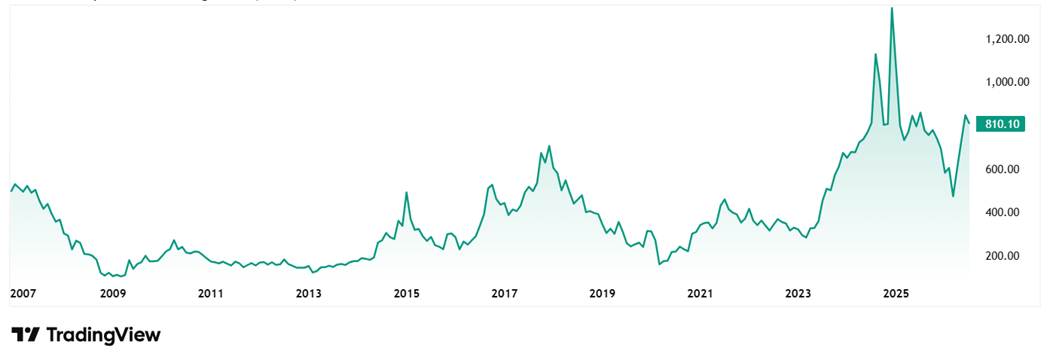
At the current price of Rs 813, the stock is trading at a discount of 44% from its all-time high of Rs 1,444 and 23% from its 52-week high of Rs 1,050.
As for the valuations, the stock is trading at a PE of a big 125x against the industry median of 30x. The 10-year median PE for the company is 38x, while the industry median for the same period is 25x. The return on equity has averaged just 6% over three years and ROCE was close to 5% in FY26, numbers no quality auto parts peer would envy.
The watch list is long. Fires at its Kariapatti plants in April 2026 halted operations there, with estimated damage of about Rs 2.7 cr at one unit and insurance claims filed. ICRA reaffirmed its BBB rating in March 2026 but cut the outlook to Negative.
The CFO resigned in February 2026 and a successor was named soon after. Each of these would be noise at a large company. At a Rs 320 cr one, each is material. The bet Porinju appears to be making is simple: a TVS group franchise with a real brand and improving cash flow is worth accumulating while the headlines are ugly.
Conviction vs. Concentration
Step back and the pattern the June 2026 filings reveal is quietly striking. Two investors known for very different styles, one a patient Chennai compounder hunter and the other a Kochi turnaround specialist, both added to two of the smallest bets in their books.
At Savera, that buying sits alongside a promoter family that has lifted its own stake to 64.62% and held it there. At Sundaram Brake Linings, Porinju has kept adding into a register the promoters lightened a year ago. Conviction is visible in both. Agreement between insiders and outsiders is visible in only one.
Neither is a core holding candidate, and position sizes should say so. A good idea would be to add these stocks to a watchlist and let the September quarter filings tell us which way the needles moved.
Disclaimer:
Note: We have relied on data from http://www.Screener.in and http://www.trendlyne.com throughout this article. Only in cases where the data was not available, have we used an alternate, but widely used and accepted source of information.
The purpose of this article is only to share interesting charts, data points and thought-provoking opinions. It is NOT a recommendation. If you wish to consider an investment, you are strongly advised to consult your advisor. This article is strictly for educative purposes only.
Suhel Khan has been a passionate follower of the markets for over a decade. During this period, he was an integral part of a leading Equity Research organisation based in Mumbai as the Head of Sales & Marketing. Presently, he is spending most of his time dissecting the investments and strategies of the Super Investors of India.
Disclosure: The writer and his dependents do not hold the stocks discussed in this article. The website managers, its employee(s), and contributors/writers/authors of articles have or may have an outstanding buy or sell position or holding in the securities, options on securities or other related investments of issuers and/or companies discussed therein.