The ₹60 Crore Market Trigger: Following Vallabh Bhanshali’s Trail
Vallabh Bhanshali does not show up in bulk deal data or even fresh buys for that matter very often. The chairman of ENAM, the investment house he co-founded with Nemish Shah and others in 1984, has spent four decades backing Indian promoters from behind the curtain, not trading in the open.
So, when BSE data showed him buying 20 lakh shares of Sunflag Iron and Steel for Rs 60 cr in early May 2026, the market took notice. The stock jumped 29% in two trading days.
Five weeks later, another name surfaced in another filing. Schneider Electric President Systems, a small enclosure maker that returned to the BSE main board on 12th June 2026, published its first shareholding pattern. On it sat Hitesh Satishchandra Doshi, a low-profile investor with a disclosed portfolio of over Rs 830 cr, holding a 3.1% stake.
Two industrial companies. Two shy names on the register. And, as always, a few catches that deserve as much attention as the headlines. Let us take them one at a time.
#1 Sunflag Iron and Steel: Vallabh Bhanshali’s Entry Into Defense & Aerospace
Let’s start with the trade itself. On 4th and 5th May 2026, Vallabh Roopchand Bhanshali bought 20 lakh shares of Sunflag Iron and Steel at an average price of Rs 300 per share, a total outlay of Rs 60 cr, per BSE bulk deal data. The sellers were members of the Sanghavi family, long-time public shareholders of the company. The June 2026 shareholding list now shows Bhanshali with a 1.1% stake, which as on 21st July was worth Rs 72 cr.
The market wasted no time. The stock surged 29% in two days once the deal became public, and touched an all-time high of Rs 428 on 7th May 2026. The exchanges sought a clarification on the volume spike. The company replied that the move was market driven, with no undisclosed price-sensitive information behind it.
Sunflag itself is an old story. Incorporated in 1984, it belongs to the Sunflag Group, founded in Kenya in 1937. With a market cap of Rs 6,526 cr, the company runs an integrated special steel plant at Bhandara in Maharashtra. Its rolled products go into automotive gears, drive shafts, steering systems, bearings and engine parts. It also supplies the Indian Railways, ordnance factories and power equipment makers. Daido Steel of Japan, one of the world’s largest special steel producers, has held a 10% stake for years.
The newer leg is more ambitious. A super alloys facility, commissioned in FY22, targets parts for fighter jets, space vehicles, nuclear reactors and gas turbines. The company has approvals from marquee aerospace and defence customers, though offtake has been slower than planned. In May 2026, it was declared the successful bidder for the Tambia South coal block in Madhya Pradesh, a step toward raw material security.
The Hidden Rs 7,724 Asset on The Balance Sheet
Now the part that makes Sunflag genuinely unusual. In March 2023, the company converted debentures it held in Lloyds Metals and Energy into 6 cr equity shares, an 11.9% stake in that company at the time of allotment. Lloyds Metals went on to become one of the biggest wealth creators on the exchanges. The result sits in plain sight on Sunflag’s balance sheet. Its investments were worth Rs 17 cr in March 2022. By March 2025, that line had swelled to Rs 7,779 cr.
The market value of those investments today is about Rs 7,724 cr. Sunflag’s own market cap is around Rs 6,526 cr. Read that again. The market is paying less for the whole company than the quoted value of the shares it owns in another company. At these prices, the steel business, with nearly Rs 4,000 cr of annual sales, comes free.
That same stake also explains two numbers that look terrible at first glance. Reported ROE is about 2%, and 3-year profit growth prints at minus 9%. Both are optical. Reserves have ballooned to Rs 8,586 cr because the Lloyds stake is marked to market through equity, which crushes the ROE math. And FY22 profit of Rs 1,115 cr included one-off other income of Rs 1,201 cr from the debenture conversion, which distorts every growth number that uses FY23 as a base or an endpoint.
Why Sunflag’s 2% ROE is a Mathematical Distortion
| Financial Year | FY20 | FY21 | FY22 | FY23 | FY24 | FY25 | 5Y CAGR |
| Sales (Rs cr) | 1,892 | 2,698 | 3,488 | 3,415 | 3,536 | 3,939 | 16% |
| EBITDA (Rs cr) | 254 | 398 | 446 | 375 | 389 | 477 | 13% |
| Net Profit (Rs cr) | 141 | 217 | 1,115 | 144 | 162 | 202 | 7% |
EBITDA here refers to operating profit before other income. FY23 net profit includes the Rs 1,201 cr one-off gain discussed above; strip it out and that year looks much like FY24. The audited FY25 results, approved on 29th May 2026, showed consolidated sales of Rs 3,939 cr and net profit of Rs 202 cr, up about 25% over FY25. The board also recommended a final dividend of Rs 1 per share, after Rs 0.75 for FY25.
Is the Core Steel Business Available for Free?
The share price of Sunflag Iron & Steel Company was about Rs 85 in July 2021 and as on 21st July 2026 it was Rs 359 which is over a jump of 320% in 5 years.

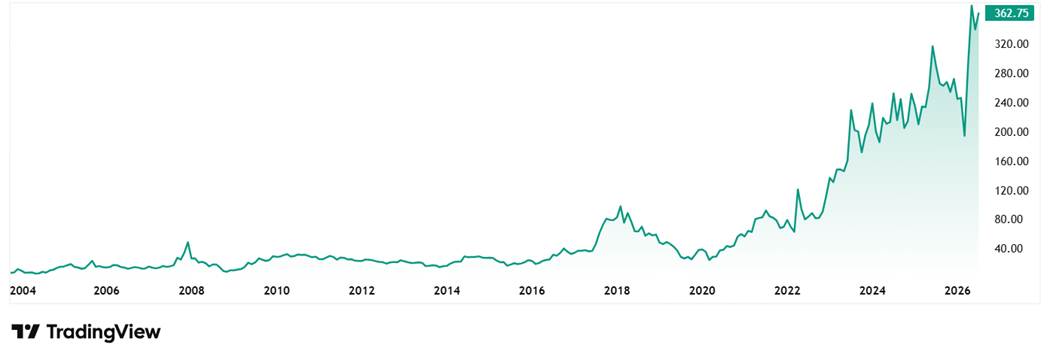
At the current price however, the stock is trading at a discount of 16% from its all-time high of Rs 428.
Regarding valuation, the stock is trading at a PE of 31x and the current industry median is 22x. The 10-year median PE of the company is 12x while the industry median for the same period is 19x. But one must note that the FY23 one-off warps the earnings history and the Lloyds stake warps the price. The honest lens is the one above: the investment book alone covers the market cap. Operating margins have held in a 10% to 15% band for a decade, and borrowings of Rs 624 cr against a net worth of about Rs 8,766 cr as of March 2025 leave the company almost debt free.
The risks are just as concrete. Core steel remains cyclical, and margins sit at the lower end of that band right now. The hidden value has been hidden for three years already; holding discounts can persist far longer than shareholders’ patience. The Lloyds stake also ties Sunflag’s book value to one volatile stock. Promoter holding has been steady at 51.16% for five years, FII holding is under 1%, and the dividend yield, even after the increase, is below 0.2%.
#2 Schneider Electric President Systems: Hitesh Doshi’s Stealth Microcap Play
Schneider Electric President Systems, earlier known as President Systems, designs and manufactures 19-inch enclosures, the racks and cabinets that house IT, telecom and industrial electronics gear. It has done this for over three decades. Schneider Electric, the French energy management giant, owns 74.12% as promoter.
The company returned to the BSE main board through a direct listing on 12th June 2026, with 1.21 cr shares admitted to trading. Its first shareholding pattern after listing, for June 2026, shows a public float of just 25.64% spread across 2,141 shareholders in total.
Inside that tiny register sits Hitesh Satishchandra Doshi with a 3.1% stake in the company. Doshi is another shy super investor who is rarely seen in headlines, even though he holds a portfolio worth over Rs 830 cr. Don’t confuse him with Waree’s Hitesh Doshi!
His 3.8 lakh shares in Schneider President are worth about Rs 85 cr at current prices, which would rank among his largest positions.
One honest caveat before anyone calls this a fresh buy. Because this is the company’s first disclosure since relisting, there is no earlier quarter to compare against and no bulk deal on record. We cannot say when Doshi bought, or at what price. He may have held these shares for years before they became visible. The filing confirms presence, not timing.
Low Float, High Volatility: The Mechanics Behind the 300% Surge
The numbers are those of a small but profitable niche manufacturer. FY26 sales came in at Rs 384 cr with a net profit of Rs 38 cr. ROCE (Return on Capital Employed) stands at about 24% and ROE (Return on Equity) at 18%. The company is almost debt free, with borrowings of just Rs 1 cr. It has paid no dividend in the years on record, despite steady profits.
| Financial Year | FY21 | FY22 | FY23 | FY24 | FY25 | FY26 | 5Y CAGR |
| Sales (Rs cr) | 253 | 367 | 334 | 393 | 457 | 384 | 9% |
| EBITDA (Rs cr) | 24 | 29 | 28 | 48 | 63 | 51 | 16% |
| Net Profit (Rs cr) | 14 | 16 | 17 | 30 | 48 | 38 | 22% |
EBITDA here refers to operating profit before other income. Two things in the table need flagging. FY26 was a down year: sales fell 16% and profit fell about 21% from FY25’s high base. The March 2026 quarter also leaned on other income of Rs 5.5 cr against a pre-tax profit of Rs 11.9 cr, so nearly half of the final quarter’s profit came from outside operations. Share capital doubled during FY26, from Rs 6 cr to Rs 12 cr, so per-share numbers across years are not directly comparable either.
The 3x Jump in One Month
On 17th June 2026, days after relisting, the share price of Schneider President stood at Rs 849, locked in a 5% upper circuit. As on 21st July the share price was Rs 2,227, which is close to a triple in about one month. It takes the market cap to its current Rs 2,694.

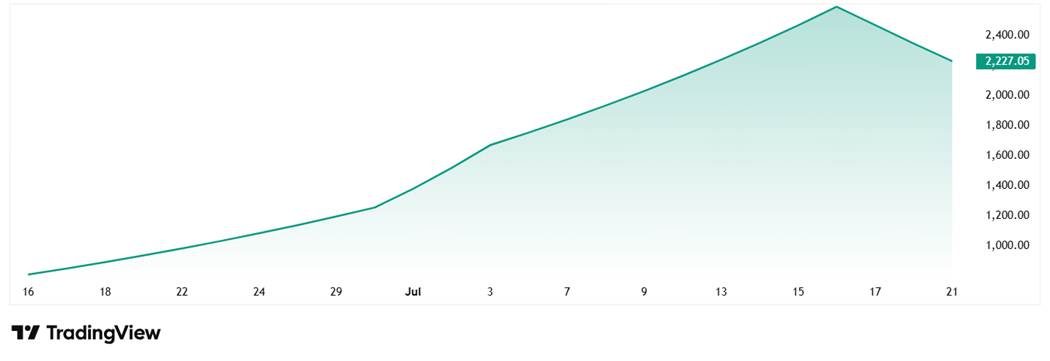
Regarding valuations, the company’s share is trading at 70x against the current industry median of 50x. Given that the stock was recently relisted, the 10-Year median PE would be misleading to look at because there is no PE history to lean on; With a 25.64% float and 2,141 shareholders, small money moves this stock violently, in both directions. Circuits that carry a stock up can carry it down just as fast.
Why Mimicking Portfolios Could be a Risky Strategy
Look at what the two buyers actually paid, not where the prices are now. Bhanshali paid Rs 300 per share for Sunflag. The stock trades about 18% above that, and his case rests on a hard, checkable fact: an investment book worth more than the entire market cap. Doshi’s entry price into Schneider President is unknown, and the stock has already tripled since it returned to the exchange.
Following a super investor into a stock is never the same trade the super investor made. The entry price is different, the information is different, and the patience is usually different too. The filings tell you where seasoned money sits. They do not tell you what it paid, or when it will leave. That homework, as ever, remains yours.
The smart thing to do is usually to add such stocks to a watchlist and keep a vigilant eye on them, to ensure you don’t miss out on any big movements.
Disclaimer:
Note: We have relied on data from http://www.Screener.in and http://www.trendlyne.com throughout this article. Only in cases where the data was not available, have we used an alternate, but widely used and accepted source of information.
The purpose of this article is only to share interesting charts, data points and thought-provoking opinions. It is NOT a recommendation. If you wish to consider an investment, you are strongly advised to consult your advisor. This article is strictly for educative purposes only.
Suhel Khan has been a passionate follower of the markets for over a decade. During this period, he was an integral part of a leading Equity Research organisation based in Mumbai as the Head of Sales & Marketing. Presently, he is spending most of his time dissecting the investments and strategies of the Super Investors of India.
Disclosure: The writer and his dependents do not hold the stocks discussed in this article. The website managers, its employee(s), and contributors/writers/authors of articles have or may have an outstanding buy or sell position or holding in the securities, options on securities or other related investments of issuers and/or companies discussed therein.