Just a day after the Union Cabinet approved Semicon 2.0 with a budget outlay of around ₹1.3 lakh crore, India’s semiconductor push has entered its next phase. While much of the attention remains on chip fabrication plants, the policy also supports companies supplying semiconductor materials, chemicals, gases, and equipment.
Supplying the Missing Link in India’s Fabs
This is shifting the focus to an often-overlooked part of the value chain. While semiconductor fabs often grab the limelight, they cannot operate without a steady supply of high-purity materials. Chip manufacturing needs high-purity chemicals, specialty gases, fluoropolymers, and advanced cooling fluids.
As semiconductor investments accelerate in India and globally, demand for these critical inputs is expected to rise. This is encouraging several Indian fluorochemical companies to expand into semiconductor-grade products. This article discusses three such companies.
#1 Gujarat Fluorochemicals
Gujarat Fluorochemicals (GFL) is strengthening its position as a key materials supplier to the semiconductor manufacturing industry. GFL’s extensive fluoropolymer portfolio caters directly to the electronics and semiconductor industries.
The company’s offerings include Polytetrafluoroethylene (PTFE), Micro Powders, Perfluoroalkoxy Alkanes (PFA), Polyvinylidene Fluoride (PVDF), Fluorinated Ethylene Propylene (FEP), Fluoroelastomers (FKM), and Polyphthalamide (PPA).
These materials are indispensable in semiconductor fabrication because they possess a unique set of properties, including strength, resistance to extreme temperatures, chemical corrosion resistance, non-wetting properties, and high durability. Currently, there are no technically viable substitutes that can match these characteristics.
Structural Tailwinds Driving Fluoropolymer Demand
GFL management anticipates that high-performance fluoropolymers, particularly PFA and FKM, will experience accelerated growth. This surge in demand is structurally driven by the global expansion of semiconductor fabs, the growth of 5G networks, and the rising need for advanced infrastructure in AI-driven data centers.
As applications in these sectors become more complex, the demand for absolute material purity and high-value-added grades continues to rise, aligning perfectly with GFL’s strategic focus. GFL has also successfully received most of the necessary product approvals from customers. As a result, GFL has now moved into the commercial supply phase.
Hitting Capacity Ceilings and the ₹472 Crore Capex
Management states that demand is such that its existing capacity for these new fluoropolymers will be near-fully utilized by the end of FY27. This is the primary reason behind GFL’s ongoing capacity expansion.
GFL has earmarked ₹222 crore for the development and manufacturing of new high-purity electronic specialty chemicals dedicated entirely to the semiconductor sector. Furthermore, GFL is investing an additional ₹250 crore to expand its overall capacity for new fluoropolymers. This ensures that it can meet the global demand as its existing capacities reach optimal utilization.
Financial Projections and Profitability Outlook
Overall, GFL expects to report 15-20% growth in the fluoropolymers products segment compared to last year. This growth will be driven by increasing penetration in growing sectors such as semiconductors, electric vehicles, and clean energy applications. Management expects the overall EBITDA to grow alongside volume growth.
From a financial perspective, operating revenue grew by 5.5% year-on-year to ₹4,996 crore. Operating profit grew by 17.3% to ₹1,290 crore while margin expanded by 300 bps to 26%. Net profit, however, grew by just 5.1% to ₹574 crore.
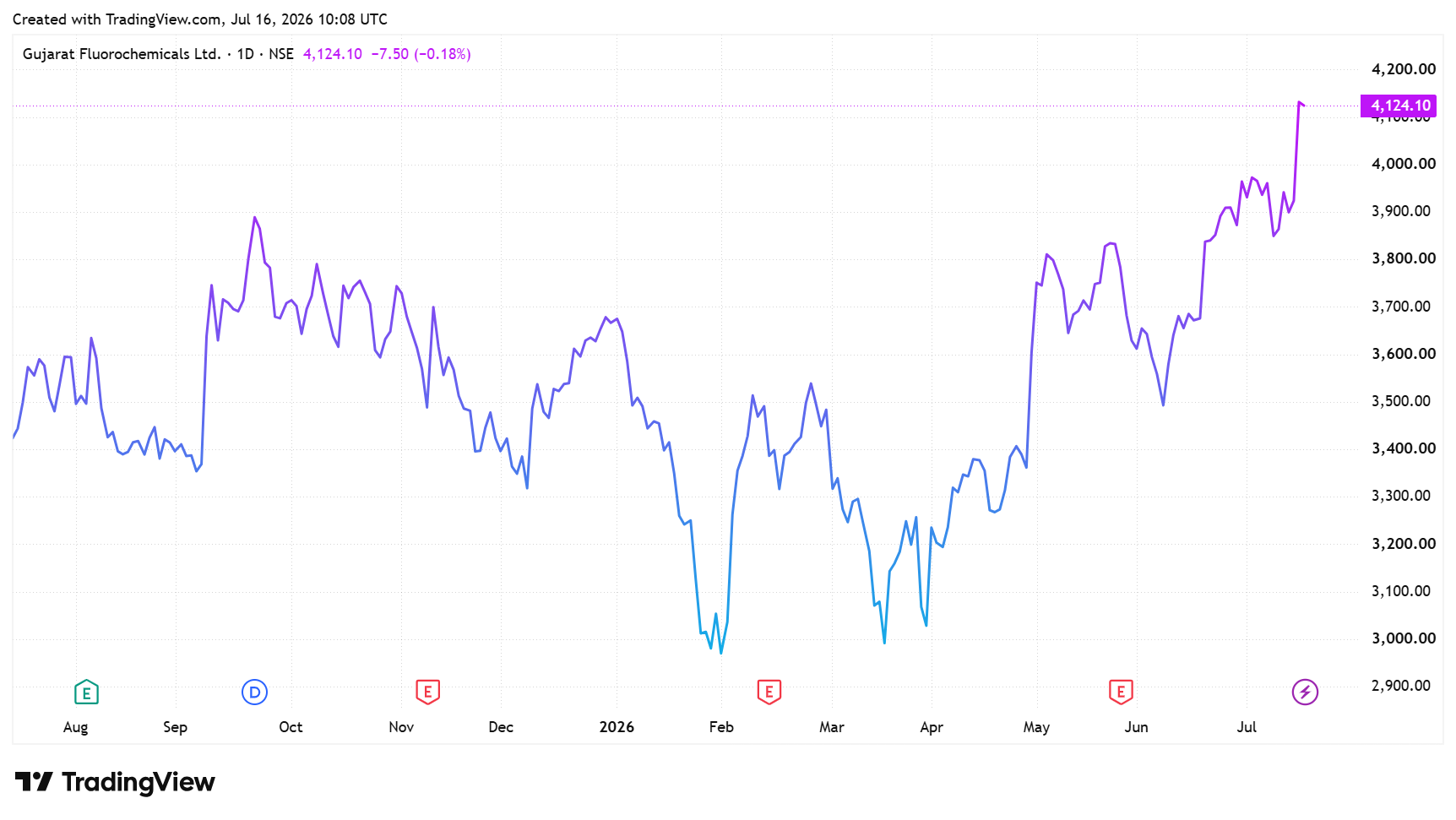
Gujarat Flurochemicals Share Price

#2 Navin Fluorine International
Navin Fluorine International is expanding into the semiconductor and advanced electronics market as a key growth vector within its Advanced Materials vertical. It has historically focused on basic refrigerants and agrochemical/pharmaceutical intermediates.
Higher Performance Products contribute 46.6% to FY26 revenue, followed by Specialty Chemicals (37%) and Contract Development Manufacturing Organisation (16.4%). It is now positioning itself as a key supplier in the global semiconductor supply chain by manufacturing ultra-high-purity chemicals.
Securing Swiss Technical Expertise via Buss ChemTech
However, creating the ultra-pure chemicals required for chips needs complex and precise engineering. To this end, Navin has access to capital, raw materials, and a strong Indian manufacturing base. However, he lacked the specialized technical knowledge to enter this field.
To bridge this gap, Navin entered into an exclusive technology partnership with Buss ChemTech, a Swiss chemical engineering firm. Buss is acting as the exclusive technology partner, providing its advanced, proprietary process technology to Navin Fluorine.
Now that it has the technical expertise, Navin is investing ₹450 crore to build a new Anhydrous Hydrofluoric Acid (AHF) plant at its Dahej facility. This capacity expansion was commissioned in February 2026, and commercial supplies have begun. Navin is targeting the production of Electronic Grade HF (N5 Grade) and Solar Grade HF (N3 Grade) for photovoltaic panels.
Supplying N5 Grade Acid for Silicon Wafer Etching
Electronic Grade HF is an ultra-pure chemical that is a key component of the semiconductor industry. This is used to clean and etch silicon wafers that eventually become the microchips powering smartphones, data centers, and artificial intelligence models. Navin is leveraging its R&D to create these chemicals with ultra-high purity.
Through this, Navin is moving up the value chain. Management noted that producing materials with such rigorous purity requirements allows the company to command premium pricing and generate superior margins. Furthermore, by supplying directly to the semiconductor and solar industries, Navin secures high-margin, long-term contracts that help insulate the business.
Expanding Ecosystem: The ₹120 Crore Chemours Hardware Cooling Tie-up
Beyond silicon wafer etching, Navin is targeting the broader semiconductor and AI ecosystem through hardware cooling solutions. The company has entered into a ₹120 crore partnership with Chemours to establish a manufacturing facility in Surat, Gujarat. This plant will produce Chemours’ proprietary Opteon two-phase immersion cooling fluid.
#3 Stallion India Flurochemicals
Stallion India Fluorochemicals provides refrigerant and industrial gases. The company focuses on the debulking, blending, and processing of both refrigerant and non-refrigerant specialty gases. Stallion caters to over 15 industries and more than 200 customers.
Its diversified product portfolio features more than 40 gases and blends. A key part of Stallion’s competitive advantage is its focus on aftermarket clients. The aftermarket accounts for 80% of the total market share and offers substantially higher profit margins compared to the Original Equipment Manufacturer (OEM) sector.
A major component of Stallion’s forward integration roadmap is its strategic entry into the high-value semiconductor and specialty gas market. This business aims to tap emerging sectors across semiconductor manufacturing, electronics, solar cells, and fiber optics.
Scaling Liquid Helium Infrastructure for Semiconductor Applications
To capitalize on this, Stallion is heavily investing in liquid helium infrastructure. This serves as an entry point for the company’s semiconductor gas business. To this end, Stallion is scaling up its Khalapur facility to include a liquid helium processing capacity of 1,200 metric tons per annum, with the capacity scheduled to go live around June 2026.
Additionally, its upcoming Mambattu facility in Andhra Pradesh will feature similar capabilities for handling helium and semiconductor gases, with operations targeted to begin by August 2026. Once the facility is operational, the qualification process will begin and take 2-3 years to complete.
Securing Supply Chain Economics via Qatar Oilfields
To secure its supply chain, Stallion has entered into a long-term strategic partnership with Sharjah Oxygen Company to source liquid helium from Qatar’s oilfields. This ensures long-term supply security and access to the high-purity helium required for critical applications. Stallion expects the overall profit margins to expand by 3-4% as these expansions go live.
Management noted that the global supply disruptions have actually created a favourable opportunity for their market entry. Helium prices have recently surged from ₹800-900 to ₹3,000-4,000, making its entry more profitable. Stallion reported strong financials for FY26.
Tracking the Path to ₹3,000 Crore Revenue by 2030
Total Revenue grew by 14.4% year-on-year to ₹434.1 crore, beating the management target of ₹430 crore. EBITDA increased by 23.3% to ₹61.35 crore, with margins improving to 14.13%. Net profit grew by 35.6% to ₹43.84 crore. Looking ahead, the company is targeting a 30%-35% revenue CAGR over the next three years.
Ultimately, management has laid out a long-term roadmap. By 2030, Stallion is targeting ₹3,000 crore in revenue and a net profit of ₹500 crore. Management estimates this to be driven by its backward integration into manufacturing and its strategic pivot toward advanced semiconductors and high-purity gases.
Final Verdict on Valuations
Navin Fluorine stands out for its strong Return on Capital Employed (ROCE) and Return on Equity (ROE), followed by Gujarat Fluorochemical and Stallion. Valuation-wise, Stallion trades in line with the industry median price-to-earnings (P/E) multiple, while Gujarat Fluorochemicals trades at a premium to both the industry and historical medians.
Navin Fluorine, on the other hand, is trading at a premium to the industry median but at a discount to the historical three-year median P/E.
Particulars | Price-to-Earnings Multiple (X) | Return Ratios | |||
| Company | 3Y Median | Industry | ROE (%) | ROCE (%) | |
| Stallion | 56.3 | NA | 56.3 | 8.9 | 11.8 |
| Gujarat Fluro | 76.8 | 65.5 | 32.8 | 7.8 | 9.9 |
| Navin Fluro | 58.7 | 67.0 | 32.8 | 20.3 | 21.4 |
| Source: Screener.in (As of 15 July 2026) | |||||
India’s semiconductor push is opening opportunities for companies across the value chain. To tap this opportunity, several Indian companies are expanding into the semiconductor value chain.
While Gujarat Fluorochemicals is scaling fluoropolymers, Navin is moving into electronic-grade chemicals, and Stallion is building a specialty gas platform. However, the pace of customer approvals, capacity expansion execution, and commercialization will determine how much of this emerging opportunity ultimately translates into earnings growth.
That said, these companies could be worth keeping on your watchlist.
Disclaimer:
Note: Throughout this article, we have relied on data from http://www.Screener.in and the company’s investor presentation. Only in cases where the data were unavailable have we used an alternative, widely accepted source of information.
The purpose of this article is only to share interesting charts, data points, and thought-provoking opinions. It is NOT a recommendation. If you wish to consider an investment, you are strongly advised to consult your advisor. This article is strictly for educational purposes only.
About the Author: Madhvendra has been deeply immersed in the equity markets for over seven years, combining his passion for investing with his expertise in financial writing. With a knack for simplifying complex concepts, he enjoys sharing his honest perspectives on startups, listed Indian companies, and macroeconomic trends.
A dedicated reader and storyteller, Madhvendra thrives on uncovering insights that inspire his audience to deepen their understanding of the financial world.
Disclosure: The writer and his dependents do not hold the stocks discussed in this article.
The website managers, its employee(s), and contributors/writers/authors of articles have or may have an outstanding buy or sell position or holding in the securities, options on securities, or other related investments of issuers and/or companies discussed therein. The articles’ content and data interpretation are solely the personal views of the contributors/ writers/authors. Investors must make their own investment decisions based on their specific objectives, resources, and only after consulting such independent advisors as may be necessary.