India’s electric passenger vehicle (PV) market is no longer in the early adoption phase. It’s entering a period of rapid growth. Yesterday, we discussed how three electric two-wheeler companies are winning the EV race. But the opportunity extends beyond two-wheelers.
Electric four-wheelers are now emerging as the next major growth engine, supported by new launches, improving charging infrastructure, and favourable government policies. In FY26, EV sales touched 2.3 lakh units for the first time, up 85.6% year-on-year. At the same time, penetration reached 4.9% of total PV sales.
The momentum has continued into Q1FY27, with EV registrations surging nearly 89.3% year-on-year to 82,737 units, showing that demand remains strong. The penetration also topped 12% for the first time during the quarter. The future growth runway remains structural, too.

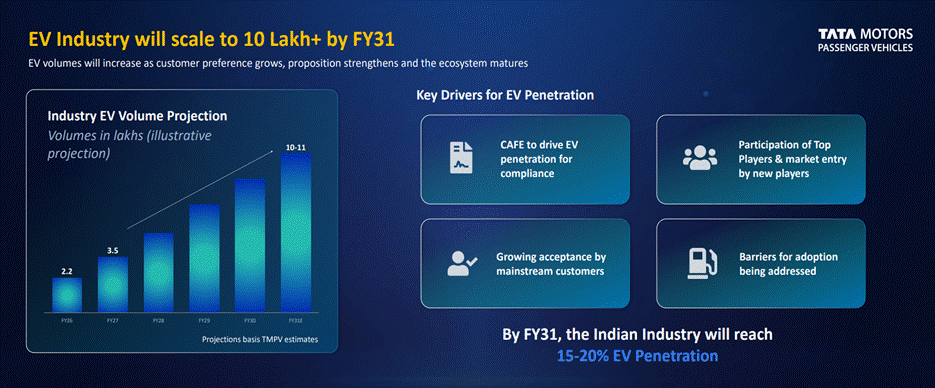
Source: Tata Motors PV Investor Presentation
Tata Motors Passenger Vehicles expects annual EV passenger vehicle sales to reach 10-11 lakh units by FY31, about 5x FY26 levels. This would bring EV penetration to 15-20% of the Indian passenger vehicle market. This structural shift is creating a multi-year growth opportunity for these two market leaders, leading India’s EV transition.
#1 Tata Motors Passenger Vehicles Commands 39% EV Market Share
Tata Motors Passenger Vehicles (TMPV), part of the Tata Group, is India’s third-largest PV player (13.6% market share) and the largest EV player. It recorded its highest-ever domestic wholesale volume of 6.3 lakh units in FY26, up 14% year-on-year. This growth was nearly double the Indian PV industry average of 8%.
Outpacing the Industry: Tata’s Record FY26 Wholesale Volumes
This was driven by its multi-powertrain strategy and a diversified fuel mix: Petrol (46%), CNG (27%), EV (14%), and Diesel (13%). TMPV sustained its market leadership in the Indian EV segment with a 39.0% market share. Domestic EV wholesale volumes grew by 45% year-on-year to 89,393 units.
As a result, revenue grew by 63.8% year-on-year to ₹13,410 crore. The segment also reported a PBT of ₹813 crore and a profit of ₹774 crore during the year. Management stated that the EV business’s profitability is expected to strengthen, driven by falling costs.
The demand environment for EVs has strengthened significantly following recent geopolitical conflict and higher fuel prices. The management noted that the launch of new EV models has led to a 25-30% increase in EV bookings. The company is consistently hitting a monthly run rate of around 9,000 units, exiting the fourth quarter of FY26 with roughly 27,000 units sold.
Capital Expenditure: Funding the ₹35,000-Crore EV Roadmap
To meet the high demand, TMPV is quickly ramping up production. The immediate goal is to cross a 10,000-unit monthly production run rate for EVs, with further capacity increases planned for the coming months. It has announced a capex of ₹33,000-35,000 crore between FY26-30 for new products, Software-Defined Vehicles (SDVs), and advanced EV powertrains.
TMPV currently offers the widest EV portfolio in India, spanning six models to cater to diverse use cases and price points. The company plans to launch five new EV models by FY30. Of these, it has already launched Sierra.ev in Q1FY27. This will need additional planned capacity to meet the expected high demand.
Infrastructure Strategy: Scaling to 400,000 Charging Points
TMPV is also strengthening the charging infrastructure to remove one of the bottlenecks behind EV adoption. The company has rolled out over 200 Tata.ev mega charging hubs across 16 states and 100 national highways. It plans to expand this to 500+ mega charging hubs.
In addition to the mega charging hubs, Tata.ev plans to install 400,000 charging points through partnerships by 2027. Currently, the company has added over 30,000 public chargers on its IRA.ev app, installed 2,500+ verified chargers at over 1,000 locations, and installed over 200,000 home chargers.
The company is also trying to remove another barrier to EV adoption. TMPV has brought EV acquisition costs closer to internal combustion engine costs through aggressive cost engineering and the introduction of a Battery-as-a-Service offering for the new Punch.ev. It has also introduced a lifetime battery warranty across the EV portfolio to drive adoption.

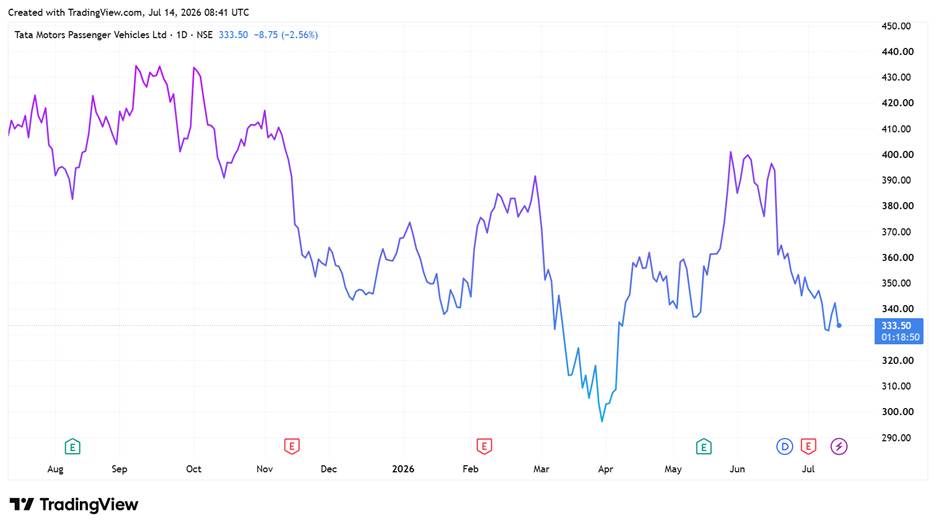
#2 Mahindra & Mahindra Boasts 23.9% EV Market Share
Mahindra & Mahindra (M&M) is India’s second-largest PV player by volume, the largest SUV player by revenue, and the third-largest EV player. M&M sold 305.2% more E4W in FY26 at 57,472 units. EV penetration within M&M’s SUV portfolio reached 9.6% in Q4 FY26.
More notably, M&M was the number-one player in the EV segment by revenue market share for the entire year, finishing Q4 at 37.7%. M&M also recorded 23.9% volume market share in FY26.
Revenue vs Profitability: The Path to PBIT Positive Returns
The EV business recorded a revenue of ₹14,423.5 crore, accounting for 9.8% of M&M’s FY26 revenue of ₹147,765 crore. The business also became EBIT-positive during the year, ahead of management’s expectations. EV operations generated EBITDA of ₹1,314 crore, a positive PBIT of ₹287 crore (including EV contract manufacturing), and a net profit of ₹386.9 crore.
The EV portfolio ended the year at around 2% PBIT margin and an EBITDA margin of 9.1%. To support this rapid growth, M&M is actively expanding its production capacity. M&M exited FY25 with an EV capacity of 5,000 units per month and expanded it to 8,000 units per month during FY26.
Overcoming Capacity Limits: The Road to 5 Lakh Vehicles by 2028
By FY28, M&M plans to add another 14,000 units to its EV capacity, including 10,000 units for vehicles on the upcoming NU_IQ platform and 4,000 units for other new EVs. A new plant at Nagpur is on track to commence operations by mid-2028. This plant will boast an annual production capacity of over 5 lakh vehicles and 1 lakh tractors.
M&M is expanding its product portfolio and aiming to launch 6 new EVs by FY31. A key driver of this expansion could be the NU_IQ platform. This would allow M&M to build both internal-combustion-engine vehicles and “Born EV” (ground-up electric) models on the exact same platform. This ensures that production can shift flexibly based on demand.
Growing the EV business is also an important part of M&M’s regulatory strategy. The company anticipates needing an EV penetration rate between 13% and 21% over the current 5-year block. This is key to meet mandatory Corporate Average Fuel Economy standards, a target they are very comfortable achieving.
Fleet Operations & The Commercial Market Advantage r
M&M is also present in the commercial and three-wheeler EV market (40% market share). The company became the first commercial manufacturer in India to cross the 1 lakh EV sales mark in a single year. It delivered 107,157 EV units (domestic and export), a 36.5% increase over the previous year. The business recorded revenue of ₹4,798.3 crore and a net profit of ₹185.5 crore.
On a consolidated basis, the EV business posted total revenue of ₹19,221.8 crore and net profit of ₹572.4 crore on 1.6 lakh units. Looking ahead, M&M is aiming for EVs to account for 20% to 30% of its overall SUV portfolio by 2027.
To ease charging bottlenecks, M&M is expanding the public charging network. Through its open-source “Charge_iN” platform, the company is scaling its footprint from the current 30 stations (featuring 120 charging points) to 250 stations. These stations feature 1,000 ultrafast charging points along major highway corridors by the end of 2027.
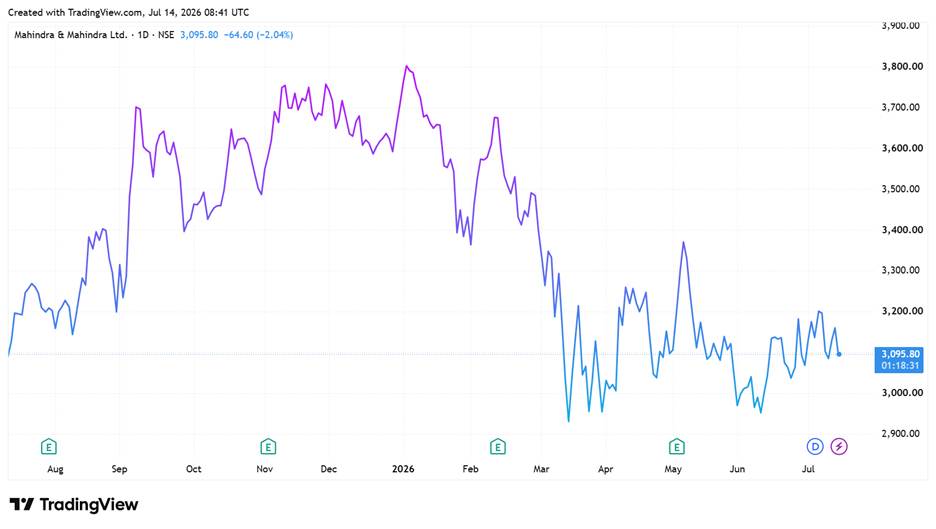
Here is a summary of where these two players stand in the E4W industry.
| Particulars | Tata Motors | M&M |
| FY26 E4W Sales | 89,393 | 57,472 units |
| YoY Volume Growth | 45.0% | 305.2% |
| FY26 Market Share | 39.0% | 23.9% |
| EV Revenue | ₹13,410 crore | ₹14,423.5 crore |
| EBITDA | NA | ₹1,314 crore |
| Net Profit | ₹774 crore | ₹386.9 crore |
Tata Motors remains the clear leader in volume and profitability, while M&M is catching up fast.
Structural Valuation: Returns Analysis vs Peer Averages
M&M has a higher Return on Capital Employed (ROCE) and Return on Equity (ROE) than TMPV Motors. This is because TMPV’s profitability has been inconsistent for years due to the highly volatile Jaguar Land Rover (JLR) business.
In terms of valuation, relative to the historical 5-year median multiple, TMPV trades at a premium, while M&M trades at a slight discount. On the other hand, both continue to trade at a discount to the industry median. That said, TMPV’s large valuation discount is due to persistent headwinds in the JLR business.
| Peer Comparison (X) | ||||
| Company | EV/EBITDA Multiple | Return Ratios | ||
| Company | 5Y Median | ROCE (%) | ROE (%) | |
| TMPV | 6.9 | 4.6 | 0.2 | 0.2 |
| M&M | 11.6 | 12.1 | 30.2 | 23.0 |
| Industry | 16.1 | NA | 19.7 | 23.2 |
India’s electric passenger vehicle market is still in its early stages. EV penetration today has only surged past 12% in Q1FY27, compared with an expected 15-20% by FY31. Tata Motors remains the volume leader with a 39% market share and an aggressive ₹33,000-35,000 crore investment plan.
At the same time, M&M is scaling rapidly through capacity expansion and new EV platforms, and has already made its EV business profitable. Both of these players have a first-mover advantage, and it will be interesting to see how their EV portfolios and market share evolve as competition increases, similar to what we saw in the two-wheeler space.
Add these names to your watchlist to track how the penetration progresses in the coming years.
Disclaimer
Note: Throughout this article, we have relied on data from http://www.Screener.in and the company’s investor presentation. Only in cases where the data was unavailable have we used an alternative, widely used, and accepted source of information.
The purpose of this article is only to share interesting charts, data points, and thought-provoking opinions. It is NOT a recommendation. If you wish to consider an investment, you are strongly advised to consult your advisor. This article is strictly for educational purposes only.
About the Author: Madhvendra has been deeply immersed in the equity markets for over seven years, combining his passion for investing with his expertise in financial writing. With a knack for simplifying complex concepts, he enjoys sharing his honest perspectives on startups, listed Indian companies, and macroeconomic trends.
A dedicated reader and storyteller, Madhvendra thrives on uncovering insights that inspire his audience to deepen their understanding of the financial world.
Disclosure: The writer and his dependents do not hold the stocks discussed in this article. The website managers, its employee(s), and contributors/writers/authors of articles have or may have an outstanding buy or sell position or holding in the securities, options on securities, or other related investments of issuers and/or companies discussed therein. The articles’ content and data interpretation are solely the personal views of the contributors/ writers/authors. Investors must make their own investment decisions based on their specific objectives, resources, and only after consulting such independent advisors as may be necessary.