





Welcome to the latest edition of Hidden Gems Weekly. In recent weeks, we examined a company that wants to move beyond selling more machine tools to selling better ones, a company quietly conquering India’s industrial supply chain and a packaged food exporter building global brand buffers. This week, we turn to a company that wants to move beyond manufacturing industrial flow solutions to supplying higher-value.
Every successful manufacturing company eventually runs into the same problem.
The business that helped it grow also becomes the business that limits its future. Demand becomes more predictable, margins stabilise and investors begin to value the company as another industrial manufacturer, even if it continues to perform well.
Aeroflex Industries appears to have recognised this challenge before the market did: its future may depend on becoming more than an industrial manufacturer.
Aeroflex Industries 1-Year Share Price Chart

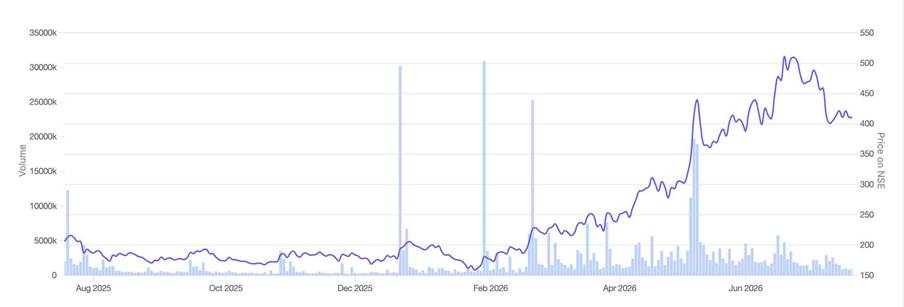
Instead of remaining largely a manufacturer of hoses and assemblies, the company is gradually expanding into higher-value engineering products, including liquid-cooling systems for data centres. If this strategy succeeds, Aeroflex could become a very different company, with a far more diversified business mix.
FY26 was strong. But that’s not the real story
Meanwhile, FY26 was another year of healthy growth.
Aeroflex reported revenue of Rs 442 crore, up 17% from the previous year. Operating profit increased 25% to Rs 100 crore, while operating margin expanded to 23% from 21%. Net profit grew 6% to Rs 56 crore despite higher depreciation arising from recent capacity additions.
The March quarter was considerably stronger. Revenue increased 38% YoY to Rs 126 crore. Operating profit rose 58% while operating margin improved to 24% from 21% a year earlier. Profit after tax grew 57%.
The improvement did not come from a sudden acceleration in demand for industrial hoses. Instead, Aeroflex sold a larger share of value-added products such as assemblies, fittings and bellows, which accounted for around 52% of FY26 revenue. That richer product mix helped lift operating margins even as revenue growth remained moderate.
That shift may prove more important than headline revenue growth because companies generally create more value by selling engineering solutions than by selling individual industrial components.
The business that could change everything
The most interesting number in Aeroflex’s FY26 results is not revenue growth.
The 57% jump in quarterly profit may grab attention today. The more important story is the market Aeroflex is trying to enter.
The pace of the ramp-up suggests FY26 may have been only the beginning. In FY26, Aeroflex sold 617 liquid-cooling Secondary Fluid Network (SFN) skid assemblies, with almost all shipments taking place during the last four months of the year. By comparison, the company sold 1,040 units in the first quarter of FY27 alone, according to a July 1 exchange filing.
That means it has already shipped nearly 70% more units in one quarter than it did during the whole of FY26.
The timing is significant. According to MarketsandMarkets, the global data centre liquid cooling market is projected to grow from US$2.84 billion in 2025 to US$21.15 billion by 2032, driven by the rapid expansion of AI infrastructure. As computing density increases, liquid cooling is expected to become an increasingly important part of next-generation data centres.
Data Center Industry Poised for Multi-Year High Growth Cycle

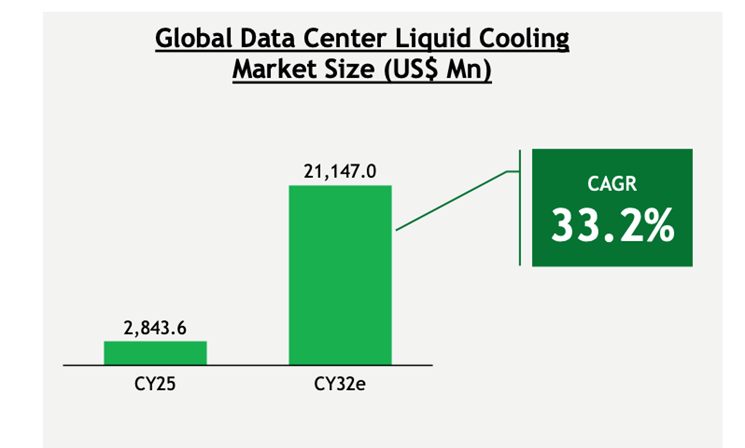
On its own, Rs 21.2 crore of revenue from skid assemblies does not transform a Rs 442 crore company. What makes it important is where management believes this business could go.
Liquid cooling systems are increasingly replacing conventional air cooling in high-density data centres. This is because artificial intelligence servers consume significantly more power and generate far greater heat. Management sees this becoming one of the company’s major growth engines over the coming years.
That is a very different market from the one Aeroflex has traditionally served. Instead of depending primarily on industrial investment, future growth could increasingly come from digital infrastructure spending.

The company’s legacy stainless steel flow solutions business continues to account for the bulk of revenue. Among the newer businesses, Hyd-Air contributed around 7% of FY26 revenue, liquid cooling skid assemblies nearly 5% and metal bellows close to 2%.
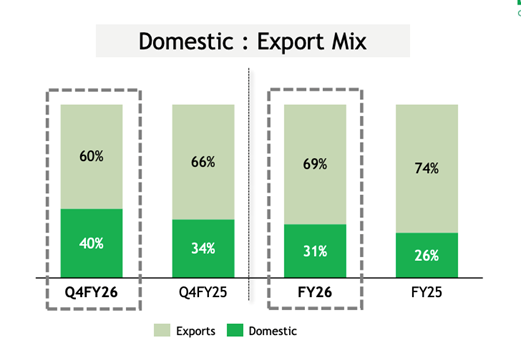
The company also derives 69% of its revenue from exports, although the domestic share has started rising as data centre-related business gains traction.
Building tomorrow’s Aeroflex
The company’s expansion plans suggest management is preparing for demand rather than reacting to it.
Annual skid assembly capacity has already been expanded from 2,000 units to 6,000 units by FY26 and to 9,000 by July 1st. It is expected to rise further to 15,000 units by the second quarter of FY27. Companies generally do not expand capacity unless they believe demand will justify it.
Management believes mature utilization could eventually reach around 75% to 80%, although new facilities typically take time to ramp up. Capacity expansion, however, is only one part of the story.
Aeroflex commissioned two robotic welding lines during the March quarter and plans to operationalise an automatic welding station and an annealing plant by December 2026. It is also developing more than 16 new products, largely aimed at higher-growth applications. These investments suggest the company is gradually moving beyond manufacturing individual components towards supplying more complex engineering solutions.
The more interesting question is this: if these investments succeed, what could Aeroflex eventually look like?
Management’s own medium-term targets offer some perspective. While the legacy hoses and assemblies business is expected to continue growing steadily, it is the newer businesses that could change the company’s earnings profile over time.
How management sees the business evolving
| Business | FY26 Revenue | Management’s estimate of revenue potential at peak utilization |
| Legacy hoses & assemblies | Rs ~381 crore | Rs 650-675 crore |
| Liquid cooling skid assemblies | Rs 21.2 crore | Rs 325-330 crore* |
| Hyd-Air | Rs 31.6 crore | Rs 45-50 crore |
| Metal bellows | Rs 8 crore | Rs 80 crore |
*At around 75-80% utilization of the planned skid assembly capacity.
A few numbers stand out.
Liquid cooling generated just Rs 21.2 crore of revenue during FY26. Management believes the business could eventually generate more than Rs 325 crore annually.
Metal bellows, meanwhile, contributed only Rs 8 crore last year. The management sees the potential for that business to grow tenfold to around Rs 80 crore.
These are, of course, management’s aspirations rather than forecasts. But they help explain why the market is increasingly viewing Aeroflex as more than a manufacturer of industrial hoses. If these businesses scale as envisaged, the company of five years from now could look very different from the one investors see today.
The first test comes in FY27
The first signs of that transition could emerge over the next 12 months. Management expects overall revenue growth of around 35% in FY27. The traditional hoses and assemblies business is expected to continue growing at 15% to 20%, while liquid cooling systems are likely to contribute a much larger share of incremental revenue.
Operating margins are also expected to remain around current levels, supported by a higher contribution from value-added products. The company also showcased its liquid cooling solutions at the Data Center World exhibition in Washington during April. This highlights its intention to deepen relationships with global customers.
One key monitorable, however, will be customer concentration. Management acknowledged that the current skid assembly business is built around an exclusive arrangement with one customer, although it did not disclose the order book because of confidentiality agreements. As the business scales, broadening the customer base will be important to reduce concentration risk and validate the long-term opportunity.
Can the balance sheet support the ambition?
Aeroflex’s balance sheet remains comfortable despite ongoing expansion. Borrowings stood at around Rs 9 crore at the end of FY26.
Cash generation has also remained strong. That gives Aeroflex room to continue expanding capacity without materially stretching its balance sheet.
Return ratios also remain healthy despite recent investments. Return on Equity stood at around 14% during FY26, while Return on Capital Employed remained above 20%. These ratios have moderated from earlier levels because the company has expanded capacity and its capital base has increased following the public issue.
If utilization improves and the share of higher-margin businesses continues to rise, return ratios could strengthen again over the medium term.
Has the market already priced in the opportunity?
Aeroflex currently trades at a trailing P/E of around 100x. This kind of valuation suggests investors are looking well beyond the company’s existing industrial flow solutions business.
Investors are no longer paying only for the steady growth of the legacy hoses business. They are also assigning value to businesses that are still in their early stages but could become much larger contributors to revenue and earnings over time.
That means the stock already discounts a meaningful part of the future opportunity management has outlined. The investment case now depends less on whether the legacy business continues delivering 15-20% growth and more on whether Aeroflex can successfully commercialise its newer businesses, diversify its customer base and translate its medium-term revenue ambitions into earnings.
If these businesses scale as expected, the current valuation could prove justified. If they take longer to ramp up or fall short of expectations, the premium valuation could come under pressure.
Conclusion
Aeroflex’s latest results indicate that the company is attempting something more ambitious than adding another product line.
It is trying to change the nature of its business.
The legacy hoses business continues to generate stable cash flows, healthy exports and attractive profitability. At the same time, investments in liquid cooling systems, automation and higher-value engineering products suggest the company wants future growth to come from sectors where demand may expand much faster than traditional industrial manufacturing.
Whether that transition succeeds will become clearer over the next few years. For now, the more important question is not how many hoses Aeroflex sells, but how much of its future will come from businesses that did not meaningfully exist just a year ago.
Note: We have relied on data from www.Screener.in throughout this article. Only in cases where the data was not available, have we used an alternate, but widely used and accepted source of information.
The purpose of this article is only to share interesting charts, data points and thought-provoking opinions. It is NOT a recommendation. If you wish to consider an investment, you are strongly advised to consult your advisor. This article is strictly for educative purposes only.
Manvi Aggarwal has been tracking the stock markets for nearly two decades. She spent about eight years as a financial analyst at a value-style fund, managing money for international investors. That’s where she honed her expertise in deep-dive research, looking beyond the obvious to spot value where others didn’t. Now, she brings that same sharp eye to uncovering overlooked and misunderstood investment opportunities in Indian equities. As a columnist for LiveMint and Equitymaster, she breaks down complex financial trends into actionable insights for investors.
Disclosure: The writer and her dependents do not hold the stocks discussed in this article. The website managers, its employee(s) and contributors/writers/authors of articles have or may have an outstanding buy or sell position or holding in the securities, options on securities or other related investments of issuers and/or companies discussed therein. The content of the articles and the interpretation of data are solely the personal views of the contributors/ writers/authors. Investors must make their own investment decisions based on their specific objectives, resources and only after consulting such independent advisors as may be necessary.


