For decades, Goodluck India built its business around steel products supplied to sectors such as infrastructure, automobiles, oil and gas and power transmission. That business continues to form the backbone of the company. But management is now trying to build something very different on top of it.
Over the past few years, Goodluck India has steadily expanded into businesses such as defence, aerospace, precision engineering, renewable energy structures, hydraulic tubes and specialised automotive components.
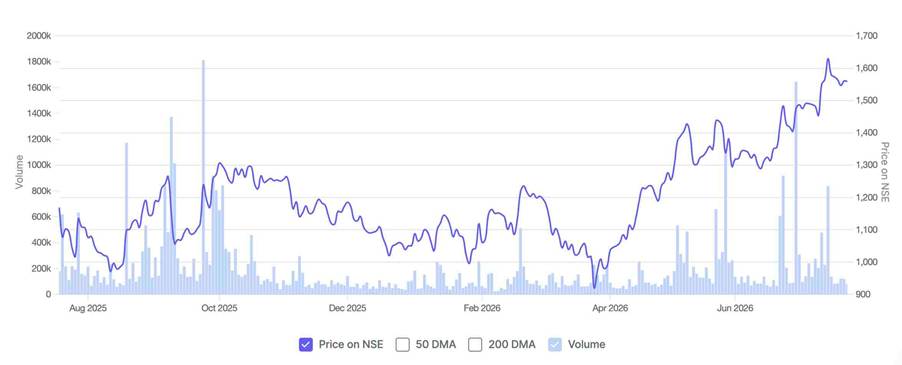
Goodluck India Ltd. 1-Year Share Price Chart

Individually, none of these businesses is large enough to transform the company today. Together, however, they represent an attempt to reduce dependence on commodity steel and increase the share of products where engineering capability, rather than steel prices, determines profitability.
Growing profits, not just revenue
Commodity businesses often struggle to improve profitability when revenue growth slows. Prices fluctuate with global supply and demand, leaving companies with little control over their margins.
Goodluck India’s FY26 results suggest that its shift towards higher-value engineering products is beginning to show in the numbers. Consolidated revenue increased 4.2% to ₹4,100 crore. Profit after tax rose 10.2% to ₹183 crore, while Earnings Before Interest, Tax, Depreciation and Amortisation (EBITDA) increased 26% to ₹418 crore. More importantly, EBITDA margin expanded from 8.4% in FY25 to 10.2% in FY26.
The contrast becomes even sharper in the quarterly numbers. Revenue during the March quarter remained broadly flat compared with the previous year, but EBITDA increased around 31%, while net profit jumped almost 34%. That suggests the improvement is coming not from higher steel prices but from a better product mix and a higher contribution from specialised businesses.
Going ahead, management wants to shift its focus from commodity steel volumes to value-added engineering products, specialised manufacturing and engineering solutions. Hydraulic tubes, front fork tubes, galvanised conduit pipes, heavy engineering structures, precision components and defence products were identified as key growth areas.
In other words, Goodluck India is attempting to earn more from every tonne of steel it processes rather than simply selling more steel.

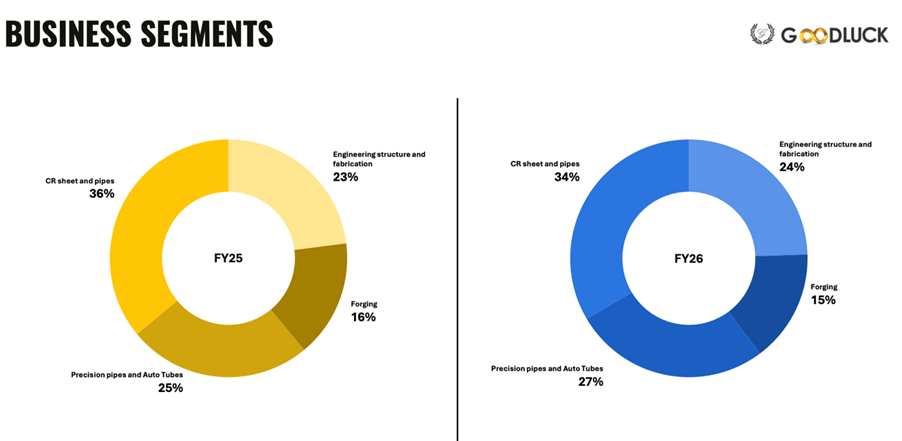
The revenue mix also shows that the transition is still at an early stage. CR sheets and pipes remained the company’s largest business, contributing 34% of revenue in FY26, followed by precision pipes and auto tubes at 27%. Engineering structures and fabrication accounted for 24%, while forgings contributed the remaining 15%.
For now, the legacy steel businesses continue to generate most of the company’s revenue. The objective is not to replace them, but to steadily increase the contribution of higher-margin engineering products, allowing profits to grow faster than revenue.
The defence business may be the biggest attention grabber
Among the company’s newer businesses, defence has understandably attracted the most investor attention.
Commercial production at Goodluck Defence & Aerospace Limited, the company’s defence subsidiary, began only during FY26. As a result, the financial contribution was still modest. Management said defence revenue stood at around Rs 46 crore during the year.
That figure, however, may not reflect the business’s future potential. Management expects defence revenue to increase to around Rs 250 crore to Rs 300 crore during FY27 as production ramps up. The existing facility has an annual installed capacity of around 150,000 artillery shells and management expects it to operate at 75% to 80% utilisation during FY27. Since commercial production began only during FY26, the company has not disclosed a comparable utilisation level for the previous year.
Why investors are watching the defence business
| Metric | FY26 | FY27 Guidance / Target |
| Defence Revenue | ~Rs 46 crore | Rs 250–300 crore |
| Shell Capacity | 150,000 units | 400,000 units |
| EBITDA Margin | Exceptionally high during start-up phase | Sustainable 30–35% |
| Defence Capex | – | Rs 400 crore |
The company is simultaneously investing around Rs 400 crore to expand annual shell manufacturing capacity to 400,000 units while building aerospace forging capabilities. The objective is to position the company ahead of future demand, become part of the global aerospace supply chain and strengthen its technological capabilities as opportunities emerge.
But defence is only one chapter of a much bigger story
Focusing only on defence risks overlooking the larger transformation underway. The same strategy is visible across almost every new investment Goodluck India is making.
Hydraulic tubes are being ramped up to serve construction equipment manufacturers. Front fork tubes are being added for two-wheelers. Galvanised conduit pipes are expected to strengthen the building materials portfolio. Solar structures continue to benefit from rising investments in renewable energy, with management indicating that sales from this segment increased around 33% during FY26. The company also continues to supply engineering products for railway projects, transmission infrastructure and industrial applications.
At first glance, these businesses appear unrelated. In reality, they share one common characteristic. They are all products where customers value engineering quality, manufacturing capability and reliability more than the underlying steel.
That shift is important because engineering businesses generally enjoy better pricing power than commodity manufacturers. If Goodluck India succeeds in increasing the share of these businesses over the next few years, margins could become structurally stronger rather than merely benefiting from favourable steel prices.
Growth without stretching the balance sheet
Goodluck India’s shift towards higher-value engineering businesses comes with a price. Expanding into defence, aerospace and specialised manufacturing requires substantial investment in new facilities and production capacity.
Total borrowings increased from about Rs 882 crore at the end of FY25 to Rs 1,119 crore at the end of FY26. Meanwhile, capital work in progress remained elevated, indicating that some of these facilities are yet to become fully operational.
The company has also been selective in where it is investing. Most of the capital is being directed towards higher-value engineering businesses that have the potential to earn better margins than its legacy steel operations. Meanwhile, stronger internal accruals and tighter working capital management helped support the balance sheet during FY26. Free cash flow remained under pressure due to higher capital expenditure, although operating cash flow improved as profitability strengthened.
The next leg of investment is already underway. Management plans to invest around Rs 400 crore to increase annual artillery shell manufacturing capacity from 150,000 units to 400,000 units while simultaneously building aerospace forging capabilities. Around 60% of this investment is expected to be funded through equity and internal accruals, with the remaining 40% through debt.
The balance sheet therefore deserves close monitoring over the next two years. The investments have already been made. Investors now need to see these assets translate into revenue and profits.
Are the investments paying off?
Return ratios often provide a clearer picture than profit growth during periods of heavy investment. Goodluck India’s Return on Capital Employed (ROCE) stands at about 14.4%, while Return on Equity (ROE) is around 12.9%.
These numbers are healthy without being exceptional. That is hardly surprising because many of the company’s newer businesses have only recently started commercial production. Facilities that operate below optimal utilisation usually depress return ratios during the initial years.
If management succeeds in increasing the contribution from defence, aerospace, hydraulic tubes and other engineering products over the next few years, these return ratios should gradually improve. If they remain unchanged despite higher capital employed, investors may begin questioning whether the expansion has generated adequate returns.
What could drive the next phase of growth?
FY27 could mark the first year when Goodluck India’s newer businesses begin contributing meaningfully to earnings. Defence remains the biggest growth driver. Management expects revenue from the business to increase from around Rs 46 crore in FY26 to Rs 250-300 crore in FY27 as production ramps up.
The exceptionally high EBITDA margin reported during the start-up phase of FY26 is not expected to continue. Instead, management has guided for a sustainable EBITDA margin of 30-35% for the defence business, still around three times the company’s consolidated EBITDA margin of about 10%.
The company also expects better utilisation in its hydraulic tube business, while front fork tubes and galvanised conduit pipes are expected to begin contributing during the year. Demand from transmission infrastructure, railways and renewable energy is also expected to remain healthy.
At the same time, steel processing capacity is being increased through debottlenecking and balancing equipment. The idea is not simply to produce more steel, but to process a larger share into specialised engineering products that command higher margins.
Valuation
The market appears to have noticed this transition. Goodluck India currently trades at around 29 times trailing earnings, well above its long-term average valuation of about 19 times.
That premium suggests investors are already pricing in some success from the company’s transformation strategy. In other words, the market is no longer valuing Goodluck India purely as a steel products manufacturer. Whether that premium is justified will depend on two factors.
First, can higher-margin businesses such as defence, aerospace and precision engineering scale up broadly in line with management’s guidance?
Second, can these businesses continue improving margins without stretching the balance sheet?
If both happen, today’s valuation may prove reasonable. If not, the stock could find it difficult to sustain its premium.
Risks
The biggest risk is that the transition takes longer than expected.
Although defence has generated considerable investor excitement, it remains a very small contributor to consolidated revenue. Capacity expansion does not automatically translate into higher sales, particularly in industries where orders depend on government procurement cycles and export approvals.
The company also continues to derive a large share of revenue from businesses linked to steel. Commodity price movements, fluctuations in raw material costs and changes in demand from infrastructure and industrial sectors will therefore continue to influence earnings.
Higher borrowings represent another area worth monitoring. While management has outlined a clear funding plan for upcoming investments, sustained capital expenditure without a corresponding increase in cash flows could put pressure on return ratios.
Finally, many of the newer businesses are still in the ramp-up stage. Investors will need to see evidence that utilisation levels and margins improve over the next few years.
The final word
It is easy to describe Goodluck India as a steel company entering defence. But the bigger story is that it is trying to build a higher-margin engineering business on top of its steel operations.
FY26 suggests the strategy is beginning to show results. Revenue growth remained modest, yet profitability improved as value-added products contributed a larger share of earnings.
The next few years will determine whether that momentum can be sustained. If management delivers on its expansion plans, the company could gradually become known less for the steel it processes and more for the engineering businesses it has built around it. That, more than any single defence order, will determine how the market values the business.
Note: We have relied on data from www.Screener.in throughout this article. Only in cases where the data was not available, have we used an alternate, but widely used and accepted source of information.
The purpose of this article is only to share interesting charts, data points and thought-provoking opinions. It is NOT a recommendation. If you wish to consider an investment, you are strongly advised to consult your advisor. This article is strictly for educative purposes only.
Manvi Aggarwal has been tracking the stock markets for nearly two decades. She spent about eight years as a financial analyst at a value-style fund, managing money for international investors. That’s where she honed her expertise in deep-dive research, looking beyond the obvious to spot value where others didn’t. Now, she brings that same sharp eye to uncovering overlooked and misunderstood investment opportunities in Indian equities. As a columnist for LiveMint and Equitymaster, she breaks down complex financial trends into actionable insights for investors.
Disclosure: The writer and her dependents do not hold the stocks discussed in this article. The website managers, its employee(s) and contributors/writers/authors of articles have or may have an outstanding buy or sell position or holding in the securities, options on securities or other related investments of issuers and/or companies discussed therein. The content of the articles and the interpretation of data are solely the personal views of the contributors/ writers/authors. Investors must make their own investment decisions based on their specific objectives, resources and only after consulting such independent advisors as may be necessary.