
India’s battery story is no longer just about electric vehicles. Grid-scale Battery Energy Storage Systems (BESS) are emerging as a second engine of demand as renewable energy capacity accelerates.
Every battery pack, whether used in an EV or a utility-scale storage project, depends on high-purity electrolyte salts, additives, lithium compounds, and bromine-based chemicals that determine safety, charging speed, and cycle life.
That is creating opportunities for a small group of specialty chemical companies that are now investing aggressively to capture this opportunity. Some are building integrated electrolyte platforms, others are developing advanced battery additives, while a few are betting on next-generation energy storage technologies.
The Global Catalyst: How FEOC Is Redrawing Battery Supply Chains
The battery chemical opportunity extends well beyond India’s domestic market. For years, China has dominated the production of key battery materials, including electrolyte salts, additives and lithium chemicals. This dynamic is currently shifting.
This change is being driven by the US Foreign Entity of Concern (FEOC) regulation. Under these rules, batteries and key battery components from or linked to designated foreign entities, including China, could be ineligible for U.S. clean energy and electric vehicle tax credits. Consequently, battery and electrolyte manufacturers exposed to the US market are aggressively qualifying alternative suppliers outside China to continue to benefit from these incentives.
This is creating a structural opportunity for Indian specialty chemical companies. Unlike India’s domestic battery ecosystem, which is still in its nascent stages, the global qualification cycle is already underway, making the opportunity much larger than India’s.
Against this backdrop, three listed specialty chemical companies are taking distinctly different approaches to the battery materials opportunity.
#1 Neogen Chemicals: Building India’s Battery Electrolyte Platform
Among publicly listed companies, Neogen Chemicals has one of the strongest positions in battery materials. Unlike companies focused on a single product, Neogen is building an integrated platform across lithium-ion battery electrolytes, electrolyte salts and additives.
The company already has more than three decades of experience in manufacturing lithium and bromine-based specialty chemicals. Building on this expertise, it has acquired a license for electrolyte technology from Japan’s MU Ionic Solution to produce up to 30,000 tonnes a year of electrolytes, alongside electrolyte salts and additives at its Dahej and Pakhajan sites in Gujarat.
In November 2025, Neogen Ionics formed a joint venture with Japan’s Morita Chemical Industries to produce solid LiPF6 salt, the key electrolyte salt in lithium-ion cells, positioned explicitly as a non-FEOC-compliant alternative supplier for international customers.
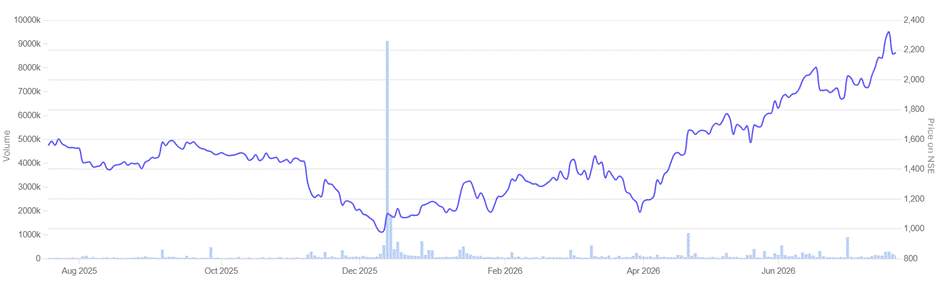
The next 12 to 18 months will be crucial for the company, as it is expected to transition from an investment phase to commercialisation. The Dahej facility is expected to start production of electrolyte in the first half of FY27 and LiPF₆ in the second half. The stock has soared almost 40% in the last 12 months, in line with these expectations.
Neogen Chemicals: 1 yr Stock Price Chart

Neogen Chemicals: Financial Performance
| Metrics | FY25 | FY26 | YoY Growth |
| Sales (₹ crore) | 777.60 | 862.00 | 11% |
| EBITDA Margin (%) | 17.50 | 15.90 | -160 bps |
| Net Profit (₹ crore) | 34.80 | 28.80 | -17% |
| Return on Capital Employed (%) | 9.00 | 6.00 | -300 bps |
Neogen’s FY26 financial performance reflects a business in the middle of a capacity expansion cycle rather than with structural weakness. Revenue was up 11% to ₹862 crore, but EBITDA margins slipped to 15.9% in the period. The primary reason for the compression in EBITDA margin is that production from new facilities is yet to reach optimal scale. Return on capital employed also moderated as the company increased debt to fund its expansion.
#2 Acutaas Chemicals: Building India’s First Electrolyte Additives Platform
While Neogen is targeting electrolyte salts, Acutaas Chemicals is building its capabilities in electrolyte additives. That’s a key part of the chemistry of lithium-ion batteries that helps improve battery life, safety and charging performance.
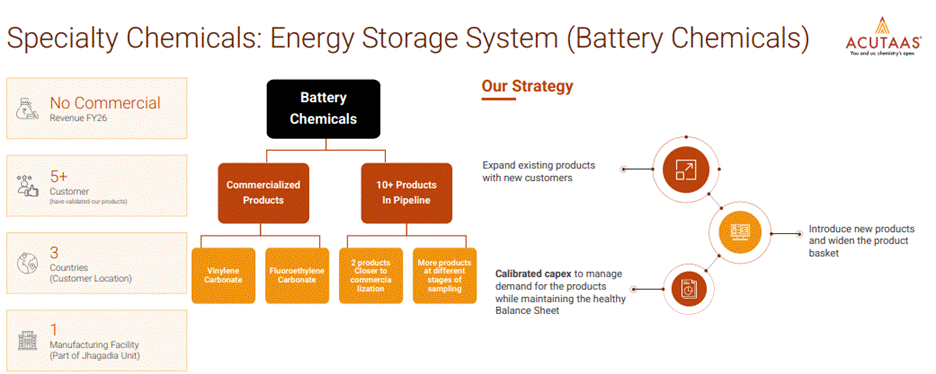
The company has already commercialised Vinylene Carbonate (VC) and Fluoroethylene Carbonate (FEC), becoming India’s first manufacturer of electrolyte additives. The first phase of its Jhagadia battery chemicals project has been completed, with a capacity of 2,000 metric tonnes each for VC and FEC, while the second phase is expected to be completed in FY27.
Alongside electrolyte additives, more than ten products are under different stages of development and commercialization.
Acutaas is following a differentiated strategy for expanding its battery chemical business. While targeting the domestic opportunity, it is also pursuing an export-led strategy. The company says more than five global customers have already validated its products across three countries.
What Will Drive the Next Phase of Growth?
FY27 is expected to be the first meaningful year of commercial revenue from Acutaas’ battery chemicals business. While the division contributed no commercial revenue in FY26, the focus now shifts from commissioning facilities to executing customer contracts and scaling production.
The 2,000 MTPA capacity each for VC and FEC is fully backed by customer contracts over the next three years. Alongside commercialised products, more than 10 products are in the pipeline that would further strengthen Acutaas’ position in the battery chemical segment.
Acutaas Chemicals: Business Snapshot of Battery Chemicals Division

Financial Performance Supported by Core Business Strength
Acutaas Chemicals: Financial Performance
| Metrics | FY25 | FY26 | YoY Growth |
| Sales (₹ crore) | 1024 | 1339 | 31% |
| EBITDA Margin (%) | 23.00 | 35.90 | 1290 bps |
| Net Profit (₹ crore) | 160 | 356 | 122% |
| Return on Capital Employed (%) | 19.10 | 39.30 | 2020 bps |
Acutaas delivered a strong operational performance in FY26, with revenue rising 31% to ₹1,339 crore and net profit more than doubling to ₹356 crore. The management has guided for around 25% revenue growth in FY27, with battery chemicals and semiconductor-related products expected to become increasingly important growth drivers.
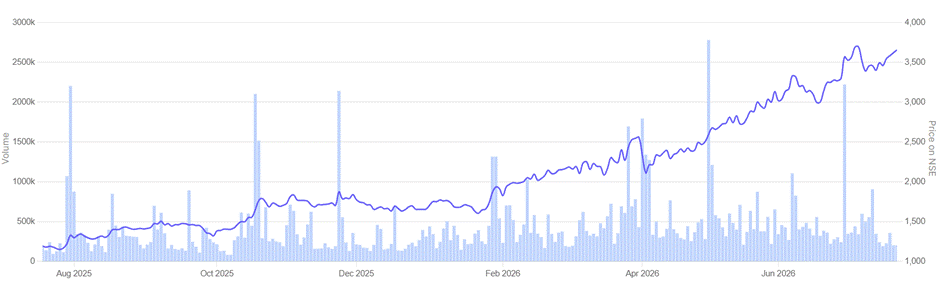
Acutaas Chemicals: 1yr Stock Price Chart

#3 Archean Chemicals: A Different Bet on Energy Storage
Unlike Neogen Chemicals and Acutaas Chemicals, Archean Chemicals is not a direct battery materials play today. Its core business remains the production of industrial salt, bromine, and sulphate of potash, which continue to generate the bulk of its revenue.
Instead, the company is building exposure to alternative energy storage technologies. Archean has purchased an 18.14% stake in Offgrid Energy Labs, based in the USA, a developer of zinc-bromide flow batteries. Unlike lithium-ion batteries, which dominate EVs and short-duration storage, zinc-bromide flow batteries are designed for long-duration stationary energy storage suitable for utility-scale grid storage.
What will Drive the Next Stage Growth?
Archean’s battery-related opportunity remains at an early stage. The key trigger is not commercial production but technology adoption.
In July 2026, Offgrid Energy Labs commissioned a 10 MWh pilot production line in the UK, marking an important step towards commercialising its zinc-bromide battery technology. Archean has also indicated its long-term ambition to set up a battery manufacturing facility in India.
Whether that vision translates into a commercially meaningful business remains uncertain and will likely take time. Beyond batteries, Archean is also building exposure to the power electronics ecosystem. Through its subsidiary SiCSem, the company is setting up India’s first commercial silicon carbide (SiC) compound semiconductor fabrication facility under the India Semiconductor Mission.
Financial Performance Reflects the Core Chemicals Business
Archean Chemicals: Financial Performance
| Metrics | FY25 | FY26 | YoY Growth |
| Sales (₹ crore) | 1078 | 1108 | 3% |
| EBITDA Margin (%) | 32.6 | 24.0 | -860 bps |
| Net Profit (₹ crore) | 162 | 105 | -35% |
| Return on Capital Employed (%) | 13.4 | 10.1 | -330 bps |
Archean’s FY26 financial performance was driven by its legacy chemicals business, with no meaningful contribution from its battery-related investments. Revenue grew modestly by 3%, to ₹1,108 crores, while profitability declined due to weakness in its core business.
For investors, the battery thesis remains one of long-term optionality rather than near-term earnings. The key variables to watch are the commercial adoption of zinc-bromide flow batteries.
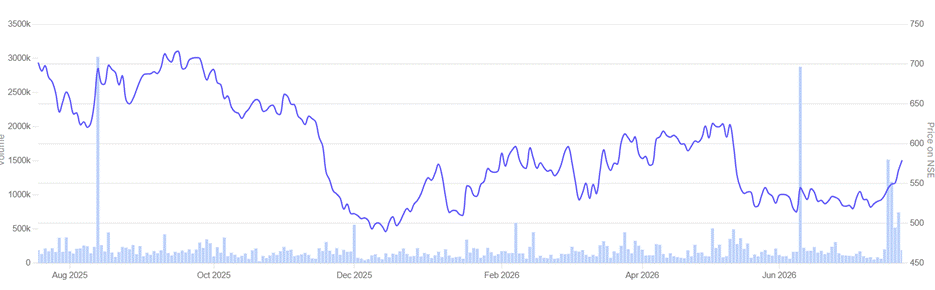
Archean Chemicals: 1yr Stock Price Chart

How Institutional Investors Are Positioned Across These Three Companies
Institutional Holdings at a Glance (in %)
| Company | FII | DII |
| Neogen Chemicals | 4.29 | 21.67 |
| Acutaas Chemicals | 21.61 | 19.55 |
| Archean Chemical Industries | 11.00 | 24.18 |
All three companies have fairly strong institutional ownership, with Acutaas Chemicals having the highest institutional ownership at over 41%, followed by Archean and Neogen at 35.18% and 25.96%, respectively.
Specialty chemical companies have traditionally attracted institutional investors because of their ability to generate high returns, sticky customer relationships, and strong export opportunities. The battery materials segment adds another layer to this investment thesis, offering exposure to a structural growth opportunity that is still in its early stages.
Are Expectations Running Ahead of Reality?
The battery materials opportunity has not gone unnoticed by the market. All three companies trade at a significant premium to both their respective five-year median valuations and the broader specialty chemicals industry.
Valuations: P/E Multiple Trend
| Company | P/E | 5-yr Median PE | Industry PE |
| Neogen Chemicals | 211.0 | 93.1 | 31.2 |
| Acutaas Chemicals | 84.4 | 58.9 | 34.0 |
| Archean Chemical Industries | 70.8 | 32.0 | 31.2 |
Neogen trades at the richest valuation, more than two times its historical median, reflecting expectations around its integrated battery materials platform. Acutaas and Archean also command healthy premiums, supported by their diversification into battery chemicals.
While the long-term opportunity remains compelling, current valuations leave limited room for execution missteps. Over the next few years, the key question will not be whether battery materials become a meaningful business, but whether these companies can ramp up commercial production, improve capacity utilisation and convert these investments into sustainable earnings growth.
The Bigger Opportunity
India’s battery materials story is much bigger than the domestic EV opportunity. It is increasingly about becoming part of a global supply chain that is looking for alternatives to China.
Among the three companies, Neogen appears to have the most integrated battery materials platform, Acutaas offers a higher-growth but execution-dependent additives business, while Archean provides longer-term optionality through alternative battery technologies and power semiconductors.
For investors, the focus should not be just on which company will benefit from India’s battery boom. The bigger question is which companies can successfully commercialise their products, win global customer approvals and convert years of investment into sustainable earnings growth. That will ultimately separate the long-term winners from the rest. Add these stocks to your watchlist and track how well they execute their growth strategies.
Note: We have relied on data from www.Screener.in throughout this article. Only in cases where the data was not available, have we used an alternate, but widely used and accepted source of information.
The purpose of this article is only to share interesting charts, data points and thought-provoking opinions. It is NOT a recommendation. If you wish to consider an investment, you are strongly advised to consult your advisor. This article is strictly for educative purposes only.
Deepan Datta has spent over a decade studying stocks and mutual funds. His passion is to uncover interesting stories in the financial markets and share them through his writings with investors at large. He is focused on delivering clear, easy to understand and research-backed insights. Deepan began his career as a Research Associate at S&P Global, where he developed a strong foundation in financial research and data analysis.
Disclosure: The writer and his dependents do not hold the stocks discussed in this article.
The website managers, their employees (s), and contributors/writers/authors of articles have or may have an outstanding buy or sell position or holding in the securities, options on securities or other related investments of issuers and/or companies discussed therein. The content of the articles and the interpretation of data are solely the personal views of the contributors/ writers/authors. Investors must make their own investment decisions based on their specific objectives, resources and only after consulting such independent advisors as may be necessary.