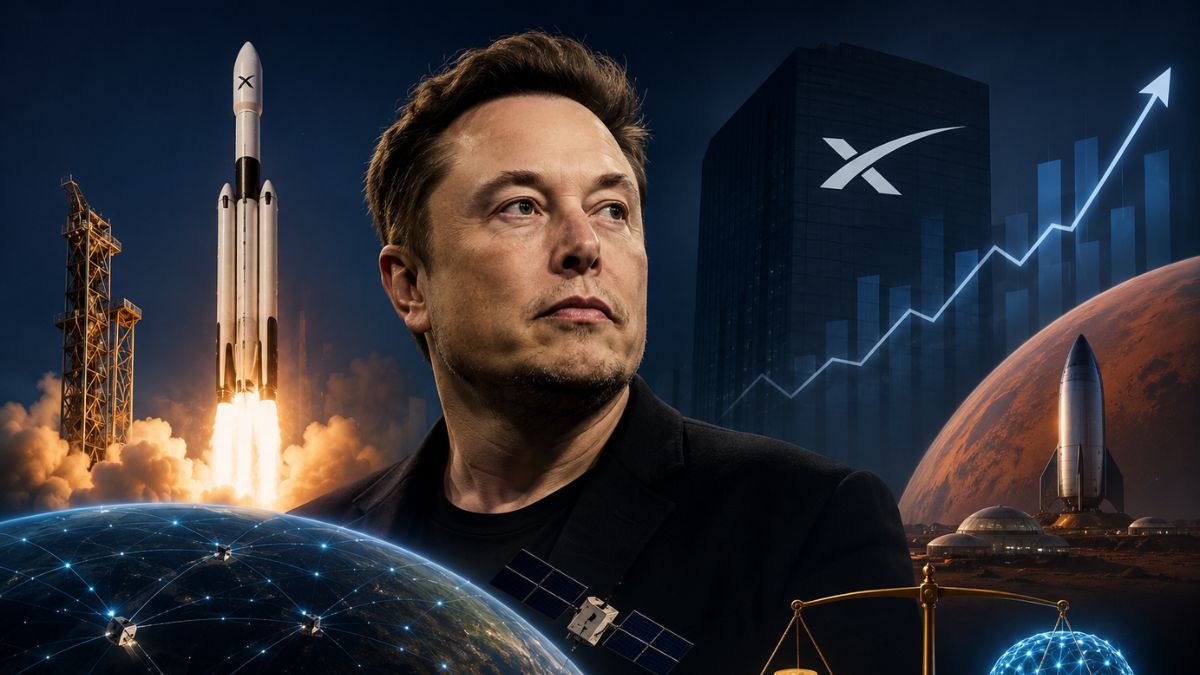
SpaceX shares slipped below their initial public offering (IPO) price for the first time on Wednesday, a little over a month after the company made history with the biggest IPO ever.
The stock later recovered slightly and closed at $135.27, just above its IPO price of $135. During the day, however, it fell as low as $132.28.
The drop marks a big change for the Elon Musk-led company, whose stock had surged after listing and briefly pushed its market value above $2.6 trillion, making Musk the world’s first trillionaire. By Wednesday afternoon, the company’s valuation had fallen to around $1.78 trillion.
SpaceX shares fall below IPO price
When SpaceX debuted on the stock market, investor excitement sent its shares soaring. At one point, the company was valued even higher than tech giants Microsoft and Amazon, despite both companies having much longer histories as public firms and stronger financial results.
But that excitement has started to fade. SpaceX made history with the biggest IPO ever when it debuted on the stock market on June 12.
On its first day of trading, the company’s shares jumped 19%. The IPO was priced at $135 per share, while the stock opened at $150, about 11% higher than the offer price. Since then, however, the shares have slowly moved lower, even after being added to the Nasdaq-100 index.
Wednesday’s decline came as the technology-heavy Nasdaq Composite also slipped about 0.2%, while technology stocks have remained volatile over the past month.
Musk is no longer a trillionaire
According to the Bloomberg Billionaires Index, Musk’s fortune is now estimated at around $850 billion. However, on June 16, when the stock crossed $225 per share, his net worth touched $1.45 trillion. Since then, SpaceX shares have fallen by more than 40%. Even after the drop, Musk remains the world’s richest person. He is still well ahead of Google co-founders Larry Page, whose net worth is estimated at $290.7 billion, and Sergey Brin, who is worth around $268.1 billion.
SpaceX could face more pressure in the coming months. After the IPO lock-up period ends, employees and early investors will be allowed to sell their shares. A rise in selling could put further pressure on SpaceX’s stock, leading to another decline in net worth. Musk owns about 38% of the company, and his SpaceX stake accounts for more than half of his total wealth. The company has 4.8 billion outstanding shares and 350 million stock options that Musk can buy at an exercise price of $8.40 per share.
Why did SpaceX shares fall?
Several factors came together to pull SpaceX’s shares lower. After the stock’s strong rally following its record-breaking IPO, many investors chose to book profits, leading to increased selling. At the same time, some on Wall Street began questioning whether the company’s valuation had become too high after it briefly crossed $2.6 trillion, especially since SpaceX reported a $4.9 billion loss last year and many of its long-term projects are still in the early stages.
Investors are also growing cautious about the company’s heavy spending on artificial intelligence after it raised $25 billion through bonds to fund new technology infrastructure. Concerns that the US Federal Reserve could raise interest rates have only added to the pressure on highly valued technology stocks.
Even SpaceX’s inclusion in the Nasdaq 100 failed to lift sentiment, with the stock falling about 13% since joining the index. Analysts also say there have been no major new developments to renew investor excitement, while the upcoming expiry of the IPO lock-up period could lead to more selling as employees and early investors become eligible to sell part of their holdings.
Investors may be cashing out
Justus Parmar, CEO of Fortuna Investments, which invests in SpaceX, believes one reason behind the recent weakness is that some investors are beginning to sell their shares and lock in profits.
“I think the elephant in the room is there’s a lot of folks that are in the stock, and maybe some of them, or a good number of them are wanting to take some liquidity, which is essentially putting a lot of pressure on the stock,” Parmar told Reuters.
He added: “You’re probably seeing a little bit of it, and through the course of the year, we’ll be seeing more of that.”
However, SpaceX is not the first major company to see its shares fall soon after going public.
One example is British chip designer Arm Holdings, which also slipped below its $51 IPO price about a week after its much-talked-about market debut in 2023. However, the stock later recovered strongly.
Data from University of Florida finance professor Jay Ritter also shows that weak performance after an IPO is quite common. According to his research, more than 70% of companies that went public between 1974 and 2021 delivered negative returns over the next three years compared with their offer price.
Still, the decline is likely to boost the argument of critics who believed SpaceX’s valuation had become too expensive. The company reported a $4.9 billion loss last year, and many of its biggest long-term projects have yet to prove they can succeed.
Nasdaq 100 inclusion fails to help
SpaceX’s entry into the Nasdaq 100 index also failed to lift the stock. Since joining the technology-heavy index, the company’s shares have fallen by about 13%.
Steve Sosnick, chief market analyst at Interactive Brokers, said investors have not seen any fresh developments that could renew confidence in the stock. “The fact that a stock has fallen a couple of dollars below its IPO price in itself is not a tragedy, but SpaceX is heavily watched and has an important role in investor psyche.”
Even though the stock has weakened, many Wall Street analysts remain optimistic about SpaceX’s future. Morgan Stanley, one of the lead underwriters for the company’s IPO, has set a 12-month price target of $300 for the stock.
JPMorgan expects the shares to reach $225 by the end of 2027. Not everyone is as optimistic, though. Morningstar believes the stock is worth much less. Last month, the research firm said it values SpaceX shares at just $63.
All eyes now on earnings and lock-up expiry
Investors are now waiting for SpaceX’s first earnings report since becoming a public company. Analysts expect the results to be released during the first week of August. Soon after that, the first phase of the IPO lock-up period will end. This will allow eligible employees and some early investors to start selling part of their holdings.
Apart from financial results, investors are closely watching SpaceX’s 13th Starship test flight.
The successful development of Starship is considered important for the company’s future plans. SpaceX hopes the rocket will lower launch costs and support ambitious projects such as orbital data centres and missions to the Moon.
Disclaimer: This article provides factual analysis only and is not, and should not be construed as, an offer, solicitation, or recommendation to buy or sell securities. Investors must conduct their own independent due diligence and seek advice from a registered financial advisor in the respective jurisdiction.