




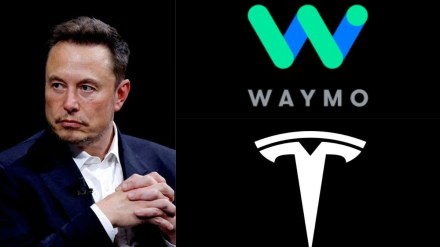
Picture two tech giants racing to revolutionise transportation. In one corner, you have Tesla with its $1.5 trillion valuation and Elon Musk promising a robotaxi empire. In the other corner, Alphabet’s Waymo, quietly racking up millions of actual driverless rides.
Wall Street seems convinced Tesla will win. But what’s actually happening on the streets tells a completely different story.
Let’s break down this robotaxi battle and figure out who’s really winning.
Round 1: Who’s actually operating?
Tesla started its Austin robotaxi service in June 2025 with about 30 vehicles. Sounds impressive until you learn that Waymo started in Austin just three months earlier in March and already has 200 vehicles on the road.
But here’s the knockout punch. Tesla’s robotaxis still have human monitors sitting inside every single vehicle carrying passengers. Though as per some reports, Tesla just began some driverless testing.
Waymo’s cars? Completely driverless.


In Austin, a University of Texas professor studying transportation said she’s never seen a Tesla Robotaxi but sees Waymos “around all the time.”
Score: Waymo by a mile.
Round 2: The scale game
Waymo completed 14 million paid rides in 2025. They’re operating in 6 cities: Austin, Phoenix, San Francisco, Los Angeles, Atlanta, and more. They have over 2,500 vehicles total and plan to expand to 20 additional cities by the end of 2026.
Tesla? They’re testing in two cities (Austin and San Francisco) with human monitors and haven’t scaled beyond that.
When it comes to autonomous miles driven, Waymo has logged 100 million fully autonomous operational miles. Tesla boasts about data from 8.5 million vehicles, but those are supervised miles with humans ready to take over. Big difference.
Score: Another clear win for Waymo.
Round 3: The technology battle
This is where things get philosophical. Tesla and Alphabet chose completely opposite paths.
Tesla’s bet: Vision-only systems using just cameras. It’s cheaper, and millions of existing Teslas could theoretically become robotaxis with a software update. Elegant solution on paper.
Alphabet’s bet: Use everything. Waymo deploys cameras, lidar, radar, and HD maps in carefully controlled geofenced areas. More expensive but more reliable.
Here’s the problem with Tesla’s approach. Cameras struggle in fog, get fooled by glare, and regulators are nervous about approving a system without sensor redundancy. Waymo’s multi-sensor approach has already won regulatory approval in multiple cities.
And that “cost advantage” Tesla claims? Experts say lidar and radar sensor costs have fallen dramatically, so it’s no longer the differentiator it once was.
Score: Waymo’s practical approach beats Tesla’s theoretical elegance.
Round 4: The timeline test
Elon Musk promised in 2016 that Teslas would drive cross-country autonomously within two years. In 2019, he predicted one million robotaxis by mid-2020. In October 2025, he said Tesla would operate in 8 to 10 cities by January 1st.
None of that happened.
Meanwhile, Alphabet started its self-driving project in 2009. It became Waymo and launched commercial service in Phoenix in 2018. Since then, they’ve been steadily expanding city by city, approval by approval, building an actual business.
Score: Consistency beats overpromising.
Round 5: The regulatory reality
Regulators are way more comfortable with Waymo’s approach. Why? Because Waymo says “We’ll operate in this specific 9-square-mile geofenced area with multiple safety systems.” Tesla says “Our cars can drive anywhere.”
Guess which one gets approved faster?
Waymo has regulatory approval to operate driverlessly in multiple cities. Tesla is still testing with safety drivers.
Score: Waymo understands the game.
The bottom line
If you’re keeping score, Alphabet’s Waymo is dominating Tesla in every metric that actually matters: vehicles deployed, cities operating in, driverless rides completed, regulatory approvals, and autonomous miles driven.
Yet Tesla’s stock hits record highs based on robotaxi promises while Alphabet trades at much lower multiples despite actually running a robotaxi business today.
Here’s the uncomfortable truth for Tesla investors. Much of Tesla’s $1.5 trillion valuation is based on the assumption that they’ll capture a huge chunk of a multi-trillion dollar robotaxi market. But by the time Tesla perfects its vision-only system and gets regulatory approval, Waymo will have already established itself as the market leader.
In the tech world, being first to market with a working product often matters more than having the most ambitious vision. And right now, Alphabet is operating the future that Tesla keeps promising.
The robotaxi race isn’t over, but Alphabet has lapped Tesla multiple times already.
Sonia Boolchandani is a seasoned financial writer She has written for prominent firms like Vested Finance, and Finology, where she has crafted content that simplifies complex financial concepts for diverse audiences.
Disclosure: The writer and her his dependents do not hold the stocks discussed in this article.
The website managers, its employee(s), and contributors/writers/authors of articles have or may have an outstanding buy or sell position or holding in the securities, options on securities or other related investments of issuers and/or companies discussed therein. The content of the articles and the interpretation of data are solely the personal views of the contributors/ writers/authors. Investors must make their own investment decisions based on their specific objectives, resources and only after consulting such independent advisors as may be necessary.


