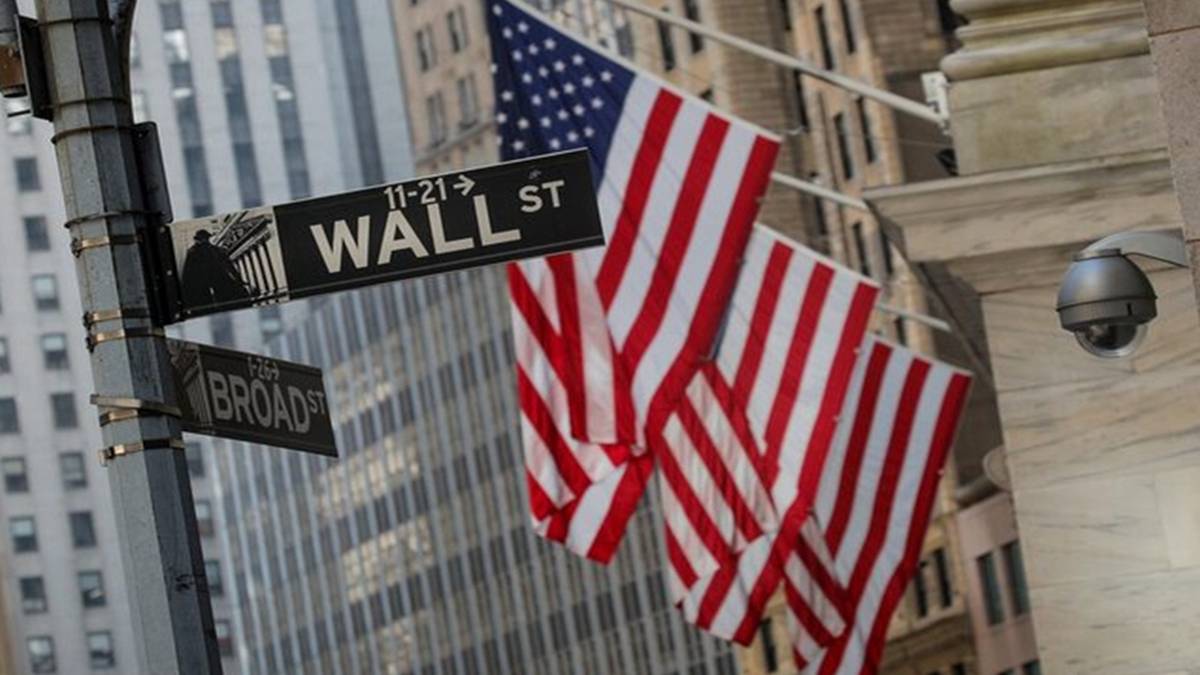
S&P 500 slid to session lows on Monday after President Donald Trump said he was reinstating a blockade on Iranian shipping through the Strait of Hormuz.
At 11:30 am ET, US stocks were lower. The Dow Jones fell 107.52 points, or 0.20%, to 52,529.49. The S&P 500 dropped 27.72 points, or 0.37%, to 7,547.67, while the Nasdaq declined 224.65 points, or 0.85%, to 26,056.96.
Trump wrote on Truth Social, “We are reinstating the THE IRANIAN BLOCKADE, so named because it is only stopping Iran’s ships or customers from entering or leaving. The U.S.A. will be, from this point forward, known as ‘THE GUARDIAN OF THE HORMUZ STRAIT,’ but as such, and as a matter of FAIRNESS, will be reimbursed, at the rate of 20% on all cargo shipped, for any and all costs necessary to do the job of providing safety and security to this very volatile section of the World.”
Trump’s announcement happened after another weekend of fighting between Iran and the US, with both sides carrying out airstrikes. Tehran attacked US facilities in several Gulf countries and said the Strait of Hormuz was closed. Trump, however, disputed Iran’s claim on Sunday and said the key shipping route remained open to commercial traffic.
Fresh weakness is visible in AI companies, including Chip stocks, which are also under further pressure, signalling continued concern about whether the sector will achieve the lofty forecasts that fuelled its speculative rise.
Micron, NVIDIA, Broadcom, Intel, and AMD are among many tech stocks in the red, down by up to 6.3%. SK Hynix ADR is down nearly 7% on Monday, a sharp reversal after the stock clocked a 13% gain on its debut last Friday.
TSMC in Focus
The standout story on Monday could be Taiwan Semiconductor Manufacturing. TSMC reported a 67.9% year-on-year rise in its June sales, ahead of its second-quarter earnings release later this week, reports CNBC. TSMC ADR has gained nearly 90% in the last 1 year and is up 42% year-to-date, but has been under pressure last week. On Monday, the ADR is trading flat before the market opens.
How Deep Is the Chip Damage?
The semiconductor sector’s remarkable first-half rally is showing significant cracks. The PHLX Semiconductor Index of chip stocks, known as SOX, which almost doubled in the first half of the year, is struggling to sustain its gains, falling over 10% from its year’s high.
The scale of the damage is captured vividly in a report by Bespoke Investment Group, as reported by Investopedia. “The 22 stocks in the S&P 500 that gained 100%-plus over the first six months of 2026 — most are in the tech sector — were recently down an average of 16% in July,” reads the report.
Market Outlook
Despite the near-term pressure, there is a meaningful bright spot in the earnings picture. According to FactSet, 57% of companies — 63 out of 111 — are issuing positive EPS guidance, which is well above the 5-year average of 41% and the 10-year average of 41%. This quarter marks the highest percentage of S&P 500 companies issuing positive EPS guidance since Q3 2021, when the reading was also 57%.
The Week Ahead
Inflation is the key macro focus this week. The June CPI reading is set to be released on Tuesday. In May, US CPI rose 4.2% year-over-year, largely due to elevated fuel prices. Oil prices crossed $78 on Monday, rising nearly 4%, following the US stepping up military operations against Iran. Western forces maintain that the Strait of Hormuz is still open for commercial shipping, but Iran maintains that it is closed.
On the earnings front, a few large national banks will release their second-quarter results this week. Today, Bank of America (BAC) is scheduled to release its second-quarter results at 6:45 a.m., followed by a conference call at 8:30 a.m. ET.
Disclaimer: This article provides factual analysis only and is not, and should not be construed as, an offer, solicitation, or recommendation to buy or sell securities. Investment in foreign securities involves significant risks, including currency fluctuations, different financial reporting standards, and varying regulatory environments. The historical performance of US stocks is not a guarantee of future returns, and gains should not be viewed as an offer or solicitation to buy. Investors must conduct their own independent due diligence and seek advice from a registered financial advisor.