
Every month, many salaried professionals promise themselves they’ll manage their money better. They download budgeting apps, track expenses for a few days and then slowly stop opening them. The problem usually isn’t knowing where the money went, it’s figuring out what to do differently the next month.
I’ve been there too. So instead of downloading a budgeting app, I decided to try something different. I opened ChatGPT and typed a simple prompt: “Act like an expert financial planner.”
I expected a list of budgeting tips or perhaps the usual advice about saving more and spending less.
Instead, ChatGPT asked me questions. It stated, “To create a realistic financial plan, I’ll first need to understand your current financial situation. Please share your monthly income, recurring expenses, loans or liabilities, savings, insurance, financial goals and your risk tolerance.”
The AI also wanted to know whether I was saving for a major life goal, how comfortable I was taking financial risks and whether I had an emergency fund. Only after understanding my finances did it begin building a financial plan.
Can ChatGPT really understand your finances?
To find out, I shared a realistic picture of my finances with ChatGPT. I’m not revealing my exact salary or expenses for privacy reasons.
My next prompt was: “Help me plan a realistic monthly budget. Here’s my salary and monthly expenses.”
After reviewing the information, ChatGPT responded: “Based on the information you’ve shared, around half of your monthly income is already committed to fixed obligations such as rent, EMIs, insurance premiums, Wi-Fi and other recurring bills. Another significant portion goes towards essential living expenses like groceries, transport and utilities. That leaves limited room for savings, so your first priority should be maintaining financial stability while gradually building an emergency fund.”
What surprised me wasn’t the calculation itself, it was the reasoning behind it.
Instead of telling me to follow a one-size-fits-all budgeting rule or save a fixed percentage of my salary, ChatGPT looked at how much of my income was already committed before the month even began. It correctly guessed that with only a small portion left after paying recurring bills and essential expenses, trying to invest aggressively could create unnecessary financial pressure.
It recommended keeping fixed commitments under control, covering essential expenses, building an emergency fund with the remaining money and only then thinking about increasing investments or making additional loan repayments.
That felt less like generic budgeting advice and more like guidance according to the financial picture I had shared.

How I asked ChatGPT to create my monthly budget
Once ChatGPT had analysed my finances, I wanted to know what I should actually do once my salary landed in my bank account.
So I asked: “Based on my current financial situation, how should I manage my salary every month?”
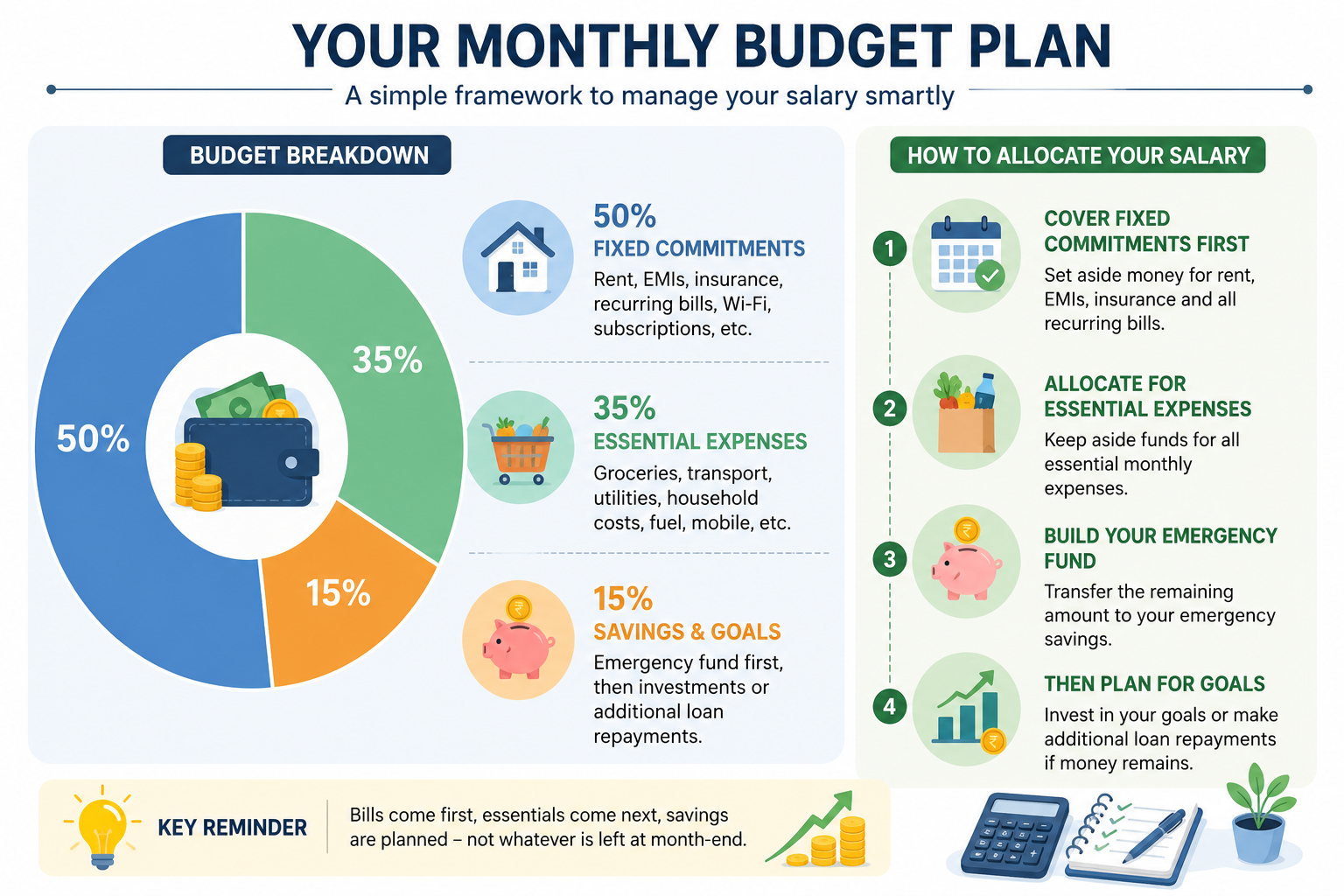
Rather than jumping straight to investments, ChatGPT laid out a clear order of priorities. It stated, “As soon as your salary is credited, first set aside money for fixed commitments such as rent, EMIs, insurance premiums and other recurring bills. Next, allocate funds for essential monthly expenses like groceries, transport and utilities. Once those are covered, transfer the remaining amount towards your emergency fund before planning any discretionary spending.”
The advice portrayed the financial picture it had already analysed.
- 50%: Fixed commitments such as rent, EMIs, insurance and recurring bills
- 35%: Essential living expenses including groceries, transport, utilities and household costs
- 15%: Emergency savings first, followed by investments or additional loan repayments if money remained
What stood out was that ChatGPT didn’t simply tell me to “save more.”
Instead, it treated every part of my salary as money with a specific purpose. Bills came first, essentials came next and savings became a planned habit rather than whatever happened to be left at the end of the month.
Curious about the bigger picture, I asked another question. “Based on my current financial commitments, what should my financial priorities be?”
ChatGPT replied: “Your immediate goal should be financial resilience rather aggressive wealth creation. Build an emergency fund that can cover three to six months of essential expenses before increasing investments or making large loan prepayments. A financial cushion will help you manage unexpected expenses without disrupting your monthly budget.”
That advice felt practical. Instead of assuming everyone should invest as much as possible, ChatGPT adjusted its recommendations based on the financial commitments I had shared. It recognised that creating financial stability was a more realistic first step than chasing higher returns.
ChatGPT’s advice on EMIs and financial priorities
Since EMIs are a significant monthly expense for many salaried professionals, I wanted to see whether ChatGPT would simply recommend paying off debt as quickly as possible.
So I asked: “Based on my current salary, monthly expenses and EMI commitments, what’s the smartest way to manage my loan repayments?”
ChatGPT didn’t tell me to increase my EMI or empty my savings to become debt-free sooner. Instead, it replied: “Continue making your regular EMI payments while building a basic emergency fund with the money left after all essential expenses are covered. Once you’ve created that financial cushion, consider using salary hikes, annual bonuses or other additional income for partial loan prepayments. Also review refinancing opportunities periodically if they can reduce your overall borrowing cost.”
I liked that the advice wasn’t focused on eliminating debt at any cost. The AI recognised that repaying loans faster isn’t always the smartest financial decision if it leaves you without enough money to handle an unexpected expense. It prioritised financial stability first and suggested accelerating repayments only when my financial situation became stronger.
How AI turned my monthly budget into a weekly spending plan
With my monthly budget ready, I wanted to know how I could actually stick to it without constantly checking my bank balance.
So I asked: “Can you break this monthly budget into a weekly plan?”
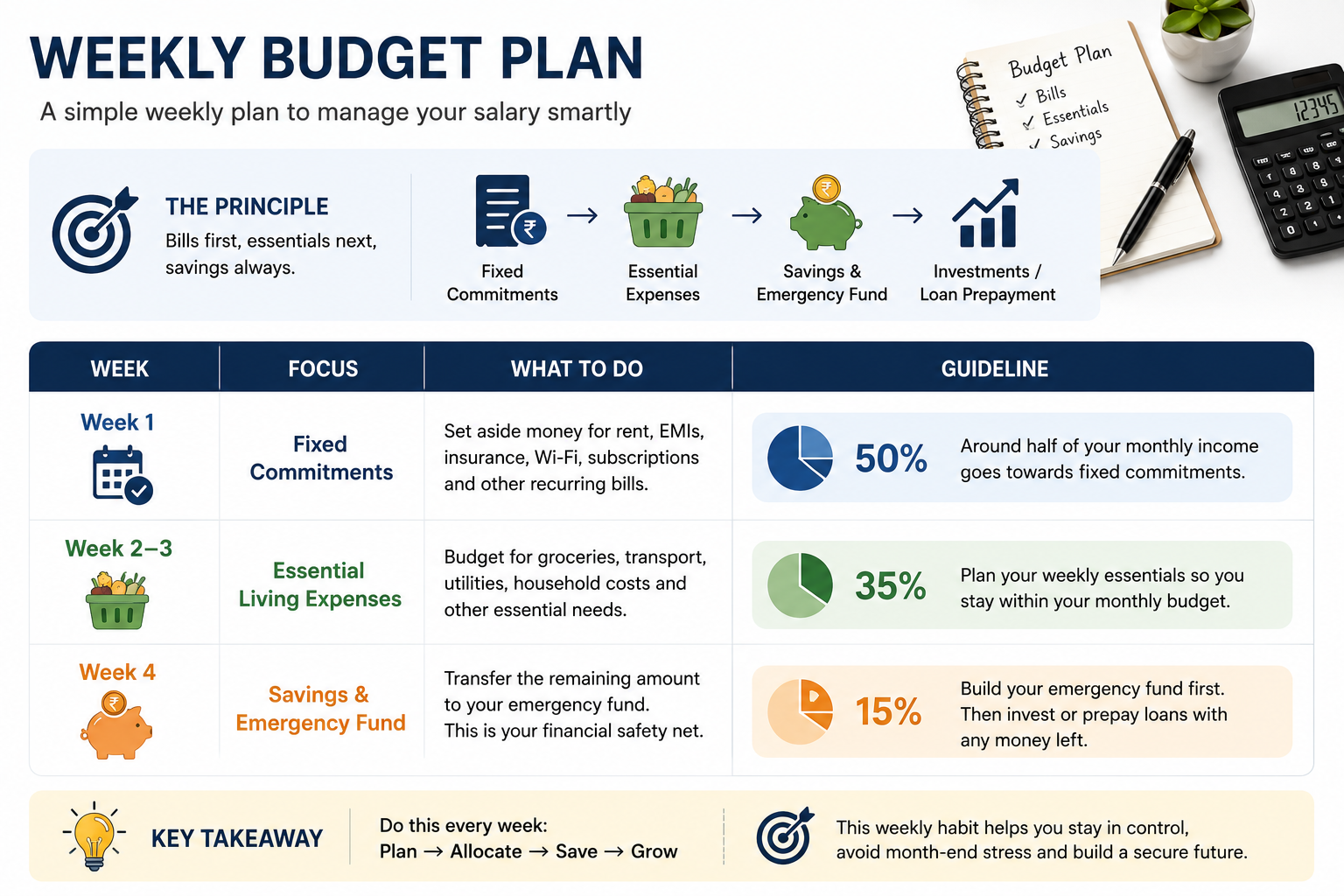
Instead of treating the remaining 50% of my income as one lump sum, ChatGPT divided it into four weekly spending targets. It wrote, “Once your fixed commitments are taken care of, manage the remaining budget one week at a time instead of thinking about the entire month. Here’s a simple structure you can follow:”
It shared numbers for the weekly budget (I won’t be able to reveal exact figures due to privacy concerns). The numbers included per week budget from the overall monthly remaining 50% from my daily essential expenditure and savings margin amount.
Week 1: Spend around 40% of that week’s budget on essentials such as groceries, transport and household expenses. Move 50% into your emergency fund or savings, while keeping the remaining 10% as a buffer for unexpected costs.
Week 2: Follow the same pattern – limit essential spending to 40%, continue building your emergency fund with 50%, and keep 10% aside for emergencies.
Week 3: Continue the routine. If you’ve spent less than planned in the first two weeks, transfer the surplus directly to your savings instead of increasing your spending limit.
Week 4: Since most major purchases are usually made earlier in the month, reduce essential spending to around 30%, increase savings to 60%, and continue keeping a 10% emergency buffer. Any money left after this should stay in your savings rather than being spent before payday.
What stood out was that ChatGPT wasn’t simply dividing my monthly budget into four equal parts. It gave each week a different objective like cover essentials, gradually build savings and always keep a small financial cushion for unexpected expenses.
Then it created a daily spending plan
I wanted to make the plan even more practical. I gave a prompt: “Can you also create a daily spending plan?”
ChatGPT suggested treating each day’s spending limit as three separate buckets instead of one amount. It wrote, “Aim to spend around 70% of your daily budget on planned expenses such as meals, transport and household purchases. Keep 20% as a reserve for unexpected expenses. If the remaining 10% goes unused, transfer it to your emergency fund or savings instead of carrying it over as extra spending money.”
It also suggested checking my spending every evening to see whether I’d stayed within my daily limit and adjusting the next day’s spending if I had overshot.
By this point, ChatGPT had built a complete budgeting framework.
I followed ChatGPT’s budget for a week. Here’s what happened
With a monthly budget, weekly roadmap and daily spending plan in place, the only thing left was to put it to the test.
For the next seven days, I followed ChatGPT’s budgeting framework as closely as possible. Before spending money each day, I checked whether the purchase fit within the week’s plan. At night, I reviewed where my money had gone and whether I had stayed within my daily spending target.
The biggest change wasn’t the amount I spent, it was how often I paused before making a purchase.
Knowing that every expense would show up in my nightly review made me think twice about impulse spending. A few purchases that I might have made without much thought suddenly felt easier to postpone because they weren’t immediate necessities.
The weekly budget also changed how I looked at my remaining money.
Instead of checking my bank balance and assuming I still had enough to spend, I measured every expense against that week’s allocation. If I spent a little more on one day, I tried to make up for it over the next couple of days rather than abandoning the budget altogether.
By the end of the week, I had stayed broadly within the spending limits ChatGPT had suggested. More importantly, I had managed to put aside money for savings instead of waiting to see if anything was left at the end of the month.
To wrap up the experiment, I returned to ChatGPT with a summary of my week’s spending. I gave it a prompt: “I followed the budget for a week. Based on my spending, how did I do?”
After reviewing my expenses, ChatGPT highlighted that I had largely stayed within my planned budget and had prioritised essential spending over discretionary purchases.
It wrote: “You’ve done a good job sticking to your spending plan, especially by keeping your essential expenses under control and setting aside money for savings instead of waiting until the end of the month. That’s a positive habit to build on.
One area to watch is your daily discretionary spending. While none of the purchases were individually significant, smaller expenses can quietly add up over time. Consider setting a weekly cap for non-essential spending so it’s easier to stay within your overall budget.
Overall, I’d rate your financial discipline this week as 8.5 out of 10. If you can maintain this routine consistently for the next three months, you’ll be in a much stronger position to build an emergency fund without feeling financially restricted.”
Verdict: Can ChatGPT really be your financial planner?
After spending a week using ChatGPT to organise my finances, my biggest takeaway wasn’t that AI had replaced a financial planner.
What it did do was make budgeting feel less intimidating. Instead of staring at a long list of expenses every month, I had a structured plan to follow. ChatGPT helped me prioritise fixed commitments, break the remaining money into weekly spending goals and build a simple daily routine that kept me accountable. For someone trying to get better control over their finances, that structure was genuinely useful.
At the same time, the experiment also showed where ChatGPT falls short. It can analyse the information you provide and suggest practical budgeting strategies, but it doesn’t know your complete financial picture unless you tell it. It can’t see your bank account, track transactions automatically or alert you if you’re overspending.
However, as a budgeting coach? I think it did surprisingly well.
It asked questions before offering advice, adapted its recommendations to the financial details I shared and gave me a framework that was simple enough to follow in everyday life.
Would I continue using it? Yes, but not because it improved my finances in a week. I’d use it because it helped me build better money habits.