




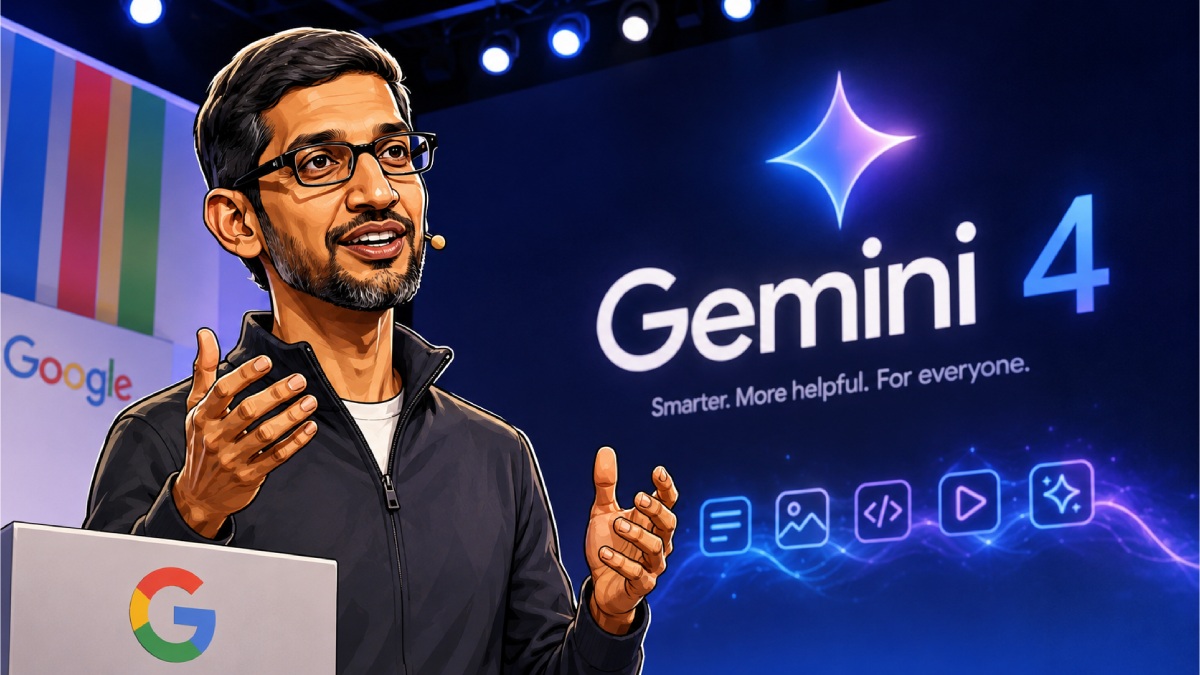
During Alphabet’s Q2 2026 earnings call, CEO Sundar Pichai clarified the company’s agenda to Wall Street – the company’s long-term focus remains on Gemini 4 while its current AI suite is scaling rapidly across consumer and enterprise markets.
In the company’s books, Gemini 4 represents the anchor of Google’s next-generation frontier AI strategy, especially as it works to maintain pace with rivals OpenAI and Anthropic. With rumours of a delay on the current-gen Gemini 3.5 Pro model release, Google’s team is working on honing the next-gen model, possibly to help the company leap ahead of OpenAI, Anthropic and others in the AI race.
Hence, for all those interested in the Gemini AI ecosystem, here is a look at what Google disclosed about the upcoming model family.
What is Gemini 4?
Gemini 4 is Google DeepMind’s next-generation flagship AI architecture that the company is training at the moment. Pichai confirmed on the call that Google has officially kicked off training for the new system, calling it the company’s “most ambitious pre-training run yet.”
Note that pre-training is the foundational, compute-heavy phase where a model ingests vast multimodal datasets, i.e., spanning text, code, images, audio, and video, to build core reasoning, spatial understanding, and logic patterns prior to safety tuning.
“We have started our most ambitious pre-training run yet, for Gemini 4, and are excited by the progress we are seeing at the frontier,” says Sundar Pichai, Alphabet CEO.
Key details confirmed about Gemini 4
1. Shift to a monthly release cadence
New frontier AI models usually in annual or semi-annual releases. Pichai hinted at an operational pivot starting with Gemini 4 – Google intends to deploy new models and iterative frontier updates on “almost a monthly cadence.” This strategy aims to bring Google into parity with the rapid model release cycles usually favoured by competitors like OpenAI and Anthropic.
2. Backed by scaled infrastructure
To support Gemini 4’s massive compute requirements, Alphabet raised its full-year capital expenditure forecast to $195 billion–$205 billion. Management noted that the surge in capex is directly dedicated to scaling global compute, custom TPU clusters, and data center capacity needed to train and serve next-generation models.
3. Focus on Agentic workflows and coding
Investor questions on the call focused on AI coding and autonomous agents, i.e., areas where delays to Gemini 3.5 Pro had drawn scrutiny. Pichai highlighted that Gemini 4 is being designed from the ground up to advance autonomous software engineering and multi-step agentic workflows, building on internal tools like Google’s Antigravity developer platform.
4. Direct Cloud and Enterprise integration
When Gemini 4 arrives, enterprise access will be immediate. Google reported that nearly 90 per cent of Fortune 100 companies now use Gemini Enterprise, with model API usage growing to 22 billion tokens per minute (up from 16 billion in Q1). Gemini 4 will serve as the core engine powering these enterprise pipelines.
Gemini 3.6 Flash and upcoming 3.5 Pro to bridge release gap
While Gemini 4 undergoes pre-training, Google has introduced several interim releases to optimise costs and performance across its stack with its Gemini Flash models:
Gemini 3.6 Flash: It functions as the primary high-efficiency workhorse model, engineered specifically to optimise speed and drop developer costs for everyday AI tasks.
Gemini 3.5 Flash-Lite: It serves ultra-low-latency workloads, making it ideal for fast, lightweight API calls and high-frequency background processing.
Gemini 3.5 Flash Cyber: This one operates as a specialised cybersecurity model, paired with Google’s CodeMender agent to actively hunt down and remediate system vulnerabilities.
Gemini 3.5 Pro: Acts as the high-reasoning flagship for complex problem-solving, currently undergoing partner testing ahead of its wider rollout.


