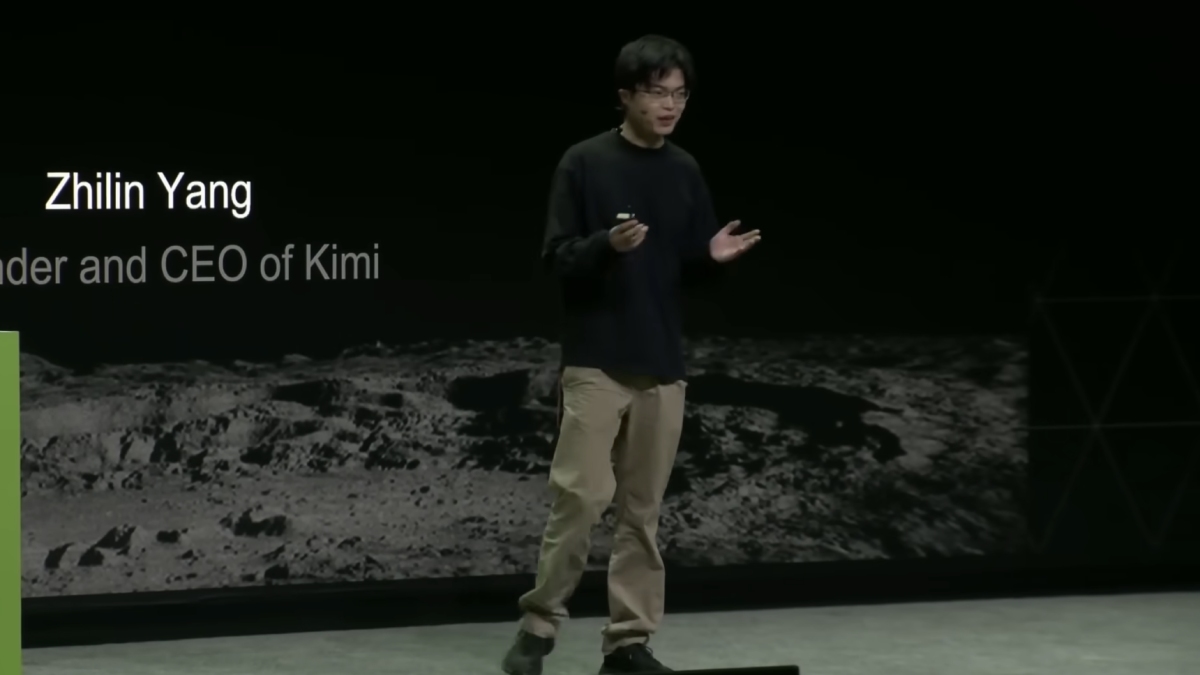
One of the biggest breakthroughs last week in the world of AI was China’s Moonshot AI unveiling its flagship Kimi K3 model – a massive 2.8-trillion-parameter open-weight system competing head-to-head with the West’s GPT-5.6 and Claude Fable. It was so disruptive that it sent shockwaves through Silicon Valley and global tech markets. It offered frontier-level performance at insanely affordable prices. At the centre of this global hype is Yang Zhilin – the man who turned down Apple years ago.
Zhilin, who is a 34-year-old researcher-turned-entrepreneur with a career journey spanning indie rock bands and a record-setting PhD work at Carnegie Mellon, is now at the helm of one of the world’s most valuable AI startups. Moonshot AI is en route to becoming a global AI force that OpenAI, Google and Anthropic might need to watch out for.
But how did Zhilin start the story of Moonshot AI and its attempt at upsetting the premier AI names of the world?
Yang Zhilin’s early obsession with rock music
Born in 1992 in Shantou, Guangdong, Yang Zhilin did not begin his life glued to a computer screen. As a teenager, his ambitions leaned toward the creative arts rather than tinkering with computer coding — he dreamt of becoming a rock musician, or a wandering poet.
Life, however, had different plans for him. He took computer science during his high school years, where his liking for raw aptitude and logic quickly took over. After just one year of intensive informatics training, he took home first prize in Guangdong’s National Olympiad in Informatics, scoring a stellar 667 points on the Gaokao (the highest science score in Shantou). He eventually earned admission to China’s prestigious Tsinghua University.
Yang initially enrolled at Tsinghua to study thermal engineering. However, after reading a novel by Japanese author Haruki Murakami, he was inspired and moved to Computer Science under the mentorship of renowned AI scholar Professor Jie Tang.
Outside the lab, Yang formed an indie rock band named Splay (named after the computer science data structure, the Splay Tree). Yang served as the band’s primary songwriter and drummer, forming deep bonds with bandmates who would later join him as co-founders in his tech ventures.
The early years to an AI-driven career
In 2015, Yang moved to the United States to pursue his PhD in Computer Science at Carnegie Mellon University (CMU) under AI luminaries Ruslan Salakhutdinov (former Director of AI Research at Apple) and William W. Cohen (Principal Scientist at Google DeepMind).
Yang completed his PhD in just four years, co-authoring fundamental architectures that solved critical context-length limitations in neural networks:
Transformer-XL (2019): It enabled Transformer models to learn long-term dependencies beyond fixed-length contexts without fragmentation.
XLNet (2019): An autoregressive pretraining method that famously outperformed OpenAI’s GPT and Google’s BERT across 20 natural language processing benchmarks.
HotpotQA: It created a benchmark dataset for multi-hop question answering and complex reasoning.
During his doctorate, Yang was interning at Google Brain and Meta AI / FAIR, collaborating with Turing Award winners Yann LeCun and Yoshua Bengio.
“Not only did he complete his PhD in just four years, but he also made truly fundamental contributions to machine learning during his time at CMU. What a spectacular career,”
wrote Ruslan Salakhutdinov, CMU Professor and Yang’s former thesis advisor.
Founding Moonshot AI
Upon graduating from CMU in 2019, Yang had multiple career opportunities. Global tech giants like Apple offered high-profile roles, with Apple even offering to set up a dedicated office for him in Beijing (as Ruslan wrote), while Stanford and MIT extended postdoctoral opportunities.
Yang, however, turned them all down. He wanted to build something of his own and hence, he returned to China.
In 2016, he founded Recurrent AI while still being a PhD student, focusing on enterprise sales intelligence tools. He also contributed key architectural insights to national model initiatives, including Huawei’s PanGu and the Beijing Academy of Artificial Intelligence’s (BAAI) Wu Dao model.
However, it was in March 2023 that Yang co-founded Moonshot AI alongside his Tsinghua bandmates Zhou Xinyu and Wu Yuxin, following ChatGPT’s global debut. The company’s official Chinese name, Yue Zhi An Mian, pays homage to Pink Floyd’s iconic 1973 album, The Dark Side of the Moon.
Moonshot AI immediately carved out a niche for itself by focusing on ultra-long context windows via its flagship assistant, Kimi. By enabling models to read and process hundreds of thousands (and later millions) of tokens natively, Kimi captured massive consumer and enterprise adoption in China rapidly.
The latest model, dubbed Kimi K3, is competing with the top-tier models like Anthropic’s Claude Fable 5 and OpenAI GPT-5.6 Sol, while offering tokens at a comparatively lower price. Moonshot AI also plans to release the source code to the market over the coming weeks.
Moonshot AI’s recent momentum has positioned it among the most valuable frontier labs. Backed by Alibaba, Tencent, HongShan (Sequoia China), and Meituan, the startup’s valuation is estimated between $20 billion and $30 billion following its Series B and pre-IPO funding rounds. Kimi’s rapid adoption allowed Moonshot AI to hit over $300 million in Annual Recurring Revenue (ARR) in mid-2026. The startup is actively preparing for an initial public offering on the Hong Kong Stock Exchange.