




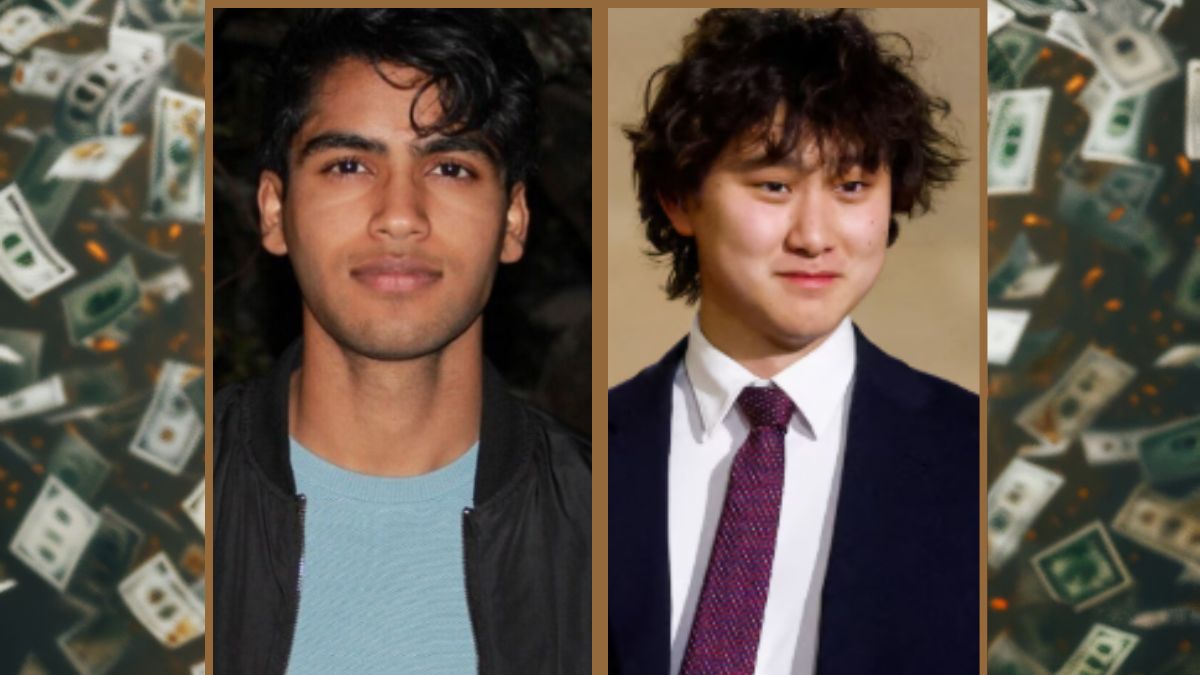
A game of snakes and ladders is taking shape on the artificial intelligence front. On one hand, AI automation is ripping job titles and taking away jobs. On the other hand, the same advanced technology’s takeover has triggered a staggering net worth boom, turning young names associated with it into billionaires and millionaires.
An analysis affirmed earlier this year that there are more Gen Z billionaires than ever before, with a record 35 people scoring the ten-digit fortune before hitting the age 30 milestone on Forbes’ latest World’s Billionaires list. On top of that, an all-time high of 12 of them are self-made.
Another report published by Bank of America researchers predicted that Gen Z is likely to be “among the most disruptive generations to economics, markets and social systems.” It is also estimated that those born between 1997 and 2012 are projected to be the richest by about 2035, as they are poised to amass about $36 trillion in roughly the next five years and more than $74 trillion by approximately 2040.
Common misconceptions continue to paint those born between 1997 and 2012, aka Generation Z, as lazy, disloyal to jobs and whatnot. However, these new AI billionaires, including Indian-origin Aman Sanger, the 25-year-old behind the AI startup recently acquired by Elon Musk’s SpaceX in a $60 billion deal, beg to differ.
4 MIT graduates who caught Elon Musk’s eye
Sanger and Cursor’s story alone is a testament to how AI has accelerated many entrepreneurs’ rise to billionaire status, as opposed to leading tech moguls who got there after a years-long wait. The AI coding startup Cursor was founded by four MIT students – Michael Truell, Sualeh Asif, Aman Sanger and Arvid Lunnemark – in 2022. The Gen Z quartet entered billionaire ranks in late 2025 when their company was valued at $27 billion in a funding round.
The four young billionaire cofounders’ net worths doubled recently, thanks to SpaceX’s $60 billion acquisition of the Cursor parent company, Anysphere, on the heels of the space giant’s blockbuster IPO on June 12. Even as a billionaire, Elon Musk enjoyed being the richest person on the planet.
Excited to train some very strong models! https://t.co/hsoqfiDzBg
— Aman Sanger (@amanrsanger) June 16, 2026
His company’s record-breaking Nasdaq debut has now turned him into the first and only trillionaire in the world. But even then, Musk’s own rise to billionaire ranks wasn’t as fast as most Gen Z AI billionaires today.
In a post-SpaceX IPO world, the $610 billion acquisition of Cursor parent Anysphere has helped four MIT students rejoice at a massive fortune boost by raising their net worth to about $2.7 billion each. Their flagship product, Cursor, which is now a widely used tool for building AI coding agents, has been adopted by many Fortune 500 companies and millions of developers. Franco Granda, a senior analyst at PitchBook, a firm tracking private companies, said, “That kind of entrenched user base is something money usually can’t buy quickly,” adding that its AI-backed platform for editing code is one of the fastest-growing software products, according to The San Francisco Standard.
Different paths of Scale AI’s co-founders, but still the youngest self-made billionaires
At 28, Alexandr Wang went viral in 2025, earning the title of Mark Zuckerberg-led “Meta’s highest-paid employee” and chief AI officer. As part of a $14.3 billion deal, the social media giant secured a 49% stake in the company Wang founded, Scale AI, and brought him on to lead a new Superintelligence Lab.
While his Meta journey came later, his entry into the billionaire ranks made headlines in 2021 when the valuation of the company he co-founded with Lucy Guo in 2016 hit $7.3 billion. And that’s how the then-24-year-old MIT dropout went on to become the world’s youngest self-made billionaire until October 2025, when Polymarket founder Shayne Coplan overtook him. The man who once left MIT to eventually launch Scale, only to leave the company that was once the “antithesis of AI” to become Meta’s chief AI officer a few years later, is now worth $3.2 billion and continues to break the stereotypical Gen Z mould.
William Hockey, the billionaire founder of fintech Plaid and one of Scale’s board members, once said, Wang “didn’t get to where he is because he’s a boy genius—MIT pumps out a lot of teenage dropouts. He has an absolutely insane work ethic like nobody I’ve ever met.”
Although a bit old to fit into the Generation Z bracket, Wang’s co-founding partner at Scale, Lucy Guo, ran a journey parallel to his. Despite the many similarities, including both being raised by their respective Chinese immigrant parents in the US and dropping out of a top university (Carnegie Mellon University), their co-founding relationship ended before either side turned 25.
Their “estranged” status on the professional front goes to show how two people who started a business together may end up carving different paths altogether and still create an over billion-dollar fortune. While Wang’s over $3 billion net worth today reflects how he stayed and continued to build Scale AI for a few years before joining Meta, Guo’s $1.5 fortune shows that the AI era doesn’t necessarily demand continued participation.
Currently worth $1.5 billion, she replaced Taylor Swift and ranked as the world’s youngest self-made woman billionaire from April 2025 to December 2025, nearly a decade after she and Wang launched the data labelling giant Scale AI in 2016. Having built Scale AI from a Y Combinator startup into a multi-billion-dollar enterprise, Wang and Guo’s paths diverged in different directions, with numerous reports identifying them as “estranged” business partners.
Despite being removed from Scale AI in 2018 over reported clashes with her cofounder and years of zero involvement, Guo continues to collect most of her fortune thanks to her shares in Scale AI, a company she no longer works for, which she retained, and that skyrocketed due to the AI boom. Guo has since co-founded venture capital firm Backend Capital and is the current CEO of Passes, a company that positions itself as the mainstream rival of OnlyFans, offering monetisation tools for content creators.
New batch of Gen Z AI billionaires who beat even Mark Zuckerberg
Forbes rang another bell in October 2025, welcoming newly minted youngest self-made billionaires: three 22-year-old founders of Mercor, a recruiting startup helping Silicon Valley’s biggest AI labs to train their models. The trio was just a group of school friends participating together on a debate team until Brendan Foody and two Indian-Americans, Adarsh Hiremath and Surya Midha, founded their San Francisco startup in 2023.
At 22, they’re even younger than Meta CEO Mark Zuckerberg was when he reached billionaire fame at 23. Bootstrapping their business from their dorm rooms at Harvard and Georgetown, the young entrepreneurs carved the path for a 7-figure annual recurring revenue and a talent pool of users spanning 25 countries. It was ultimately a $350 million funding round led by Felicis Ventures last year that valued the company at a staggering $10 billion, and turned CEO Brendan Foody, CTO Adarsh Hiremath and board chairman Surya Midha into new AI billionaires. Each possesses a roughly 22% stake in the company, according to Forbes.
Ironically, the new crop of billionaires created by the AI boom appears to be connected one way or another. The Mercor trio replaced Shayne Coplan as the world’s youngest self-made billionaires, just as the Polymarket CEO had supplanted Scale AI’s Alexandr Wang from the same post. The unicorn rivals haven’t just been tussling with each other on the billionaires list; they’ve also been entangled in a legal race, with Meta-backed Scale suing Mercor for allegedly stealing trade secrets.
Europe’s youngest self-made AI billionaire behind coding for non-coders
Within just two years of launching Lovable to help non-coders build software with AI, Swedish founder Fabian Hedin’s Stockholm AI “vibe coding” startup reached $400 million in annual recurring revenue. Hedin, who is also Lovable’s CTO, made his debut on the Forbes Billionaires list with an estimated net worth of $1.6 billion in May 2026. At just 26, the Swedish entrepreneur, alongside co-founder and Lovable CEO Anton Osika (35), owned 24% of a company which, after being launched in November 2024, achieved $100 million in subscription revenue (on an annualised basis) in just 8 months, making it the fastest-growing software startup in history.
In March, their platform even went free for a day, thus creating or updating more than 500,000 projects. In December 2025, Hedin and Osika’s Lovable raised $330 million in a round led by CapitalG and Menlo Ventures, pushing the firm’s valuation to $6.6 billion. Even after emerging as one of Europe’s youngest self-made billionaires behind a multi-billion-dollar startup, wealth appears to be last on the 20-something entrepreneur’s priorities. Hedin has joined his co-founder, Anton, in making a charitable pledge to donate 50% of his earnings from an eventual exit to causes focused on AI safety, according to Forbes.
While he may be all about Lovable right now, the young technologist jumped into entrepreneurship even earlier in high school, launching his first company, a property-technology startup developing digital tools for managing real estate. His journey had already mapped out an experienced cycle of experimentation by the time he hit his early 20s and laid the foundation for Lovable.
Even if these youthful AI rivals are embroiled in controversial sagas, their growth in the tech world goes to show that there is more to professional highs than a linear path to success. As torchbearers of the AI era, the fresh batch of billionaires named above proves that work dynamics are evolving and professional development doesn’t simply constitute climbing a straight corporate ladder. From college dropouts to unconventional business launching pads and side quests, these AI pioneers have embraced it all and then laid the base for their present-day professional empires worth billions of dollars. Even that has rarely been the end of their career’s rise.


