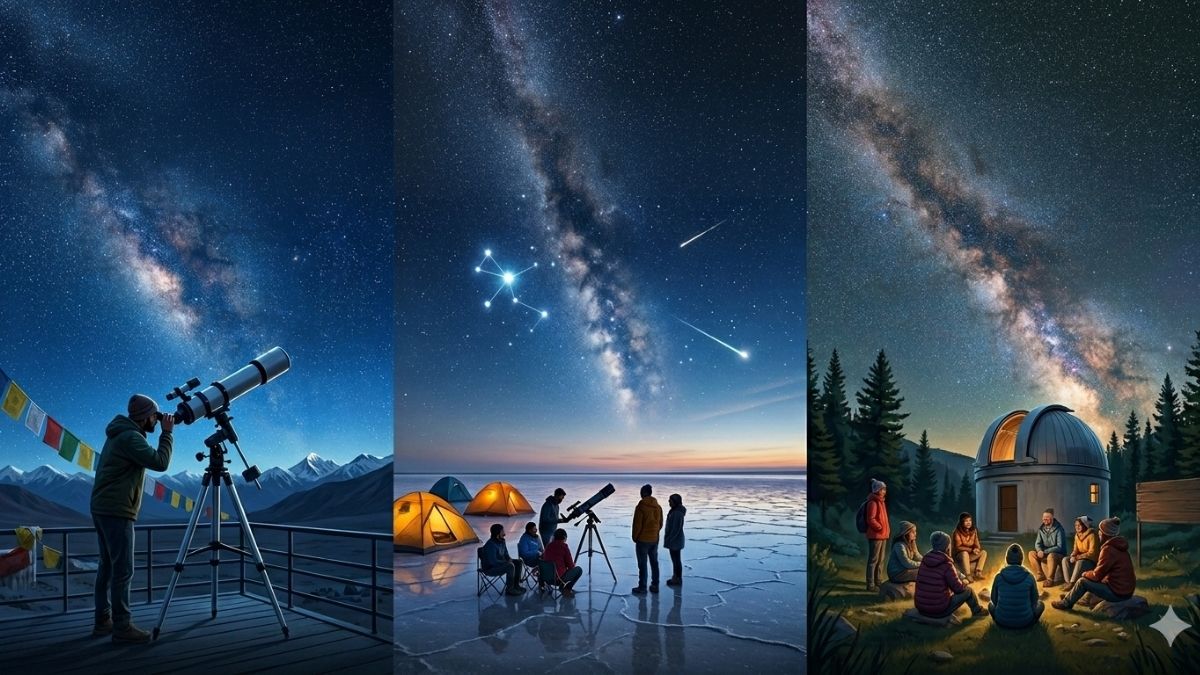
Nearly 78% of Indian travellers are interested in ‘noctourism’ or travel experiences centered around the night sky and after-dark activities, according to travel trend data cited by premier private observatory chain and astro-tourism platform Starscapes from Booking.com. As India rides a growing wave of fascination with space science fuelled by missions such as Chandrayaan and Artemis II, along with science-fiction films like Project Hail Mary, astrotourism is rapidly emerging from a niche hobby into one of the country’s fastest-growing experiential travel segments.
Across the Himalayas, deserts and forest reserves, travellers are increasingly planning vacations around stars, meteor showers and Milky Way sightings. From telescope camps in the salt deserts of Kutch to luxury stargazing retreats in Ladakh and astronomy observatories in Uttarakhand, India’s dark skies are becoming major tourism attractions.
“Astrotourism in India has evolved from being a niche, hobby-led activity into one of the fastest-growing experiential travel movements in the country,” said Jaishri Chadha, chief operating officer of Astroport India, one of India’s pioneering astrotourism companies. “Travellers are actively seeking dark-sky destinations and meaningful night-sky experiences that combine astronomy with hospitality, storytelling, local culture, wellness, nature and adventure.”
The boom reflects a broader shift in public interest toward space sciences. India’s recent space missions have transformed scientists into public figures, while social media is flooded with images of galaxies, meteor showers and lunar eclipses. Science fiction has further amplified curiosity around the cosmos, particularly among younger travelers. Industry players say the pandemic fundamentally changed travel behaviour, pushing people toward outdoor and nature-led experiences.
“After the pandemic, people turned towards nature. They observed the stars and the sky. Then there was a drastic change,” said Nishant Gor, director of Stargazing India, a Gujarat-based operator known for astronomy tourism in the Rann of Kutch. “Compared to pre-pandemic levels, we have seen growth of almost 100 times.”
Stargazing India began as an astronomy initiative launched by Gor’s father in 1991 through the Kachchh MHR Astronomers Club.
The company later became one of the first operators to integrate astronomy into mainstream tourism during the rise of Gujarat’s Rann Utsav.
“At that time, we asked ourselves what Kutch had that the rest of the world didn’t,” Gor said. “The answer was the sky.”
Today, the company runs astronomy sessions, ‘desert sky safari’ tours and customised astrophotography trips in Gujarat and Madhya Pradesh. During peak season at Rann Utsav, Stargazing India says it handles hundreds of visitors in a single night, with some new moon sessions drawing over 1,000 participants.
The rise of companies such as Starscapes reflects how quickly the sector is professionalising. Founded in 2017, the startup operates observatories and astronomy experiences in destinations, including Bhimtal, Kausani and Benital in Uttarakhand.
“Over the past few years, we have seen astrotourism in India evolve from a niche interest into a fast-emerging experiential travel category,” said Ramashish Ray, founder of Starscapes. “The strongest acceleration came post-pandemic, when travellers began actively seeking outdoor, immersive and meaningful experiences away from crowded urban environments.”
Ray said the customer base has widened dramatically. Families looking for educational and screen-free holidays, young professionals, astrophotographers, solo travelers and luxury experiential tourists are all contributing to demand. “Astro-tourism is no longer restricted to metro audiences,” he said. “What defines the audience is curiosity and interest in astronomy rather than geography.”
Mapping India’s Dark-Sky Hotspots
India’s geography is emerging as one of its biggest advantages in the astrotourism race. The high-altitude cold deserts of Hanle Dark Sky Reserve, which is India’s first Dark Sky Reserve, are considered among the best stargazing locations in the world because of minimal light pollution and exceptionally clear skies. Ladakh’s astro-tourism season typically runs from May to September, when roads remain accessible and skies stay dry.
Nearby regions such as Spiti Valley and Kibber in Himachal Pradesh have also become hotspots for astrophotographers and astronomy camps, particularly during summer and post-monsoon months.
In western India, the Rann of Kutch offers vast open skies and uninterrupted horizons, making winter months ideal for bright constellation viewing. Operators say the desert landscape allows visitors to experience nearly 360-degree views of the night sky.
Meanwhile, Uttarakhand is positioning itself as one of India’s leading astronomy destinations. The state hosts the Aryabhatta Research Institute of Observational Sciences in Nainital district and is developing observatories in Abbott Mount, Pithoragarh, Kausani, Jadhang and Takula.
According to Ray, destinations such as Kausani and Mukteshwar are currently among the strongest performers because they combine dark skies with relatively accessible tourism infrastructure. Ladakh, meanwhile, has emerged as a major market for deep-sky observation and astrophotography because of its altitude and sky quality. The company is also seeing strong interest in event-led travel centered around meteor showers, eclipses and planetary alignments.
“What stands out overall is that travellers are no longer treating astronomy as an add-on activity,” Ray said. “Increasingly, it is becoming one of the primary reasons influencing destination choice and travel planning.”
Counter-Vailing Current
While industry operators describe astrotourism as one of the fastest-growing experiential travel categories, tourism bodies say the segment is still at an early stage compared to more established sectors such as eco-tourism and adventure travel.
“Astrotourism, also known as dark-sky tourism, is still a fairly new trend in India,” said Rajiv Mehra, general secretary of Federation of Associations in Indian Tourism and Hospitality.
“Some destinations like Hanle and Pangong in Ladakh have become popular for astrotourism, attracting travellers interested in astronomy and students interested in astrophysics.”
Mehra said the sector is growing steadily, aided by increasing urbanisation and rising light pollution in cities, which are making remote dark-sky destinations more attractive to travellers seeking immersive experiences. However, he noted that astrotourism still remains smaller than eco-tourism and adventure tourism because those sectors already have mature ecosystems and established destinations.
According to Mehra, regions with high altitude, dry climates and tourism infrastructure are best positioned for commercial growth. He identified Hanle and Pangong in Ladakh, Spiti Valley, Rann of Kutch and Jaisalmer among the destinations with the strongest astrotourism potential. He also pointed to Coorg as an emerging candidate for astronomy-based tourism in southern India.
Travel companies now offer packages ranging from simple one-night telescope sessions to week-long astronomy expeditions that include astrophotography, village stays, observatory visits, desert safaris and astronomy storytelling.
Different seasons are now shaping travel patterns for astronomy tourists. Winter skies are preferred for bright constellations and crisp atmospheric conditions, while the Milky Way becomes far more visible between March and October. Ladakh and Spiti attract travelers during summer months, while Kutch and Rajasthan see peak activity in winter. Meteor showers and new moon weekends often witness the highest bookings.
Yet the industry faces serious long-term challenges. “The biggest challenge in scaling astrotourism is preserving access to truly dark skies,” Chadha said. “If destinations are not managed carefully, increasing tourism activity and artificial lighting can damage the dark skies that attract visitors in the first place.”
Light pollution is emerging as one of the sector’s biggest concerns, especially as tourism infrastructure expands into remote areas.
Still, industry players remain optimistic. Ray believes astrotourism aligns naturally with the future of sustainable and experience-led travel. “Travellers today are moving away from purely transactional tourism toward experiential and purpose-driven travel,” he said. “Astronomy naturally fits into this shift because it combines nature, science, storytelling, wellness and slow travel.”
Operators believe India could eventually emerge as a major global astrotourism destination alongside countries such as Chile and New Zealand because of its combination of dark skies, wildlife reserves, mountains, deserts and cultural tourism.