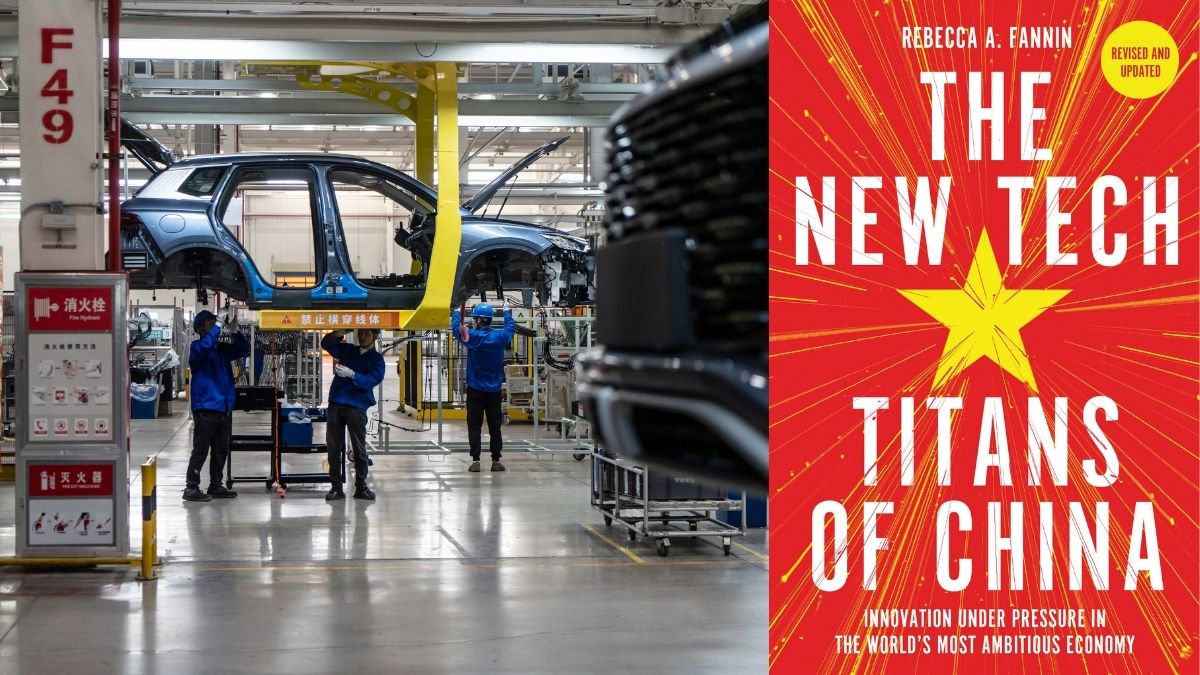
When Rebecca Fannin first published Tech Titans of China in 2019, the country’s technology sector appeared to be entering a golden age. Alibaba and Tencent dominated the digital economy, venture capital flowed freely, global investors were eager participants and China’s technology ambitions seemed constrained more by competition than geopolitics. Six years later, much of that world has disappeared. US sanctions have tightened, export controls have become a central instrument of policy, venture capital flows have fragmented and technological self-reliance has moved from aspiration to necessity. It is this changed scenario that Fannin has substantially revised and updated her edition — The New Tech Titans of China: Innovation Under Pressure in the World’s Most Ambitious Economy.
The book’s significance lies less in its attempt to chronicle China’s technology sector than in its effort to explain how that sector is adapting to a world that is increasingly trying to constrain it. Earlier accounts of China’s rise often focused on how the country built technological capabilities. Fannin’s updated work examines a different question: Can China continue innovating when access to technology, capital and markets can no longer be taken for granted?
Fannin recognises that the story of Chinese technology in current times is no longer primarily about internet platforms. The centre of gravity has shifted. While Alibaba, Tencent and Baidu continue to feature in the narrative, they no longer define it. Instead, the book turns its attention to electric vehicles, artificial intelligence, robotics, advanced manufacturing and semiconductors. This shift mirrors developments in the real economy, where China’s ambitions increasingly extend beyond consumer internet services to strategic technologies that underpin industrial competitiveness.
The strongest sections of the book deal with electric vehicles and AI. Fannin highlights that China has moved beyond being a fast follower in these sectors and has emerged as a genuine innovator. The success of companies such as BYD, Nio and XPeng is presented not as an isolated achievement but as evidence of a broader ecosystem encompassing batteries, software, manufacturing capabilities and policy support. Whether one agrees entirely with her conclusions or not, she makes a persuasive case that China’s technological strengths today rest on a much wider foundation than many western observers acknowledge.
Artificial intelligence receives similar treatment. Here, the author avoids the temptation to frame the debate as a simplistic race between the US and China. Instead, she highlights the ways in which Chinese firms are deploying AI across manufacturing, logistics, healthcare and consumer services. Her argument is that innovation should not be measured solely by breakthroughs in foundational models but also by the ability to commercialise and scale technologies across an economy. In that respect, China possesses advantages that deserve attention.
Perhaps the most interesting aspect of the book is its treatment of pressure itself. Fannin contends that sanctions and restrictions, rather than derailing Chinese innovation, have accelerated efforts to build domestic capabilities. Nowhere is this more evident than in semiconductors, where export controls have exposed vulnerabilities while simultaneously prompting enormous investment in indigenous alternatives. The book does not suggest that China has solved its semiconductor challenge. Rather, it says that external pressure has reinforced the strategic imperative of self-reliance.
This focus on adaptation distinguishes the revised edition from its predecessor. The original book was written during a period when technological globalisation appeared largely irreversible. The updated version reflects a world in which technology has become a theatre of geopolitical competition. Supply chains, capital flows and access to advanced technologies are increasingly shaped by national security considerations. Fannin is at her best when documenting how Chinese companies are responding to these new realities.
The book also benefits from the author’s extensive reporting and access to entrepreneurs, investors and executives. Fannin has covered China and technology for decades, and that familiarity is evident throughout. The narrative moves comfortably between boardrooms, venture capital circles and policy developments, offering readers a broad overview of an ecosystem that is often misunderstood outside China.
State-Led Blindspots
The book’s prime weakness is that it has not dwelt enough on the costs and trade-offs of state-led innovation as much it has on China’s technological successes. Fannin is an effective chronicler of China’s advances, but she is less interested in examining the inefficiencies, distortions and risks that can accompany heavy policy intervention. Questions surrounding capital allocation, overcapacity and the sustainability of state-backed industrial strategies receive comparatively limited attention. Readers seeking a more sceptical assessment of the Chinese model may, therefore, find the treatment somewhat uneven.
There is also a tendency at times to view developments through the lens of technological achievement rather than economic outcomes. Innovation is undoubtedly important, but the relationship between technological leadership and broader economic performance is often more complex than the book acknowledges. A deeper exploration of these tensions would have strengthened the analysis.
However, the book arrives at a time when China occupies a central place in debates about technology, trade and industrial policy. Understanding the country’s innovation ecosystem is no longer a niche interest for technology specialists. It has become essential for policymakers, investors and businesses across the world.
The real value of the book is in showing how the story of Chinese technology has evolved. The question is no longer whether China can innovate. The evidence presented by the author suggests that it can. The more consequential question is whether it can sustain that innovation in a world increasingly defined by technological rivalry and strategic competition.
The New Tech Titans of China: Innovation Under Pressure in the World’s Most Ambitious Economy
Rebecca Fannin
Hachette
Pp 256, Rs 599