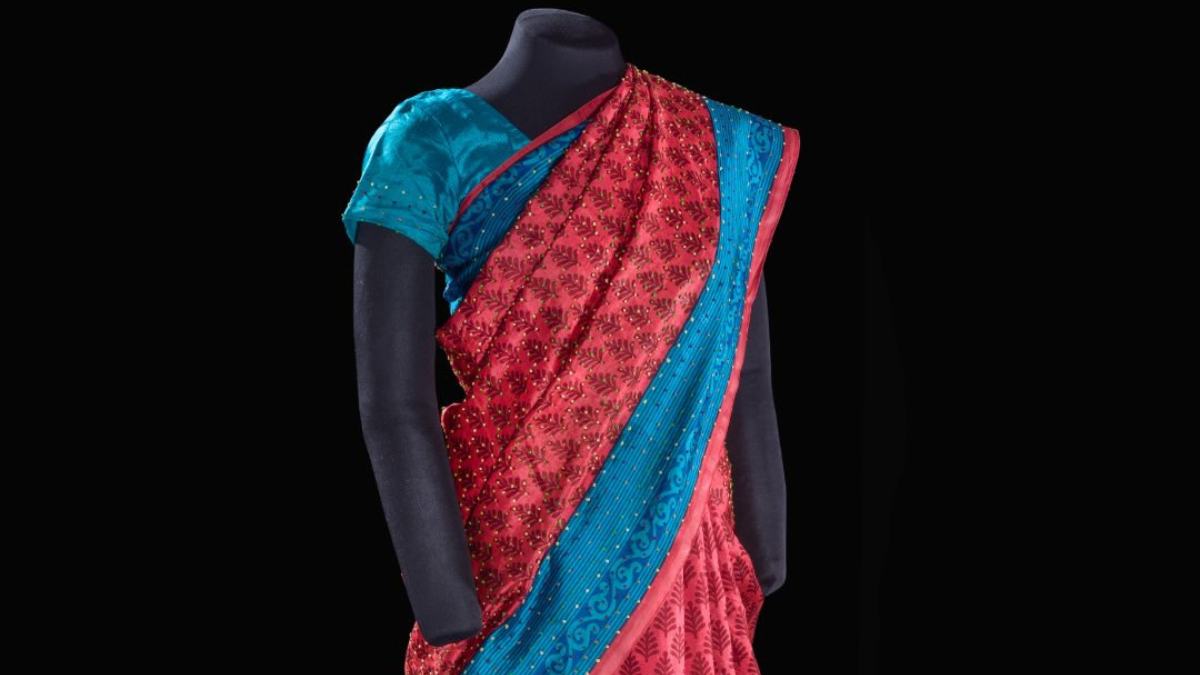
Inside the Smithsonian National Air and Space Museum in Washington, D.C., among artefacts that chronicle humanity’s greatest journeys beyond Earth, hangs a saree.
Not a spacesuit or a satellite component, but a six-yard drape of red and blue fabric that once belonged to an Indian scientist who helped send her country’s first spacecraft to Mars.
This is less unusual than it sounds. The museum’s Space History department actively collects artefacts from foreign space programmes, and alongside its aircraft and spacecraft, it preserves oral histories, diaries, works of art, and records — anything that captures the human experience behind aerospace history. A garment worn at a defining moment qualifies on exactly those grounds
`
The story of how Nandini Harinath’s saree ended up in one of the world’s most prestigious science museums is as much about identity and symbolism as it is about space exploration.
The woman behind the mission
Harinath served as project manager, mission designer, and deputy operations director on the Indian Space Research Organisation’s (ISRO) Mars Orbiter Mission, widely known as Mangalyaan.
Her path to the stars began, unexpectedly, in front of a television set. “My mother is a maths teacher and my father is an engineer with great liking for physics and as a family we were all so fond of Star Trek and science fiction that we would sit together and watch it on TV,” she has said.
At the time, a career in space science was the furthest thing from her mind. “For me at that point of time, I was watching science fiction movies, reading books, watching Star Trek,” she recalled in an interview. It was only much later that she found herself heading one of the most watched missions in India’s scientific history.
ISRO was the first job she ever applied to, and over the course of over two decades, she went on to work on 14 missions. Mangalyaan, however, would become the mission that placed her — and her saree — in the global spotlight.

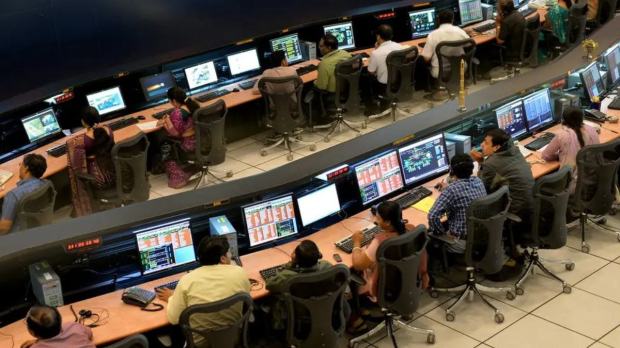
The success of Mangalyaan made India the first Asian country and the fourth country in the world to reach Mars — and, as ISRO has pointed out, the first to do so on the very first attempt. The mission was originally intended to last six to ten months, but Mangalyaan continued operating for over seven and a half years.
What made the achievement even more striking was its cost. At just $74 million, India’s space agency put the satellite into orbit for a fraction of what other nations had spent — compared to the U.S. MAVEN satellite, which cost $671 million.
As CNN reported at the time, Prime Minister Narendra Modi himself noted that even the Hollywood thriller Gravity had a larger budget, at $100 million. It was, by any measure, the most cost-effective Mars mission ever flown.
The saree that went viral
Harinath wore the saree in mission control during the spacecraft’s successful trans-Mars injection manoeuvre on November 30, 2013, when the spacecraft left Earth’s orbit on a path to intersect Mars — the first critical operation after Mangalyaan’s launch.
When Mangalyaan reached Mars orbit in September 2014 and transmitted its first images, it was the photographs from ISRO’s mission control that captivated the world just as much as the images from space.
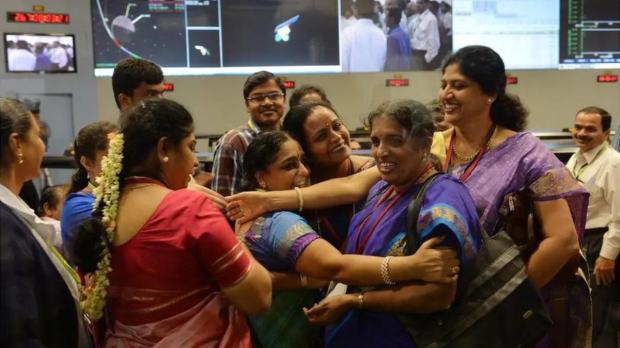
Images of Indian women in colourful sarees in ISRO’s mission control became instantly iconic — evidence, as the Smithsonian itself noted, of the increasingly global character of space exploration, and of the importance of women in spaceflight’s present and future.
International publications from science journals to fashion magazines picked up the imagery, with many noting that these scientists had shattered the idea that a certain kind of dress or appearance defined who got to do serious science.
For Harinath herself, the attention around gender was something she quietly resisted. “I would like to be known as a scientist, not a woman scientist,” she has said. “It’s a myth that women aren’t interested in maths and science.”
A gift to history
In 2021, Harinath donated the saree to the National Air and Space Museum of the Smithsonian Institution. It is now on display as part of the museum’s Futures in Space gallery.
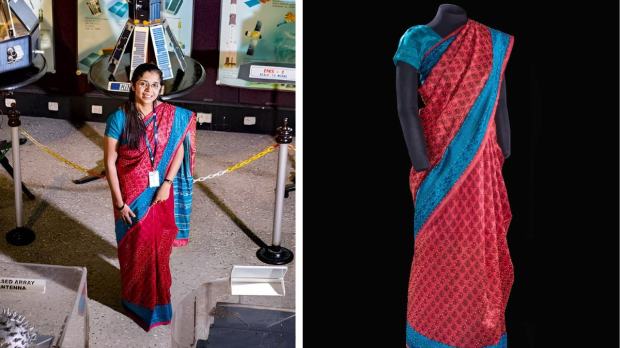
The acquisition was not accidental. Matt Shindell, space history curator at the museum and co-host of the museum’s AirSpace podcast, explained that he had actively sought out representation for the Mangalyaan mission:
“I really wanted that mission to be represented in this gallery as an example of how other nations are now doing more ambitious things in space. And this becomes really important to national pride. I started reaching out to folks who knew the women who had worked on the Mars Orbiter Mission at the Indian Space Research Organization, and I eventually got connected with Nandini Harinath.”
As Shindell told the BBC separately, “I felt it would be a great story to tell, the story of these ‘Rocket Women’ who were at the front and centre of this important mission.”
Once the saree arrived at the museum, it required careful preparation before going on display. Textiles conservator Beth Knight watched YouTube videos to learn how to drape it correctly on the mannequin — a small but telling detail about the care taken to treat the garment as a serious historical artefact.
The Smithsonian’s own collection page describes the garment as a saree worn during a defining moment in India’s space history and situates it within a broader narrative about global participation in space exploration. In her own words, as documented by the Smithsonian, Harinath explained the significance of the donation: “The saree is symbolic of the modern Indian woman and this one [is] dedicated to all those who worked on the Mangalyaan mission.”
The Smithsonian has acknowledged that the sarees worn by ISRO’s women scientists were not just regular workday outfits — they represented India’s achievements on a global stage, and challenged assumptions about what the face of science looks like.
Shindell has drawn a direct parallel between the saree and other garments in the museum’s collection worn at defining moments, noting that the gallery also holds the blue t-shirt Sally Ride wore aboard the Space Shuttle — objects that tell the story not just of missions, but of the people who made them possible.
More than an exhibit
The Futures in Space gallery was designed around three central questions: who goes to space, why go, and what should we do when we get there. Shindell has described the gallery’s curatorial intent as wanting to show that “other nations are now doing more ambitious things in space” and that national pride and representation are as central to the story of space exploration as the engineering itself. Harinath’s saree sits squarely within that vision.
Harinath’s saree now sits alongside some of the most celebrated objects in aerospace history, from moon rocks to Neil Armstrong’s spacesuit, as proof the idea that the story of space belongs to everyone. Her message to the next generation has always been consistent: “All of you should have a dream. But make sure you have a passion to drive that dream.”
Harinath’s work did not stop with Mangalyaan either. In the years that followed, she led the operations team at ISRO’s Telemetry Tracking and Command Network Centre, overseeing missions including Chandrayaan-3 and Aditya L1.
Her career is a thread connecting India’s early satellite ambitions to its most celebrated interplanetary achievements — and one end of that thread is now permanently preserved in Washington, D.C., draped across a museum mannequin in six yards of red and blue.