




On most evenings, after office hours (hopefully), India’s large and restless young workforce converges online on Reddit’s ‘MBA India’ community. In the anonymous room shaped by anxiety and ambition, the same question appears week after week, worded differently, but with the same undertone: “Is an MBA still worth it?”
The responses are half-cynical, half-hopeful. Some users insist the degree is a “scam for the insecure”. Others argue it is “the only escape for an upgrade”. Many warn that the job market is unforgiving, and AI has changed everything. A few soothing voices say the MBA is evolving, not dying, but even they admit the uncertainty is daunting.
This tension between old prestige and new doubt captures the mood of 2025 and beyond. Once the surest route to corporate stability, the MBA is facing its toughest identity test in decades. Layoffs are hitting precisely the layers MBAs used to dominate. AI is swallowing tasks they once owned. And employers are demanding new kinds of skills, new kinds of thinkers, and in many cases, fewer managers. And yet, paradoxically, India’s top business schools have rarely been more competitive. The question, then, is not whether the MBA is disappearing. It is what an MBA needs to become to remain valuable.
Internal rate of return
The numbers that fuel Reddit fears are real enough. Layoffs in tech and adjacent industries continue at a scale unseen since the 2008 crisis. According to layoffs.fyi, 122,549 tech employees have been laid off globally so far in 2025, following nearly 153,000 in 2024. This cycle has struck deeper and higher in organisational charts. “It wasn’t the juniors, it was the mid-level and senior people. Almost 50% of anyone with a senior title,” says one manager who lost his job. He later discovered his role had been quietly reposted, in Mexico.
This flattening is part of a larger shift. Departments that once needed three layers now operate with one. AI systems are generating reports, identifying trends, writing memos, processing customer queries, and in some cases, advising executives on strategic options.
A recent KPMG survey of Indian CEOs underlines this shift. While 65% of the respondents say AI is their top investment priority, 34% cite the digital skills gap as a challenge. About 81% say AI has changed the skills required for entry-level roles.
Companies no longer just want analysts but want people who understand how AI works, when not to trust it, and how to make judgments AI cannot. It would be logical, then, to assume that the MBA would be losing relevance. But the reality on the ground is surprisingly different.
IIM Ahmedabad, the oldest of India’s IIMs, is overflowing. Its flagship programme has 675 students, including 231 women, far above its sanctioned intake. It placed 424 graduates last year with a median salary of Rs 30 lakh.
IIM Bangalore enrolled 1,139 students in MBA-equivalent programmes. Every one of the 517 students who graduated on time was placed. The median salary? `33 lakh. And its executive education arm, which are programmes designed largely for mid-career and senior professionals, trained 4,278 individuals and brought in `89 crore. At the Indian School of Business (ISB) in Hyderabad, the Class of 2025 is an impressive international-style batch: 816 students, average age 27, average GMAT 719, nearly four years of experience. In the placement season, 364 companies made 1,164 offers, including 37 international roles across West Asia, Africa, Southeast Asia and Europe. And the Class of 2026 is 53% women.
Clearly, something more complex is happening. The institutions that adapt quickly are thriving. The ones that don’t risk fading into irrelevance.
The shift is happening
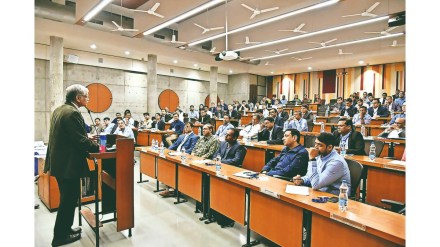
If you walk into an MBA classroom today, at an IIM, ISB, IIT, or a premium private school, the changes are visible immediately. The old case-study culture is still there, but it now sits beside dashboards, machine-learning simulations, ethics modules for algorithmic decisions, and assignments built around generative AI.
At ISB, the shift is intentional and philosophical. “We view AI, data analytics and digital transformation as core managerial capabilities, not technical specialisations,” says Professor Deepa Mani, deputy dean of academic programmes. For her, the analogy is clear: a manager who cannot work comfortably with AI in 2030 will be as disadvantaged as a manager who didn’t know Excel in 2005. ISB has embedded AI across disciplines. The school is piloting AI-based adaptive learning tools, software that tailors content to each student’s pace and problem areas.
Similar changes ripple across the country. IIT Indore launched an Executive PG Diploma in Management & AI. IIT Roorkee offers quantum-computing certificates linked to AI applications. BITS Pilani has introduced an MBA in AI for Business.
The boldest move comes from IIM Ahmedabad, which now offers India’s first two-year blended MBA in Business Analytics & Artificial Intelligence, a programme that feels like a response to ChatGPT-era anxieties.
Its chairman, Professor Anindya Chakrabarti, connects it to a broader moment in scientific history: “When AlphaFold cracked the protein-folding problem, it showed how data and machine learning can unlock entirely new worlds. These advances are a call to action, to develop leaders who can apply data-driven thinking to solve critical problems.”
MBA faculty across institutions insist, however, that technology alone does not define what a manager is. For many, the real frontier lies in teaching judgment, not code. At IIM Bengaluru, Professor Suresh Bhagavatula argues that the real intellectual work of management education happens elsewhere, not in tools but in thinking. Students rarely remember the granular details of a class years later, but they retain the frameworks and reflexes that help them navigate complexity.
In other words, the “finished product” coming out of IIMs or ISB is no longer the stereotypical spreadsheet-wielding analyst. It is someone who can think with AI, challenge its outputs, navigate people and politics, make decisions in grey areas and learn continuously. These skills are not on YouTube. And that is precisely why the conversation is so conflicted.
Into this churn come the loudest critics of traditional education, India’s startup founders. No one has drawn more attention than Nikhil Kamath, co-founder of Zerodha, whose comments triggered debates in the past couple of months.
“Colleges are dead,” he said. “If you’re 25 and going to an MBA college today, you must be some kind of idiot. Everything you’re taught is free on YouTube.”
Kamath believes the internet has eroded the scarcity that once justified the MBA’s cost and duration. “Everything you are taught in an MBA college,” he said, “is available for free on YouTube.” With AI tools like ChatGPT, learners no longer need structured courses to analyse case studies or understand business models.
Many young professionals agree. After all, some of India’s most successful founders, such as Oyo’s Ritesh Agarwal, Ola’s Bhavish Aggarwal, Zomato’s Deepinder Goyal, or Zoho’s Sridhar Vembu, never pursued MBAs.
But here is what online education cannot easily replicate. A peer group that challenges you or a network that changes your career trajectory. No YouTube playlist can replace that ecosystem.
Vineeta Singh, founder of SUGAR Cosmetics and an IIM Ahmedabad alumna, articulates this balance clearly: “I would still choose IIM-A because the two years changed how I think and gave me confidence that helped throughout my career. But I would be more intentional about why I am doing it and how I use the experience. The world has changed, but the value of great peers and intense learning has not.”
As an employer, she looks for something more than credentials: “I look for clarity, ownership and the ability to learn fast. An MBA is useful, but it is not a guarantee of readiness. The core skills B schools focus on like structured thinking, communication and understanding business fundamentals are still relevant, but startups also need hustle, bias for action and resilience. I try to see whether the candidate can move from theory to execution.”
A degree for reinvention
The future is not a battle between MBAs and AI. It is a hybrid world where MBAs, micro-credentials, AI fluency, apprenticeships and industry partnerships coexist.
TimesPro, an EdTech that offers professional education and training programmes to help individuals with career growth, exemplifies this shift. According to Varun Dhamija, its chief digital strategy officer, companies are grappling with acute skill shortages in areas such as digital transformation, data analytics, AI and emerging technologies. “Our collaborations have evolved into industry-academia models designed to close these gaps,” he says. “We combine academic rigour with market intelligence so organisations can build future-ready talent pipelines.”
The company now co-creates curricula with IITs and IIMs, embedding modules on generative AI, cloud computing, digital strategy, machine learning, and data-led decision-making. These programmes use simulations, real-world case studies and capstone projects to ensure participants grapple with current business challenges rather than academic hypotheticals.
Dhamija says learner behaviour has changed dramatically since Covid. Professionals are no longer pursuing education for credentials alone. They want structured upskilling, career transitions, entrepreneurial knowledge and leadership pathways that help them stay competitive. Non-tech to tech transitions and mid-career shifts into digital leadership roles are especially in demand.
Over 6,000 professionals have completed IIM Kozhikode’s digital transformation programmes through TimesPro. Many now work in data science, product, AI/ML, or innovation roles. Companies notice the difference not on resume, but in performance.
This modular learning model is likely to strengthen, not weaken, business schools. Executive MBAs and micro-credentials are becoming on-ramps to advanced programmes. Companies are increasingly funding short courses rather than full degrees. And mid-career professionals who do not want to step out of the workforce are choosing hybrid options.
Meanwhile, students entering full-time MBAs appear more cautious and more intentional. When a friend of mine, Chirinjibi Thapa applied to MICA Ahmedabad during the pandemic, he was working in a media company’s market desk. The decision was not easy.
“The cost was not just the fees,” he says. “The mental cost was the do-over anxiety, starting over as a fresher after half a decade in a job.” His calculus included opportunity cost, market uncertainty and the value of MICA’s creative-plus-corporate blend. Speaking to alumni helped. “The potential designation bump and financial compensation made it worth the risk.”
Looking back, he still believes those motivations hold, though he is quick to point out how quickly marketing has evolved. Even during his time, the conversations around AI and digital transformation were accelerating. Today, he says, B-schools must move faster to capture the pace of innovation.
For Sony Thomas, who pursued an MBA at Saintgits in Kerala with an HR specialisation, the decision was driven by mobility and skill-building. But the job market even then was uneven. “HR has traditionally offered fewer opportunities and lower starting salaries,” she says. “Compared to today, it hasn’t changed much.” The layoffs of the last two years have made the market “highly unstable”, especially in consulting.
What has changed, she says, is that companies have become more selective about skills. Practical exposure, internships, digital fluency and demonstrable competencies matter more now than the credential itself. Her own programme was theoretical, but newer cohorts, she notes, have access to live projects and AI-centric content that reflects industry demand.
The real shift is that an MBA is seen less as a ticket and more as a launchpad for reinvention. And reinvention is exactly what the degree now aims to deliver.
Entrepreneur vs employee
Even India’s entrepreneurship landscape has been reshaped dramatically in the years before and after Covid. Before the pandemic, India was already showing a steady rise in entrepreneurial appetite. The Global Entrepreneurship Monitor (GEM) 2018–19 report recorded that nearly 50% of adults saw good opportunities to start a business and 52% believed they had the capability to do so. Entrepreneurial intention had doubled to 20.6%, and early-stage entrepreneurial activity rose to 11.4%.
Yet this was still a phase where entrepreneurship was driven as much by circumstance as by optimism; almost 46% of new ventures were necessity-driven, and fear of failure remained high at 50.1%. Founders tended to be young, often between 25 and 34 years, with a substantial share coming from engineering or MBA backgrounds, a pattern that reflected the belief that structured education was the safest springboard into business.
Covid scrambled that pattern entirely. The GEM India 2022–23 findings show a post-pandemic landscape where entrepreneurship not only rebounded but broadened. More founders today are opportunity-driven, pulled in by digital models that require low upfront capital such as cloud kitchens, small D2C brands, creator-led services, edtech tutoring, teleconsultations, hyperlocal logistics. The typical founder is now younger, more digitally fluent and far more comfortable with AI tools and analytics. As TimesPro’s Varun Dhamija observes, “Professionals now prioritise structured upskilling to remain competitive… with strong demand for transitions into tech, digital roles and entrepreneurial tracks. Employers want applied, job-ready capabilities, not pure theory.” This shift explains why engineering, design and analytics backgrounds dominate the post-Covid founder base.
The motivations have changed as well. While pre-Covid ventures often emerged from limited job options, post-Covid founders are driven by agency and possibility. Remote work, online marketplaces and rapid AI-enabled prototyping have lowered risk and encouraged experimentation. “People become passionate as they go along… What matters is reflection, the ability to learn from cues. Passion can become mindless. Reflection cannot,” says IIM Bangalore’s Professor Bhagavatula. The remark captures the deeper post-pandemic truth: entrepreneurship today rewards the reflective learner who can absorb change, not the person who simply has an idea.
Even experienced founders acknowledge this shift. Vineeta Singh of SUGAR Cosmetics says the emotional and cognitive demands of entrepreneurship changed more than the tools. “IIM-A taught me discipline and problem solving. What it did not prepare me for was the emotional volatility of entrepreneurship. Things like dealing with failure, self doubt, cash flow panic and leading teams through chaos only came from real experience.”
So, is the MBA still relevant? Well, the MBA is not dying but being rebuilt for an AI-shaped world. It is no longer the only path but neither is it an outdated one.
And for the young professionals on Reddit asking the big question, Is an MBA still worth it?, the answer is no longer binary. It’s a deeper, more personal one: What skills do you want to build, what career do you want to shape, and which learning path, MBA or AI-powered alternative, gets you there fastest?


