




The Indian Institute of Management (IIM) Bangalore continues to hold the title of India’s best B-school in major global listings, ranking 28th in the FT Masters in Management 2025 and 30th in the QS Business Master’s Rankings 2026. But in the national NIRF rankings, it consistently trails IIM Ahmedabad.
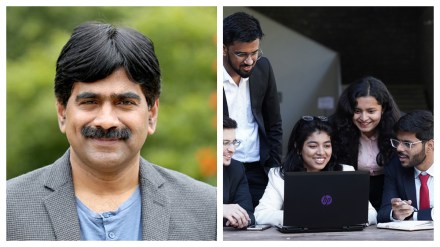
According to U Dinesh Kumar, director in-charge at IIM Bangalore, this disparity often stems from differing metrics, with the NIRF focusing on national contributions, and global rankings on competitiveness.
“As a B-school, we have certain obligations, such as creating talent that is interdisciplinary and relevant, and that is the main focus. Once that happens, everything follows,” Kumar said. He emphasised the institute’s focus on “impact research – not just publishing some paper, but tracking the impact those publications are making,” noting that such initiatives are valued highly by global rankings and supported by the board.
New campus
The institute has opened a new campus in Jigani, roughly 20 km from the main site. Addressing why the expansion remained within Bangaluru rather than underserved regions like northern Karnataka, Kumar explained the logistical and financial realities.
“In Jigani, we got the land for free from the Karnataka government, and are investing Rs 1,200 crore just on developing the campus,” he said. He added that while they might have developed elsewhere had land been provided, attracting talented faculty to Bangaluru is significantly easier than to remote locations.
But Kumar hinted at future outreach. “Having said that, we can create satellite campuses, maybe somewhere near Hubli,” he said. He described satellite campuses as “location convenient” hubs for executive education, similar to IIM Kozhikode’s presence in Kochi or IIM Trichy’s in Chennai, which are economically beneficial and save time for participants.
New UG programmes
Marking a first for the institute, IIM Bangalore is launching a four-year undergraduate programme called the Bachelor of Science (Honours).
“It is starting with data science and economics,” Kumar said. “The batch size is 80 students – 40 each in BSc (Hons) in Economics, and BSc (Hons) in Data Science.”
Admission requires candidates to have passed class XII with Mathematics as a compulsory subject. Selection will be based on the IIMB Undergraduate Admissions Test (60% weightage) and a personal interview (40% weightage).
Sustainability goals
IIM Bangalore stands as one of the few B-schools in India with set net zero targets. Kumar described the main campus as the “lifeblood of Bengaluru,” featuring thousands of trees and 75 recharging wells that have raised the regional groundwater level by 13 feet.
“We’re also moving towards green energy. But a lot more can be done. That’s why the new campus has sustainability in its blueprint,” Kumar said. The institute has set a Scope 2 emissions target (indirect, from electricity) for 2030, and a Scope 1 emissions target (direct, campus operations) for 2035.
Student diversity
When asked about the lower international student presence at Indian campuses compared to western universities, Kumar pointed to the rigorous entry barriers. “The top IIMs are highly selective. Getting into such IIMs requires CAT percentile of 99.7 – it’s far tougher than SAT or GMAT,” he noted. He also highlighted the intensive curriculum, where failing to meet the “2 CTPA” cutoff results in a student being out of the system. While the primary focus remains serving Indian students, Kumar stated that international immersion programmes bring students from dozens of countries to the campus.
Financial health
Financially, the institute remains self-sustaining, having last taken government grants nearly 20 years ago. The latest data for the year ended March 31, 2024, notes a total income of Rs 348 crore, of which Rs 301.34 crore was from academic receipts, and the rest from investments, grants/subsidies, and interest. The total expenditure stood at Rs 238.23 crore, covering staff payments, academic expenses, and infrastructure maintenance.
The institute also continues to expand its reach through IIMBx on edX, ensuring quality management education reaches students in smaller towns who cannot afford to attend in person.


