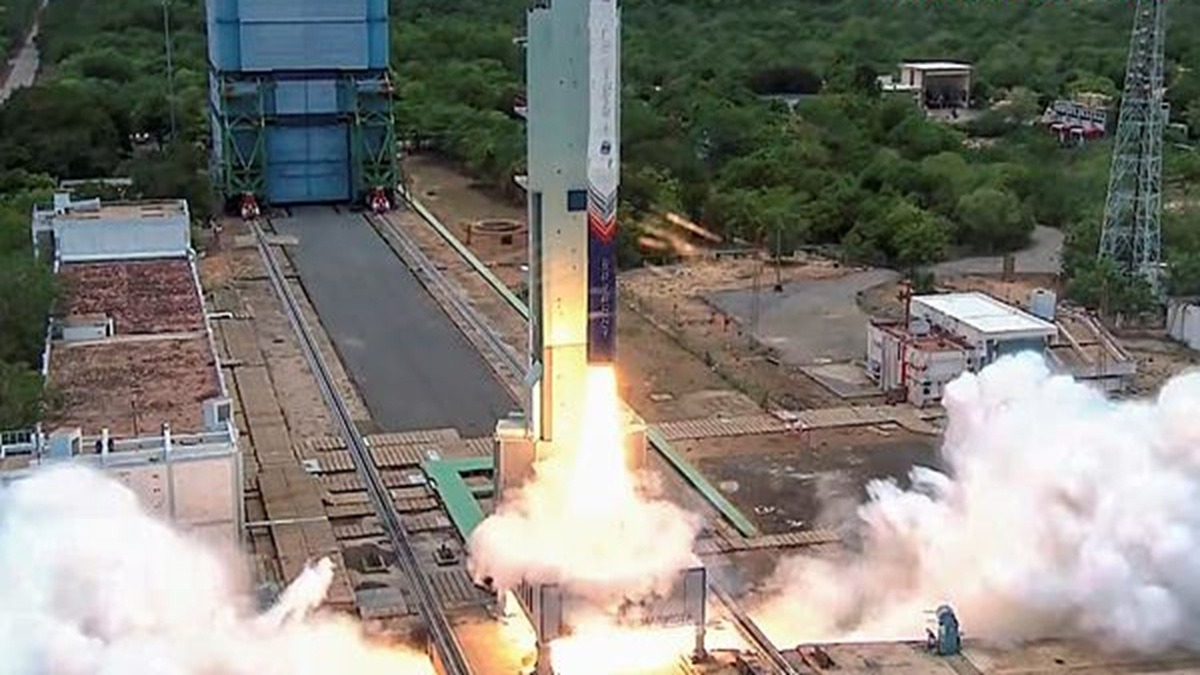
Skyroot Aerospace’s Vikram-1 Test Flight-1 successfully reached orbit on July 18, marking the maiden flight of India’s first privately developed orbital-class rocket and a major milestone for the country’s space industry. The mission, named ‘Mission Aagaman‘, launched from the Satish Dhawan Space Centre in Sriharikota, a barrier island off the coast of Andhra Pradesh. The 24-metre carbon-composite rocket completed its planned sequence of flight stages and injected its payloads into a nearly 450-km orbit.
ORBIT ACHIEVED. 🚀
Vikram-1 Test Flight-1 has reached orbit. India's first privately developed orbital rocket has completed its final burn and injected its payloads into a ~450 km orbit, making India the third country in the world with private orbital launch capability.…
— Skyroot Aerospace (@SkyrootA) July 18, 2026
The rocket’s three solid-fuel stages performed as planned, beginning with Kalam-1200, which carried Vikram-1 through the densest part of the atmosphere before separating cleanly. The payload fairing then separated, exposing the payloads to space. Next, Kalam-250 completed its burn and separated, followed by the ignition of Kalam-100, the smallest and highest-flying solid stage in the vehicle. The solid-propulsion phase ended with Stage 3 separation, allowing the Orbital Adjustment Module to complete the final push to orbit using its 3D-printed liquid engine.
Skyroot said Vikram-1 is designed to deploy payloads of up to 350 kg into a 450-km low Earth orbit and combines three solid-fuel stages with a liquid orbital adjustment module that can start, stop and restart in space. The maiden flight carried multiple payloads, including the lab-grown Diamond Lotus from Bengaluru-based Cosmos Diamonds, as well as a handwritten postcard from Prime Minister Narendra Modi bearing the words “Vande Mataram.”
Vikram-1 underscores India’s push towards $44 billion space economy by 2033
Standing about 22 metres tall, Vikram-1 is designed to carry payloads of up to 350 kg into low-Earth orbit using three solid-fuel stages and a liquid-fuel orbital adjustment module powered by a 3D-printed engine, technologies the company says are being flown for the first time in India.
The launch also comes against the backdrop of India’s push to grow its share of the global space economy to $44 billion by 2033, up from about $8 billion now, as the government looks to private companies to compete in the global small-satellite market dominated by players in the US, Europe and China. Founded in 2018, Hyderabad-based Skyroot Aerospace had already made history with its Vikram-S suborbital mission in 2022, and now aims to move from test flights to regular commercial launches.
PM Modi, other leaders hail success of Vikram-1
Prime Minister Narendra Modi congratulated Skyroot Aerospace after the successful launch, telling company CEO Pawan Kumar Chandana and co-founder Naga Bharath Daka over the phone that the mission showed India’s ability to build space systems with indigenous talent and effort. Chandana responded that the rocket was “completely designed and made in India,” and added that the Prime Minister’s postcard had successfully reached orbit. “Vande Mataram is in orbit,” he said.
Spoke to the team of Skyroot Aerospace and congratulated them on the successful launch of Vikram-1.
This is a defining moment in India’s space journey. The growing participation of our private sector is opening new frontiers and accelerating innovation.
This achievement will… pic.twitter.com/epWjOY8yKa
— Narendra Modi (@narendramodi) July 18, 2026
External Affairs Minister S Jaishankar called the launch “truly historic,” saying India’s space ambitions had soared to new heights and describing the mission as proof of what can happen when youthful innovation and entrepreneurial drive are backed by bold reforms.
Union Minister of State for Science and Technology Jitendra Singh said the success reaffirmed India’s rise as a global space player, noting that the country’s space economy could grow substantially in the coming years. He added, “Today’s successful launch is a reiteration of India’s entry as a global player in the highly competitive arena of space economy.”
#WATCH | Delhi: Union Minister of Science and Technology Jitendra Singh celebrate as India’s first privately developed orbital rocket, Vikram-1, has successfully reached orbit after completing its final burn and injecting payloads into a 450 km orbit.
The milestone makes India… pic.twitter.com/5ns7Sr5FqP
— ANI (@ANI) July 18, 2026
Skyroot’s 24-metre Vikram-1 combines lightweight carbon-composite construction
Vikram-1 is a 24-metre, multi-stage rocket built with an all-carbon-composite structure and powered by three solid-fuel stages plus a liquid orbital adjustment module. Skyroot said the vehicle is designed to place payloads of up to 350 kg into a 450-km low Earth orbit with a 60-degree inclination, while also testing technologies such as 3D-printed engines, modular stage separation, and lightweight manufacturing.
For Skyroot Aerospace, the launch capped years of development and testing, marking a breakthrough moment for India’s private space ecosystem. The company has positioned Vikram-1 as a launch vehicle for rapid and on-demand small satellite services, with the mission serving as a demonstration of both technical capability and commercial ambition.
An employee at Sriharikota described the emotional intensity of the launch, saying, “Our hearts were pounding like anything… The delay took our hearts… We are so happy… Everyone put their heart and soul into this project…” The reaction captured the sense of anticipation around a mission that not only delivered a successful orbital insertion, but also signaled a new chapter for private Indian spaceflight.