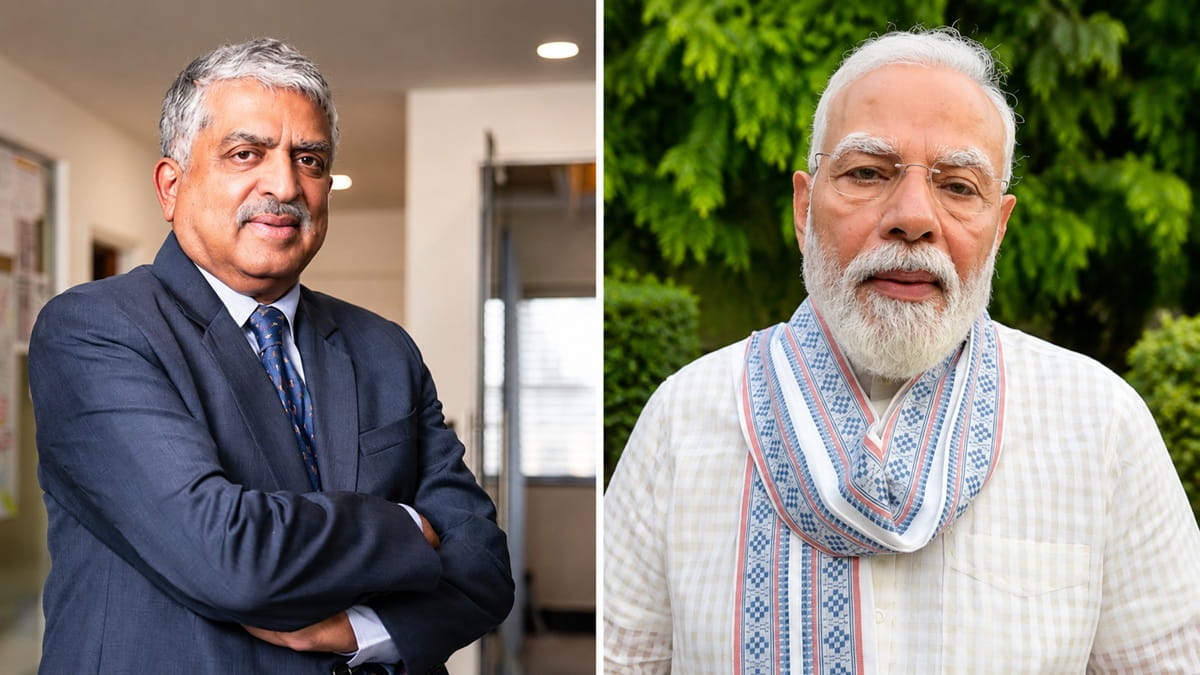
Prime Minister Narendra Modi on Sunday announced the formation of a high-powered task force under the leadership of technocrat Nandan Nilekani to recommend reforms aimed at making India’s examination system more transparent, reliable and technology-driven. This announcement comes amid growing concerns over the credibility of competitive examinations and protests that erupted across the country following the resignation of Union Education Minister Dharmendra Pradhan.
In a video message shared on social media, PM Modi said the government was taking several measures to safeguard the future of students and strengthen the examination system.
“Those who tampered with the students’ future are languishing in jail. We have already established fast-track courts. We are also moving towards enacting new legislation in Parliament that incorporates stringent legal provisions,” PM Modi said.
Stressing on the need for long-term reforms, PM Modi said India’s examination system must be made more reliable and transparent while making greater use of technology.
“Keeping all these factors in mind, we have decided to constitute a high-powered task force under the leadership of the world-renowned technology expert Nandan Nilekani,” he said.
The task force will focus on examination reforms and submit recommendations to strengthen the credibility of upcoming examinations. The government will take further steps based on the panel’s report, PM Modi added.
PM announces fast-track courts, tougher law
The Prime Minister said the government had already taken steps against those accused of compromising students’ futures. He said fast-track courts had been established to deal with examination-related cases and that the Centre was also moving towards introducing new legislation in Parliament with stringent provisions against irregularities.
The proposed legal framework is expected to strengthen action against paper leaks and other forms of malpractice that compromise competitive examinations.
Protests erupted demanding Pradhan’s resignation
The announcement of the task force came after Union Education Minister Dharmendra Pradhan resigned from his post. The resignation comes following nationwide protests by the students, raising concerns over examination irregularities and demanding accountability in the education and examination system.
In his resignation, Pradhan had said that he was stepping down in the larger interest of students and to ensure that the country’s youth did not remain “trapped in a web of confusion”.
The subsequent protests also brought renewed attention to the NEET paper leak controversy and the wider functioning of the National Testing Agency (NTA).
47 NTA personnel removed
Amid the controversy, at least 47 people were removed from the National Testing Agency. Further action is also expected against some of them, although details about their roles and designations have not been disclosed.
One of the key areas likely to be reviewed is the NTA’s outsourcing model, with the government considering changes to make the examination process more secure and reduce the risk of leaks.
Who is Nandan Nilekani?
Nandan Nilekani is one of India’s best-known technology leaders and is the co-founder of Infosys. He is also the founding chairman of the Unique Identification Authority of India (UIDAI) that is responsible for implementing Aadhaar, the world’s largest biometric identity programme.
In 1955, Nilekani was born in Bengaluru and graduated in electrical engineering from the Indian Institute of Technology (IIT) Bombay. He later joined Patni Computer Systems where he met NR Narayana Murthy.
In 1981, the duo, along with five others, founded Infosys, which went on to become one of India’s largest IT services companies and a global technology giant. Between 2002 and 2007, Nilekani served as the company’s Chief Executive Officer before becoming its Co-Chairman.
What is the National Testing Agency?
In 2017, the Centre established the National Testing Agency as an autonomous and self-sustained testing body. The agency conducts entrance examinations for admissions and fellowship programmes in higher educational institutions across India.
The NTA has come under increased scrutiny over the security of examinations and allegations of question paper leaks and other irregularities.