Motor Vehicle (Amendment) Bill 2016 , approved by PM Narendra Modi-led Cabinet on Wednesday, aims to reduce the number of road accidents and fatalities resulting from them. According to government statistics, every year 5 lakh road accidents are reported, in which 1.5 lakh people lose their lives. In the present Motor Vehicle Act, there are 223 Sections out of which the Bill has tried to amend 68 sections. New provisions are being made to simplify third party insurance claims and settlement process. Stricter penalties for offences by juveniles, higher compensation for hit and run cases, improved process for registration of new vehicles – these are some of the key features of the Motor Vehicle (Amendment) Bill 2016.
The Motor Vehicle Bill proposes insertion of 28 new sections. The amendments are mainly focused on issues that relate to improving road safety and citizens’ ease and facilitation while dealing with the Transport Department. Last mile connectivity, public transport, strengthening rural transport, automation and computerization, enabling online services are some of the other areas that find focus in the Bill. We take a look:
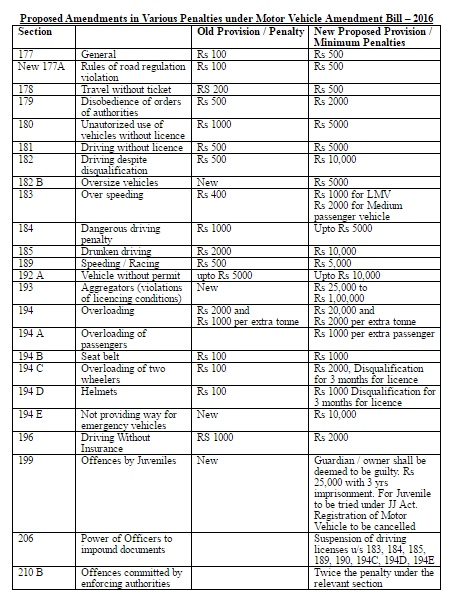
1) With an aim to enhance road safety, the bill proposes to increase penalties, that it hopes will act as deterrent against traffic violations. Stricter provisions are being proposed with respect to offences like driving without licence, over-speeding, juvenile driving, drunken driving, dangerous driving, overloading etc.

2) To improve delivery of services, e-governance is a highlight of the bill. This includes doing away with the requirements of educational qualifications for transport licenses, enabling online learning licenses, increasing validity period for driving licenses.
3) The compensation for hit and run cases will be increased from Rs 25,000 to Rs 2 lakh. There is also a provision for payment of compensation up to Rs 10 lakh in the case of road accidents fatalities. To help road accident victims, “Good Samaritan” guidelines have been incorporated in the Bill.
4) Stricter provisions for helmets have been introduced along with provisions for electronic detection of violations.
5) The Bill also proposes that in the case of offences committed by juveniles, the guardian/owner shall be deemed guilty. The juvenile would be tried under JJ Act. Registration of the motor vehicle will also be cancelled.
6) There is also a proposal to improve the registration process for new vehicles. Registration at the end of the dealer is being enabled and restrictions have been imposed on temporary registration, under the new Bill.
7) There is also a proposal to mandate the automated fitness testing for the transport vehicles with effect from October 1, 2018. The government is of the opinion that this would reduce corruption in the transport department, while at the same time improving road worthiness of a vehicle. Penalties have also been proposed for deliberate violation of safety/environmental regulations.
8) To bring harmony of the registration and licensing process, government proposes to create National Register for Driving Licence and National Register for Vehicle registration through “Vahan” & “Sarathi” platforms. This will facilitate uniformity of the process across the country, says the government.
9) Under the new Bill, the process for testing and certification of automobiles will be regulated “more effectively”. The testing agencies issuing automobile approvals have been brought under the ambit of the Act.
10) The driving training process has been strengthened enabling faster issuance of transport licenses. This will help in reducing the shortage of commercial drivers in the country, the government hopes.