




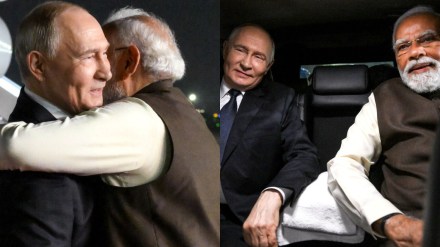
The world’s gaze turned to New Delhi as Vladimir Putin stepped onto Indian soil, his first visit in four years and his first since the Ukraine war. After two days of diplomatic exchange, the Russian president has now returned to Moscow, leaving behind space for questions and analysis
Across major Western newsrooms, the optics of Putin’s arrival were framed as a decisive moment in India’s delicate foreign-policy balancing act. For Prime Minister Narendra Modi, the visit became a test of whether he could safeguard India’s historic partnership with Russia, its biggest source of defence hardware and discounted oil, all while dealing with mounting tariff pressure and political heat from the US
The Telegraph
The Telegraph wrote that Modi is “walking a fine line” with his public embrace of Putin, who arrived in New Delhi on Thursday afternoon for a state visit. It explained that India’s deepening reliance on discounted Russian oil since the Ukraine war has helped its economy but strained relations with the West.
“Mr Modi will have to gauge how far he can push his relations with Putin without inviting further sanction from his erstwhile guests in the West,” the publisher wrote.
Though India has reduced Russian oil dependence following President Donald Trump’s tariffs and sanctions targeting state energy companies Lukoil and Rosneft, Moscow insists this pullback is temporary. Kremlin spokesperson Dmitry Peskov told Sputnik that Russia has “technology” to skirt sanctions.
Much of Moscow’s messaging before the summit has focussed on defence cooperation the backbone of the India-Russia relationship for decades. Yet Modi has increasingly diversified his military procurement, striking new deals with Western partners.
The Telegraph has given a stark warning, pushing too far toward Moscow could leave New Delhi vulnerable to Western restrictions, including access to high-end defence platforms needed to counter threats from Pakistan.
The Washington Post
The Washington Post described the visit as a “delicate diplomatic challenge,” saying Modi must keep faith with Russia “without riling President Donald Trump,” who has penalised India for buying Russian crude and “fueling its ‘war machine’ in Ukraine.”
The Post said Indian refiners have already scaled back Russian oil purchases as sanctions tighten, a trend analysts call a “significant blow” to Moscow’s wartime finances.
The New York Times
The New York Times explained the political messaging behind Modi personally receiving Putin on the airport tarmac, a gesture telling “the strong personal rapport” between the two leaders. It said India is “searching for a way to resolve its economic tangle with the Trump administration,” which has accused New Delhi of helping finance Russia’s war through cheap crude imports. Trade, defence supplies, nuclear cooperation, fertilisers and labour mobility were among key items on the bilateral agenda, the paper reported.
The Wall Street Journal
The Wall Street Journal delivered one of the starkest assessments of the stakes involved. It wrote that Putin’s visit aims “to protect a partnership that is a crucial economic and diplomatic lifeline for Moscow but one that has drawn the ire of the Trump administration.”
It added Trump has imposed 50 per cent tariffs on Indian exports to punish New Delhi for large-scale Russian crude purchases. It reported that India plans to cut its intake further, from 1.8 million barrels per day in November to around one million this month, under new US sanctions pressure.
Still, Putin is expected to offer “cheap oil and Russia’s latest arms” to improve ties, even as New Delhi manages expectations of fresh defence deals. It Journal concluded that “the trajectory of the relationship is upward,” with both nations seeking to expand trade beyond energy.
CNN
CNN spotlighted the war in Ukraine. Just before landing in Delhi, Putin told India Today Russia would “liberate Donbas and Novorossiya… by military or other means,” adding: “We will finish it when we achieve the goals set at the beginning of the special military operation, when we free these territories.”
CNN tied those remarks to his recent Moscow meeting with US envoy Steve Witkoff and Jared Kushner, Trump called it “a perfect meeting” but conceded “it does take two to tango.
Across major US coverage, the summit is framed as a test of India’s strategic autonomy, its determination to maintain a crucial relationship with Russia, its biggest defence supplier, while expanding a fast-deepening security partnership with US
Chinese media coverage
Chinese state media treated the visit with caution, overshadowed by President Emmanuel Macron’s concurrent Beijing trip but the Global Times explained Putin’s warm remarks about India. He told India Today, “India and China are our closest friends, we treasure that relationship deeply.”
Yet the paper also explained his more careful line: Russia has “no right” to interfere in India-China disputes. “At the same time, Russia does not feel entitled to intervene, because these are your bilateral affairs,” Putin said in India Today interview.
Xinhua briefly noted Putin rejecting US accusations over India’s Russian oil purchases. “If the US has the right to buy our fuel, why shouldn’t India have the same privilege?” he asked, adding, “This question deserves a thorough examination, and we stand ready to discuss it, including with President Trump.”
Beijing’s restrained posture explains a long-standing anxiety, Russia’s close ties with New Delhi, preserved even through the worst Sino-Indian tensions, remain a point of discomfort in the China-Russia partnership.
The Western narrative is clear, Modi is attempting one of the most difficult diplomatic balancing acts of the moment, defending India’s traditional ties with Russia while protecting its rapidly rising partnership with the United States.
The United States is now India’s largest trading partner. Russia remains India’s primary source of military equipment. And China’s rise looms over every decision. Putin’s visit places India at the centre of a shifting world order.


