




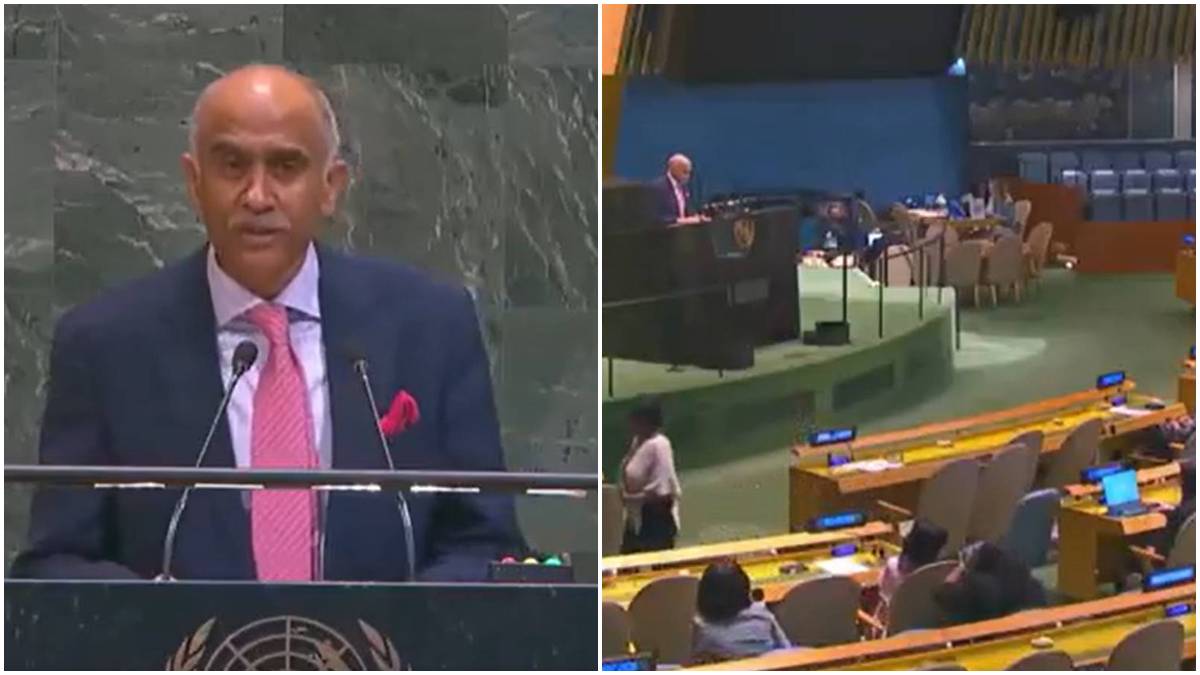
India on Friday delivered a sharp response to Pakistan at the United Nations General Assembly (UNGA) after Islamabad raised the issue of Jammu and Kashmir during discussions on the annual report of the UN Security Council, as reported by PTI.
India’s Permanent Representative to the UN, Ambassador Parvathaneni Harish, stated that Pakistan had once again used an international platform to raise what New Delhi considers an internal matter and accused it of promoting misleading narratives while serving as a non-permanent member of the Security Council.
“The unwarranted reference by Pakistan to a matter strictly internal to India, the Union Territory of Jammu and Kashmir, has compelled me to respond,” Harish stated during the plenary session.
India rejects Pakistan’s remarks on Jammu and Kashmir
Harish said Pakistan’s repeated references to Jammu and Kashmir at multilateral forums reflected a pattern of using global platforms for political reasons.
“Pakistan has decided not to spare this forum either from their characteristic misuse of august UN platforms for their divisive political interests.”
The Indian envoy also slammed Pakistan’s conduct as a current member of the Security Council, saying the body’s membership holds significant responsibilities.
“Being a member of the UN Security Council is a huge responsibility. It is not a forum for peddling biased and false narratives,” Harish mentioned.
VIDEO | New York: Permanent Representative of India to the United Nations, Parvathaneni Harish (@AmbHarishP) delivered India's statement at the UN General Assembly Plenary on Annual Report of the Security Council.
"The unwarranted reference by Pakistan to a matter strictly… pic.twitter.com/DIeJR1GlfD
— Press Trust of India (@PTI_News) June 6, 2026
Reaffirming India’s position, he further added, “Jammu and Kashmir was, is and will always remain an integral and inalienable part of India.
He further added that any claims suggesting otherwise were “baseless” and inconsistent with historical facts. “Empty rhetoric and hollow claims by Pakistan would not change this fundamental realty,” Harish stated.
Pakistan’s current term as a non-permanent member of the Security Council is due to conclude later this year.
Call for Security Council reforms
During his address, Harish also renewed India’s demand for reforms in the UN Security Council, asserting that the existing structure does not adequately reflect present-day geopolitical realties.
“The current structure reflects geopolitical realities of 1945. Retaining the status quo has so far not enabled effective functioning of the Security Council and cannot do so in future,” he said.
According to Harish, meaningful reform requires expansion of both the permanent and non-permanent categories of membership. He underlined that earlier reforms had not significantly changed the functioning of the Council.
India has long supported reforms of the Security Council. The G4-grouping-India, Brazil, Germany and Japan has proposed expanding the Council beyond its current 15-member structure. The Council currently comprises five permanent members with veto powers and 10 non-permanent members elected for two-year terms.


