




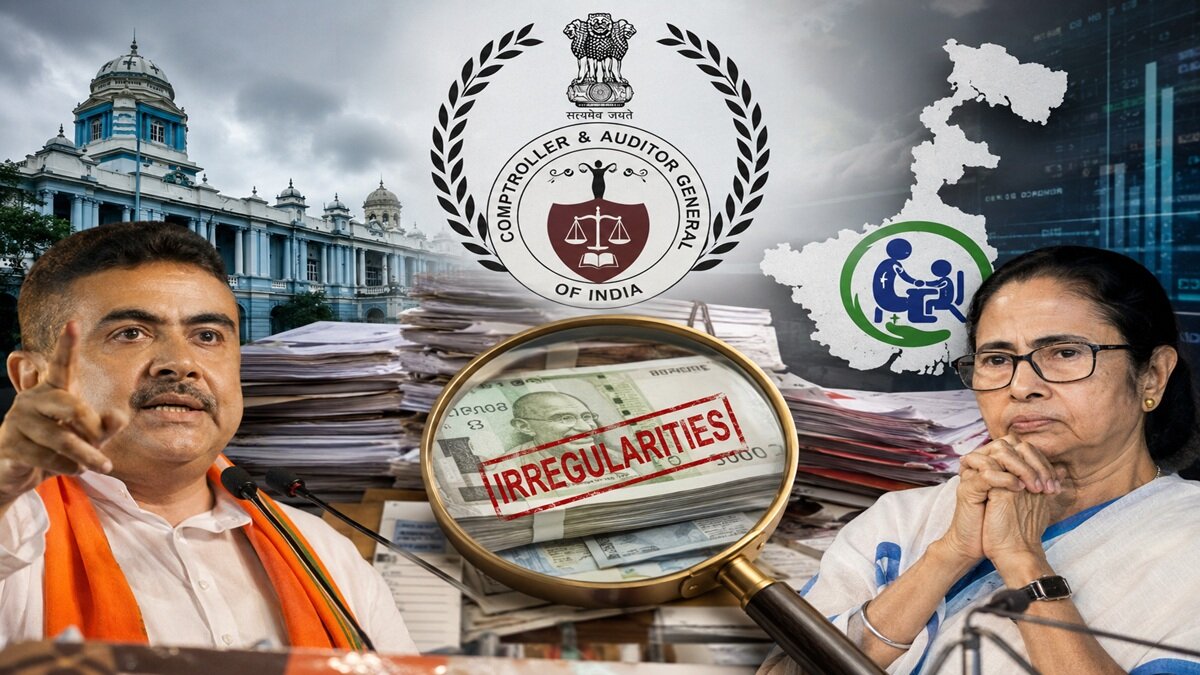
The Comptroller and Auditor General (CAG) has flagged deep financial and operational lapses in West Bengal’s ‘Swasthya Sathi scheme’, including excess payments to hospitals, unpaid insurance claims, weak grievance handling and poor enforcement of contract terms. The audit suggests that these deficiencies not only strained public finances but also raised the risk of ineligible beneficiaries, service shortfalls and avoidable expenditure.
The observations are part of the Performance and Compliance Audit Report of the CAG for the year ended March 2023, tabled in the assembly on Saturday (July 25). The performance audit covered the scheme’s implementation during 2018-19 to 2022-23 and found that the State Nodal Agency had neither prepared comprehensive guidelines nor annual action plans to meet the scheme’s objectives as of July 2024.
‘Swasthya Sathi’ is West Bengal’s flagship state-funded health insurance scheme that provides cashless, paperless treatment to residents through a smart-card system, with coverage of up to Rs 5 lakh per family per year for secondary and tertiary care. It covers families of any size, includes pre-existing diseases from day one, and is fully funded by the state government, so beneficiaries do not pay the premium or card cost.
Swasthya Sathi was launched in Bengal in 2016 under the then Trinamool Congress government and officially rolled out from February 1, 2017; the state scheme’s own portal says it was announced by the Cabinet on February 17, 2016 and launched by the Chief Minister on December 30, 2016.
Highlighting how mandatory CAG reports were suppressed for years, Chief Minister Shri @SuvenduWB confirms that the audit findings will finally be tabled, followed by a dedicated debate in the next session.
The warning is loud and clear: wherever CAG uncovers concrete evidence of… pic.twitter.com/kZEJo706Jm— BJP West Bengal (@BJP4Bengal) July 22, 2026
CAG flags fiscal deficit and verification gaps
The Bharatiya Janata Party (BJP) government on Saturday tabled 28 long-pending CAG reports, covering the financial years 2020-21 to 2024-25, in the Assembly and announced that a special session would be convened to deliberate on their findings.
Finance Minister Swapan Dasgupta accused the previous TMC government of committing a constitutional lapse by failing to present the reports in the House, adding that the current administration was committed to placing the audit findings and any governance shortcomings before the public through a detailed Assembly discussion. He said the reports would provide a true picture of the state’s financial condition and explain the reasons behind the state’s financial deficit of more than Rs 8 lakh crore.
The report said enrolment under the scheme was around 10 per cent higher than the number of ration card-holding families in the state as per Public Distribution System records of August 2023, creating the possibility of benefits reaching ineligible households. It also said the Aadhaar-linking exercise initiated in October 2021 remained incomplete, weakening verification and increasing the risk of multiple enrolments.
ভারতের কম্পট্রোলার অ্যান্ড অডিটর জেনারেল (CAG) আজ কলকাতায় পশ্চিমবঙ্গ সরকারের ২০২০–২১ থেকে ২০২৪–২৫ অর্থবর্ষের রাজ্যের অর্থসংক্রান্ত অডিট রিপোর্ট নিয়ে এক সাংবাদিক বৈঠক করেছেন। pic.twitter.com/6XFZg6kiz3
— PIB in West Bengal (@PIBKolkata) July 25, 2026
28 CAG reports span finance, health, education and governance
The 28 CAG reports tabled in the Assembly cover a broad spectrum of governance and public spending, including the state’s finance and appropriation accounts, Panchayati Raj institutions, government undertakings, public sector enterprises, health infrastructure and healthcare services.
The audits also examine land management in tribal areas, implementation of the Samagra Shiksha programme, Integrated Child Development Services (ICDS), and several performance audits assessing the efficiency and effectiveness of key government schemes and departments.
CAG uncovers Rs 14.48 crore excess payouts, shortfall in healthcare providers
The CAG found that 31 of 50 private empanelled hospitals test-checked had been graded higher than justified by their infrastructure, services and sanctioned bed strength. As a result, they received higher package rates than admissible, leading to excess payments of Rs 14.48 crore. The report also said that against a requirement of 3,038 healthcare providers to serve 2.43 crore beneficiary families, only 2,605 had been empanelled, restricting choice and affecting service delivery.
On claims and recoveries, the audit said 3,955 claims worth Rs 7.26 crore remained unpaid by five insurance companies between April 2018 and July 2022, with no reasons on record. It also said the State Nodal Agency failed to recover penalties worth Rs 31.33 crore from three insurers for delayed settlement of claims, while National Insurance Company and Bajaj Allianz General Insurance Company had not refunded Rs 29.78 crore despite failing to meet the mandated claim ratio.
Rs 721.95 crore borrowings highlight budget stress in state health scheme
The report pointed to excess expenditure of Rs 46.97 crore on enrolment and distribution of smart cards to 1.65 crore families through Third Party Administrators and Implementation Support Agencies. It also said the non-implementation of ‘Ayushman Bharat-Swasthya Sathi’ deprived residents, especially migrant workers, of cashless healthcare access through a nationwide hospital network, and prevented the state from drawing central funding in 2020-22 to supplement scheme spending.
Budget pressure also showed up in borrowing. The CAG said inadequate budgetary support forced the State Nodal Agency to take loans of Rs 721.95 crore during 2020-22, resulting in interest payments of Rs 10.85 crore. In six test-checked districts, Utilisation Certificates worth Rs 15.43 crore were submitted to the Single Nodal Agency (SNA) without supporting certificates from sub-allottees, creating a risk of misutilisation of funds.
245 vacancies, Rs 11.78 crore penalties: CAG flags operational failures in health scheme
Joint inspections of empanelled hospitals found serious service deficiencies. Resident Medical Officers were inadequate in 36 hospitals, nursing staff were short in 32, and 16 hospitals lacked equipment such as ventilators, infusion pumps and defibrillators. The audit also found that 399 out-patients in six hospitals paid consultation fees ranging from Rs 70 to Rs 700, while 141 in-patients in 32 hospitals incurred costs of Rs 250 to Rs 20,000 for diagnostic tests, contrary to the scheme’s cashless treatment promise.
Beneficiary satisfaction audits were not conducted, so the scheme’s performance from patients’ perspective was never properly assessed. Post Discharge Medical Audits were also absent until January 2023; when audits were finally carried out between February and March 2023, penalties of Rs 11.78 crore were imposed on healthcare providers, of which Rs 8.36 crore was realised.
The CAG said the State Nodal Agency failed to create and fill 245 contractual posts, including medical officers, accountants and data entry operators, which affected enrolment, empanelment, monitoring, medical audits and timely payments to providers. It also found the grievance redressal mechanism to be weak, with complaints neither auto-populated nor acknowledged on the SNA portal.
There was no system to track grievance disposal, and no timelines, escalation matrix or SMS alerts for complainants. Taken together, the audit paints a picture of a scheme with large spending commitments but weak controls, delayed recoveries and significant operational and financial leakage.


