




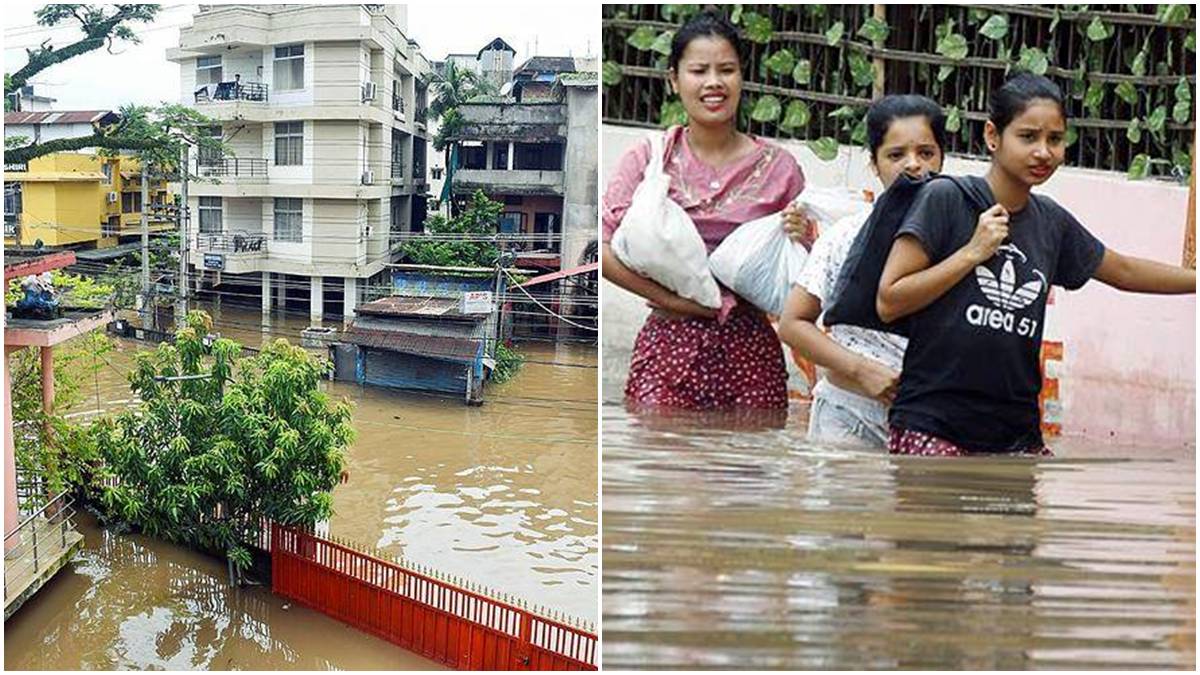
Assam remains in the grip of a major flood crisis, with the death toll rising to 66 and over 6.54 lakh people affected across 10 districts. Updates shared by the Assam State Disaster Management Authority on its official X account indicate at least 810 villages remain inundated. The state has operationalised 90 relief camps and 184 relief centres, sheltering 18,902 people. Chief Minister Himanta Biswa Sarma added that around 25% of the worst-hit spots remained ‘inaccessible’ to relief teams and the situation was still “dangerous”.
Prime Minister Narendra Modi also dialled Sarma to take stock of the situation on Saturday — assuring full support to Assam, prioritising relief efforts and expressing condolences. Opposition leaders have issued calls for the floods to be declared a ‘national calamity’ and urged the Centre to announce a Rs 10,000 crore relief and rehabilitation package.
The devastation has also raised an important question: What turned heavy monsoon rain into one of Assam’s worst flood disasters in recent years?
Hundreds of villages submerged, roads washed away
A Disaster Reporting and Information Management System report issued by ASDMA on Saturday revealed that hundreds of villages remained “submerged” — causing extensive damage to the agricultural sector. Approximately 34,970.8 hectares of crop area are currently under water. Even as water began to recede in parts of Upper Assam, it left behind homes buried under mud, battered infrastructure and damaged farmland. Around 4,54,071 animals were affected, and 3,021 animals, including poultry, were washed away in the floodwaters.
The water levels of major rivers continue to pose a threat, and the floods have also caused significant infrastructural damage across the state. A total of 143 roads have been damaged, primarily in Sivasagar, Jorhat, and Charaideo. 10 embankments have been affected, with seven breaches reported in the Sivasagar district alone.
The ASDMA has urged people to rely on official updates and avoid travelling to flood-affected areas.
Why did the floods become so destructive?
As per a report by The Indian Express, officials and experts stated the crisis was caused by a combination of extreme rainfall, environmental factors and swollen rivers. According to Chief Minister Himanta Biswa Sharma, exceptionally heavy showers over Nagaland’s Mon, Mokokchung and Wokha districts and Charaideo in Assam caused tributaries of the Brahmaputra to rise at an “unprecedented” pace. Sarma mentioned rainfall departures reached 436% in Charaideo and 493% in Mokokchung. With the Brahmaputra already swollen, drainage from tributaries slowed significantly, worsening the flooding across Upper Assam.
The Assam government has initially linked the flooding to a cloudburst in Nagaland’s Mon district. However, an Indian Meteorological Department (IMD) scientist told The Indian Express that Mon received 137 mm of rainfall over eight to nine hours, not a cloudburst. As per the IMD, rainfall exceeding 100 mm within one hour is termed a cloudburst.
Experts say heavy rain alone cannot explain the extent of the disaster. Dhrubajyoto Sahariah, Professor of Geography at Gauhati University, stated to The Indian Express that the floods resulted from a “mix of rainfall and anthropogenic factors.”
Former IIT Roorkee professor Nayan Sharma pointed towards deforestation.
“This excess silt then raises the river bed and reduces carrying capacity,” he stated to The Indian Express.
Experts have also cautioned that climate change is making high-intensity rainfall events more frequent.
Relief operations continue as recovery begins
According to the latest ASDMA update, around 34,971 hectares of cropland remain submerged. The Central Water Commission stated that the Dikhow River in Sivasagar and the Dhansiri (South) at Numaligarh continue to flow above the danger level. The flood has damaged 143 roads, impacted 10 embankments, and affected more than 4.5 lakh livestock, according to a report by ANI.
Receding water has exposed homes and farmland buried under thick mud and sand. Calling it “one of the most devastating in recent memory”, resident Sanjay Jha stated to ANI that floodwaters increased so quickly many families had no time to collect their belongings.
In another update on X, ASDMA mentioned that the Indian Army is using drones to deliver drinking water and key relief supplies to remote areas of Sivasagar cut off by floodwaters.
After visiting affected areas, Union Minister Sarbananda Sonowal described the situation as “extremely critical”. In a separate post on X, he said he met residents in Sivasagar, Sonari and Mahmora and assured them of “every possible assistance”.
Chief Minister Himanta Biswa Sharma said the government would provide compensation to eligible families, financial support for damaged homes, diesel support for tractors and help replace lost certificates and books.
‘Whether it is compensation, damaged homes, lost certificates or books, we will help in every possible way,” he stated in a video shared on X.
In separate posts, he said Prime Minister Narendra Modi has assured Assam of all possible assistance, while reasserting the state government’s commitment to relief, rehabilitation, rebuilding homes and restoring livelihoods.


