




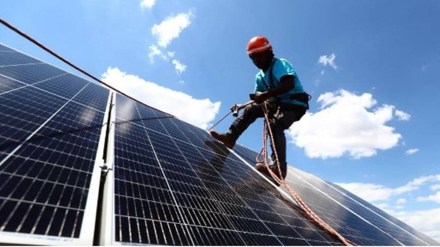
Under the government’s flagship programme, PM Suryaghar Muft Bijlee Yojana, the country’s rooftop solar capacity increased by more than 50% in just six months since its launch in February.
Around 400,000 rooftop solar connections totalling to a new residential rooftop solar capacity of 1.8 gigawatts (GW) have been installed in the period. This already amounts to more than half of India’s total residential solar rooftop capacity, as per a report by JMK Research and Analytics.
As of March 2024, residential rooftop solar installed capacity in India was about 3.2 GW, or 27% of the total rooftop solar installations in the country, data from the report showed.
The cumulative installed capacity of rooftop solar stood at almost 11.9 gigawatts (GW) as of March 2024, with the commercial and industrial segment accounting for about 60%.
With the new scheme, the government aims to address the issues with rooftop solar capacity addition, including the high costs. The increase in subsidy for the modules to 60% from earlier 40% and provision of loan to households at a minimum rate of interest of 7% are expected to boost households’ ability to opt for rooftop solar units.
The industry believes that the scheme is expected to be a game-changer in India’s solar story, enhancing the residential solar capacity to 30 GW by 2027.
“The government is easing the rules in terms of getting approval from discoms (for sale of surplus). It has also improved the financing options and aims to bring about awareness among households,” Vikram V, Vice-President & Co-Group Head – Corporate Ratings, Icra had said.
At a target of 30 GW residential rooftop solar installations by March 2027, the country will need to add about 8-10 GW of annual capacity additions from FY25-FY27.
Analysts believe that with increased capital subsidy under the scheme and other factors such as decreasing solar module costs and improved consumer awareness and understanding of rooftop solar technology, the outlook for India’s residential rooftop solar market looks highly promising.
“The surge in consumer interest is supported by improved financing availability and enabling regulatory and implementation support from state regulators. Almost every state in India provides net metering to residential customers installing rooftop solar systems,” according to JMK Research and Analytics.
Analysts believe that with strong impetus from the government, the financing options and terms for the residential rooftop solar market have improved significantly.
“The number of financers has risen from just a handful a few years ago to more than 25, including all leading private and public sector banks, non-banking financial companies (NBFCs) and fintechs,” said JMK.
The scheme launched in February by Prime Minister Narendra Modi aims at installing rooftop solar at 10 million households by 2027 with a total outlay of Rs.75,021 crore. While the scheme is incremental in realising India’s renewable energy goals and net-zero targets, experts believe that some critical pieces are still missing from the renewable energy mix before the country could provide solar power to all.
As per JMK, the primary challenge is the need for more availability of domestic content requirement (DCR) modules for the residential sector, considering the wide gap between photovoltaic (PV) cell and module manufacturing capacity in India.
Additionally, there are some concerns about scheme adoption by its target demographic (i.e. small- to medium-scale electricity consumers), as cost economics and loan availing capability still favour the wealthier and creditworthy residential consumers. “In certain states, such as Assam, there is a considerable mismatch between the number of project applications and the availability of vendors, which may affect the near-term growth of installations,” said the report.
Ajay Yadav, joint secretary in the ministry of new and renewable energy had earlier at an industry event while noting the challenges of the scheme had said that there are some states where the transportation cost of the panel is high like some northeastern states, and islands including Lakshadweep and Andaman & Nicobar. “We are trying to work out a way for this,” he had said.
Even as the scope of the scheme appears to be big, analysts are cautious and believe the actual impact can be assessed after one year of implementation of the scheme.


