




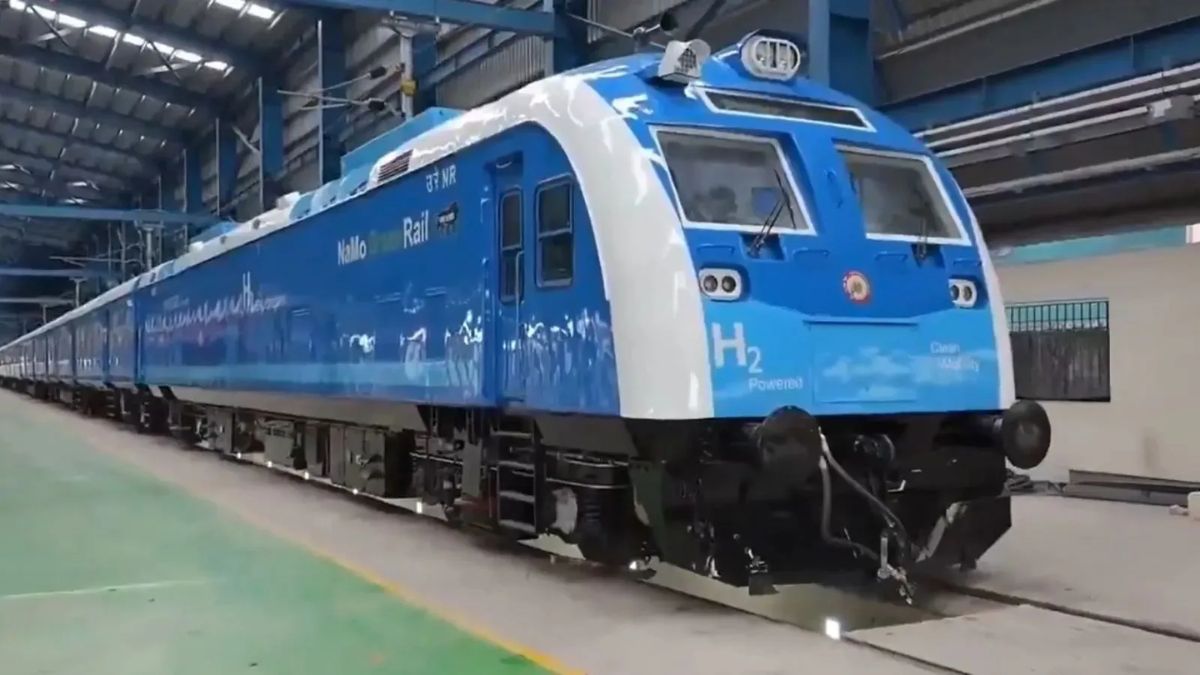
Prime minister Narendra Modi on Friday flagged off the first indigenously-developed hydrogen fuel cell train on the 89-km Jind-Sonipat section of Northern Railway in Haryana, making India enter a small group of nations that operate hydrogen-powered trains. Developed under the “Make in India” initiative, the project is being positioned as a pilot to evaluate the feasibility of clean rail transportation in the country.
The PM said that hydrogen train technology has emerged 7-8 years ago globally, and is currently available in a handful of countries where it is still at a nascent stage. Highlighting the train’s technical capabilities, he said the newly launched hydrogen train is the world’s most powerful with a 3,200-horsepower engine and 10 coaches. He noted that hydrogen trains operating in other countries typically have 3-4 coaches whereas India deployed a longer train on the first attempt. “India has successfully demonstrated its prowess by running a hydrogen train with ten full coaches straightaway,” Modi said.
Technical Engineering Benchmarks
The train is powered by a 1,200-kW hydrogen fuel cell propulsion system and can carry around 2,600 passengers. It has been approved to operate at a maximum speed of 75 kmph, although its design speed is 110 kmph. Besides the trainset, railways has also established the country’s largest railway hydrogen storage and refuelling facility at Jind, capable of storing nearly 3,000 kg of hydrogen. The facility has also received the safety clearances from the Petroleum and Explosives Safety Organisation (PESO).
The PM said that hydrogen-powered trains require distinct infrastructure and specialised support systems, unlike conventional rail networks. To meet the specific network needs, he said new factories and allied facilities will be set up, creating economic ripple effect at the local level. “This advanced train network is absolutely guaranteed to create numerous new employment opportunities for the youth of Haryana,” he said.
Global Strategic Insulation
Modi said India’s near-complete railway electrification has insulated the rail network from global fuel disruptions triggered by the ongoing West Asia conflict, which has affected key shipping routes for petroleum, diesel, LPG and fertilisers. “Through this vital maritime route, India imports a massive quantity of essential fuels and agricultural inputs. Because of complete electrification, our trains continued to run completely uninterrupted despite the severe global oil crisis.”
Compared with diesel locomotives, hydrogen fuel-cell trains produce lower emissions, operate more quietly and can improve energy efficiency on non-electrified routes. Experts said that the hydrogen technology is particularly attractive for railway routes where electrification is either uneconomical or technically difficult. “Every new technology deserves a fair trial, but its future must ultimately be decided by lifecycle cost, energy efficiency, safety and operational practicality,” said Lalit Chandra Trivedi, former general manager, East Central Railway.
Currently, the hydrogen-powered trains are operational or under development in countries such as Germany, Japan, China and the US. Although the technology is still new globally, India’s latest pilot project will provide valuable operational experience and support future applications of hydrogen-powered mobility in the rail sector.


