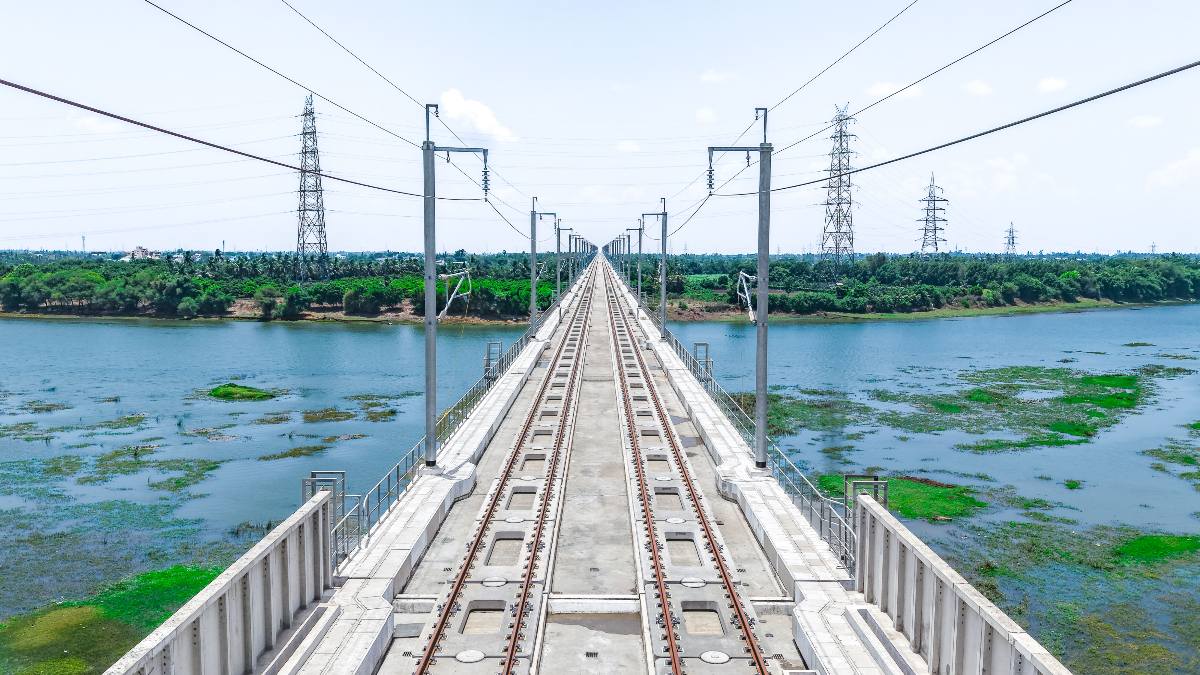
India’s first bullet train project has crossed another key milestone as electrification work gathers pace on the 508-km Mumbai-Ahmedabad High-Speed Rail (MAHSR) corridor.
But unlike conventional railway lines, this corridor will run on an advanced power system that has never been used in India before.
The National High Speed Rail Corporation Limited (NHSRCL) has begun installing the 2×25 kV Overhead Traction System—a technology used on high-speed rail networks in countries like Japan and France.
The system is designed to provide a stable and uninterrupted power supply, allowing bullet trains to safely operate at speeds of up to 320 kmph.
How will the new power system work?
The 2×25 kV traction system is specially designed for high-speed rail. Unlike conventional railway electrification, it can deliver electricity more efficiently over longer distances, ensuring trains receive a continuous power supply even while travelling at very high speeds.
Power from the National Power Grid will first reach specially designed Grid Substations before being supplied to 14 Traction Substations along the corridor. Of these, five will be in Maharashtra and nine in Gujarat.
More than just overhead wires
The electrification network is much more than overhead cables. The corridor will also have 31 Switching Posts, which can quickly isolate faults and maintain power supply if a section develops a problem.
Additionally, 16 Distribution Substations are being built to supply electricity to stations, signalling systems, maintenance depots and other railway infrastructure.
The overhead wires will be installed under carefully controlled mechanical tension, ensuring the train’s pantograph can smoothly collect electricity while running at speeds of up to 320 kmph.
Safety features built into the system
Safety is another major focus of the project. Every Traction Substation will be equipped with Early Earthquake Detection Seismometers, capable of detecting seismic activity within seconds.
If an earthquake is detected, the system can automatically trigger protective measures to stop trains before they enter affected sections of the track.
In total, 28 seismometers will be installed across Maharashtra and Gujarat, including in earthquake-prone areas along the corridor.
Know more about India’s first Bullet Train corridor
The Mumbai-Ahmedabad High-Speed Rail corridor is India’s first bullet train project, stretching 508 km between Mumbai and Ahmedabad. Once operational, it is expected to reduce travel time between the two cities to just 2 hours and 7 minutes.
The corridor will have 12 stations—Mumbai, Thane, Virar, Boisar, Vapi, Bilimora, Surat, Bharuch, Vadodara, Anand, Ahmedabad and Sabarmati.