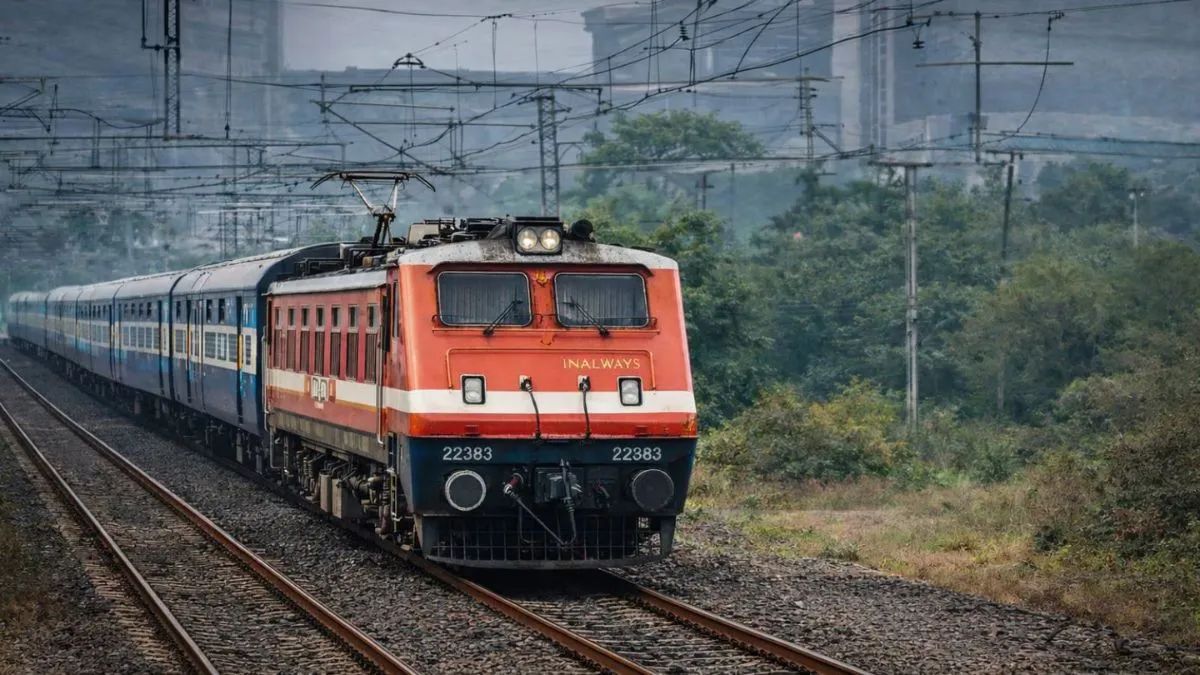
Indian Railways has electrified 99.6% of its broad gauge (BG) network, completing one of the world’s largest railway electrification programmes and placing India second only to Switzerland in terms of network electrification. While the achievement marks a major infrastructure milestone, its significance extends beyond replacing diesel locomotives—it is expected to reduce fuel imports, lower logistics emissions, improve operational efficiency and support the Railways’ long-term net-zero ambitions.
According to information shared by Railway Minister Ashwini Vaishnaw in a written reply in the Lok Sabha on Tuesday, electrification has been carried out in mission mode over the past decade. Of the total 69,873 route kilometres of the broad gauge network, 48,072 route km were electrified between 2014 and 2026, compared to 21,801 route km completed over nearly six decades before 2014.
The remaining unelectrified stretches are also under execution, while all new railway lines and multi-tracking projects are now being sanctioned with electrification from the outset.
India’s electrification now among world’s highest
Unlike many railway systems that prioritise only high-density passenger or freight corridors, Indian Railways has pursued full-network electrification.
According to the International Union of Railways (UIC) report released in June 2025, India’s railway electrification now stands at 99.6%, behind only Switzerland.
Railway electrification across major countries
| Country | Electrified railway network |
|---|---|
| Switzerland | 100% |
| India | 99.6% |
| China | 82% |
| Spain | 67% |
| Japan | 64% |
| France | 60% |
| United Kingdom | 39% |
The ministry said India’s achievement is particularly significant because of the scale of its network, making it one of the world’s most extensively electrified railway systems.
Beyond wires: Why electrification matters
Railway officials say the benefits of electrification extend beyond environmental gains.
Electric traction reduces dependence on imported diesel, lowers operating costs, improves haulage capacity and enables trains to accelerate faster. This translates into shorter journey times, greater freight movement and improved asset utilisation.
The transition has already resulted in a sharp decline in diesel consumption.
According to the Railways, diesel used for traction purposes has fallen from 293 crore litres in 2015-16 to 108 crore litres in 2024-25, a reduction of 185 crore litres.
Officials said the reduction has helped save significant foreign exchange that would otherwise have been spent on importing fuel.
Diesel consumption for railway traction
| Financial Year | Diesel consumption |
|---|---|
| 2015-16 | 293 crore litres |
| 2024-25 | 108 crore litres |
| Reduction | 185 crore litres |
The ministry also cited a NITI Aayog report showing rail transport emits substantially less carbon dioxide than road transport.
CO₂ emissions per tonne-km
| Mode | CO₂ emissions |
|---|---|
| Road | 101 gm |
| Rail | 11.5 gm |
This means rail transport produces around 89% lower CO₂ emissions than road transport for moving the same quantity of freight.
Renewable energy becoming the next focus
Electrification alone does not guarantee cleaner transport unless electricity itself comes from cleaner sources.
To address this, Indian Railways has been expanding its renewable energy portfolio by commissioning solar and wind projects to power railway operations.
As of June 2026, the Railways has commissioned:
| Renewable source | Installed capacity |
|---|---|
| Solar power | 1,161 MW |
| Wind power | 103 MW |
| Total | 1,264 MW |
The ministry said Indian Railways plans to progressively meet a larger share of its traction power requirement through renewable sources, including hybrid solar-wind systems and energy storage, reducing the carbon footprint of railway operations further.
Nearly all railway zones fully electrified
Most railway zones have already achieved complete electrification, with only a few nearing the finish line.
| Railway Zone | Electrification |
|---|---|
| Central Railway | 100% |
| Northern Railway | 100% |
| Eastern Railway | 100% |
| Western Railway | 100% |
| South Central Railway | 100% |
| East Central Railway | 100% |
| East Coast Railway | 100% |
| North Central Railway | 100% |
| South Eastern Railway | 100% |
| West Central Railway | 100% |
| North Western Railway | 99.8% |
| Northeast Frontier Railway | 98.7% |
| Southern Railway | 98.7% |
| South Western Railway | 96.1% |
Similarly, several states, including Delhi, Uttar Pradesh, Bihar, Madhya Pradesh, Maharashtra, Gujarat, Telangana, Odisha, Punjab and West Bengal, have already achieved 100% railway electrification.
Mission mode execution
The Railways acknowledged that completing electrification while trains continued operating was one of the programme’s biggest engineering challenges.
To accelerate execution, Indian Railways created a Project Monitoring Group (PMG) portal to resolve implementation bottlenecks, strengthened project monitoring, delegated higher financial powers to field units and ensured continuous funding support.
With the remaining stretches under construction, the ministry said Indian Railways is now close to completing full electrification of its entire broad gauge network, positioning the system for greater use of renewable energy and lower-carbon rail transportation in the coming years.