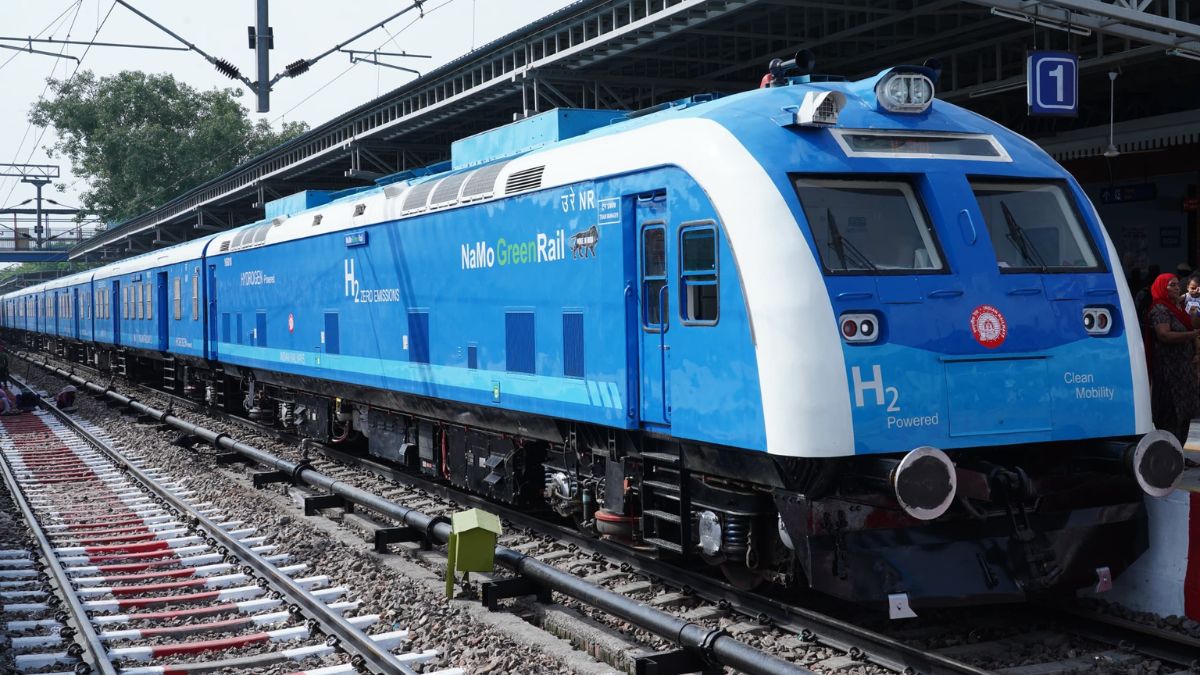
India is ready for the launch of its first hydrogen train today. Prime Minister Narendra Modi will visit Haryana and flag-off the much-awaited train from Jind at around 11 am. The 89-kilometre Jind–Sonipat hydrogen train has been conceived, developed, and assembled in India using home-grown technology. Powered by hydrogen fuel cell technology, it emits only water vapour, eliminating harmful exhaust emissions.
The train operates independently of overhead electric lines, offering a quieter travel experience while reducing reliance on conventional fossil fuels. Its 10-coach formation is driven by a high-performance 3,200 HP propulsion system, demonstrating India’s progress in sustainable rail transportation. Let;s find out exactly how it would work.
The Physics Behind: How does the hydrogen-powered train work?
Unlike conventional trains that run on diesel or draw electricity from overhead power lines, the hydrogen-powered train generates its own electricity onboard. It uses hydrogen fuel cells, where hydrogen reacts with oxygen to produce electricity. This electricity powers the train’s motors, while the only direct emission from the process is water vapour, making it a clean and environmentally friendly mode of transport.
Hydrogen stored in high-pressure cylinders reacts with oxygen drawn from the atmosphere inside the fuel cell. This electrochemical reaction produces electricity, which powers the train’s traction motors, while water vapour and heat are released as the only direct by-products.
In simple terms, the process works as: Hydrogen + Oxygen → Electricity + Water Vapour → The Train Moves.
Because electricity is produced onboard, the train does not depend on continuous overhead electric supply while also eliminating direct carbon emissions associated with diesel-powered trains.
The trainset consists of two Hydrogen Driving Power Cars (DPCs) positioned at either end and eight passenger trailer coaches. Each power car houses fuel cells, lithium iron phosphate (LFP) batteries and hydrogen storage cylinders that work together to generate and manage traction power.
Together, the two power cars produce 2,400 kW (around 3,200 hp), enabling a design speed of 110 kmph.
Why hydrogen train matters even after Railways’ 99% electrification
At first glance, investing in hydrogen trains may appear unnecessary when Indian Railways has already electrified almost its entire Broad Gauge network.
However, hydrogen propulsion addresses a different challenge.
Conventional electric trains rely on overhead catenary systems for power. Hydrogen trains generate electricity onboard, allowing them to operate independently of continuous external power supply while maintaining zero tailpipe emissions.
This makes the technology particularly relevant for future applications on non-electrified routes, isolated sections, heritage railways or locations where extending overhead infrastructure may not be economically viable.
Hydrogen also helps diversify India’s energy mix by reducing dependence on imported diesel while supporting the country’s broader clean-energy and net-zero ambitions.
How India’s hydrogen train compares with global projects
Hydrogen-powered passenger trains are already operating in countries such as Germany and China, but they are generally limited to two- or three-coach regional trainsets carrying relatively fewer passengers.
India’s hydrogen train has been designed at a significantly larger scale.
The 10-coach train can accommodate around 2,600 passengers, making it one of the largest hydrogen-powered passenger train configurations developed for regular railway operations.
The project is intended not only as a technology demonstration but also as a test of whether hydrogen propulsion can be scaled for higher-capacity passenger services.
Why the Jind-Sonipat route was chosen
The Hydrogen Fuel Cell Train will initially operate on Northern Railway’s 89-km Jind-Sonipat section in Haryana.
The route has been selected to evaluate the operational performance, safety and reliability of hydrogen-powered passenger services under regular operating conditions.
To support the project, Indian Railways has also developed a dedicated hydrogen storage, compression and dispensing facility at Jind, creating what is expected to be the country’s first integrated hydrogen railway ecosystem.
The train has been equipped with multiple safety systems capable of detecting hydrogen leaks, heat, smoke and flames, reflecting the specialised safety requirements associated with hydrogen fuel.
What this means for Indian Railways
Whether hydrogen trains become a mainstream mode of rail transport in India will depend on their long-term operating costs, reliability and the availability of hydrogen production and refuelling infrastructure.
For now, the significance of the project lies less in the launch of a single train and more in what it represents—a new phase in the evolution of railway propulsion. Having transitioned from steam to diesel and then to electric traction, Indian Railways is now testing whether hydrogen can become the next major step in building a cleaner and more sustainable rail network.