




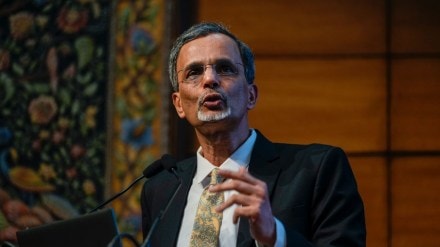
Chief Economic Adviser V. Anantha Nageswaran on Wednesday downplayed concerns over the rupee’s sharp fall past the 90-per-dollar level, stressing that the currency’s weakness does not currently pose risks to India’s inflation trajectory or export competitiveness.
Speaking at the CII IndiaEdge Summit, Nageswaran said the government is “not losing sleep” over the domestic currency’s slide as long as macroeconomic fundamentals remain intact.
Rupee touches record lows
The rupee touched a fresh intra-day low of 90.30 against the U.S. dollar on Wednesday, extending its decline for the sixth consecutive session. The currency has depreciated nearly 5% so far in 2025, pressured by sustained foreign portfolio outflows, heavy bank buying of dollars, and the absence of progress on an India–US trade deal. A fall in domestic equity markets has added further strain, making the rupee Asia’s worst-performing currency this year.
Despite these pressures, the Nageswaran maintained that the depreciation is not alarming in the current context. “It will come back next year. Right now, it’s not hurting our exports or inflation. I am not losing my sleep over it. If it has to depreciate, now probably is the right time,” Nageswaran said. He emphasised that temporary volatility should be assessed against broader macroeconomic strengths, rather than triggering panic.
Nageswaran on FDI
Nageswaran also underscored that India, as a rapidly developing economy, will see imports continue to rise. Financing these imports sustainably, he said, will require stronger export growth and higher investment inflows. “Imports will only grow, and they need to be financed through exports and through investments. We need to crank up our efforts to get FDI,” he noted.
Looking ahead, Nageswaran expressed optimism about foreign investment prospects. Gross FDI inflows could cross $100 billion in FY26, he said, supported by a 16.1% year-on-year rise in inflows to $50.36 billion in the first half of FY26, as per RBI data. However, net FDI—inflows minus outflows—remained low at $7.64 billion during the same period.
Nageswaran attributed the subdued net inflows to the sharp rise in interest rates across developed economies over the last three years, which has redirected global capital away from emerging markets. Simultaneously, Indian companies have ramped up outbound investments into advanced economies, further weighing on net figures. “Starting 2023-24, the nature of the terrain has shifted in respect of net FDI inflows. We need to up our game,” the he added.


