The India-UK Comprehensive Economic and Trade Agreement (CETA) officially came into force on July 15, 2026, along with the Agreement on Social Security, also known as the Double Contribution Convention. The two agreements mark the beginning of one of India’s biggest trade deals and the United Kingdom’s largest bilateral trade agreement since it left the European Union.
The details of the agreement come from official documents released by the UK Department for Business and Trade and India’s Ministry of Commerce and Industry through the Press Information Bureau (PIB).
The agreement gives duty-free access to many labour-intensive industries that employ a large number of people in India.
Products such as garments, textiles, footwear, carpets, cereals, vegetables, fruits, spices, fish, meat and processed food items will now enter the UK without paying import duties. Earlier, these products attracted tariffs ranging from 4% to 16%.
Other industries expected to benefit include automobiles, motorcycles, auto components, machinery, electronics, fabricated metal products, ceramics, glass, stone and cement-related products.
India-UK trade deal comes into force
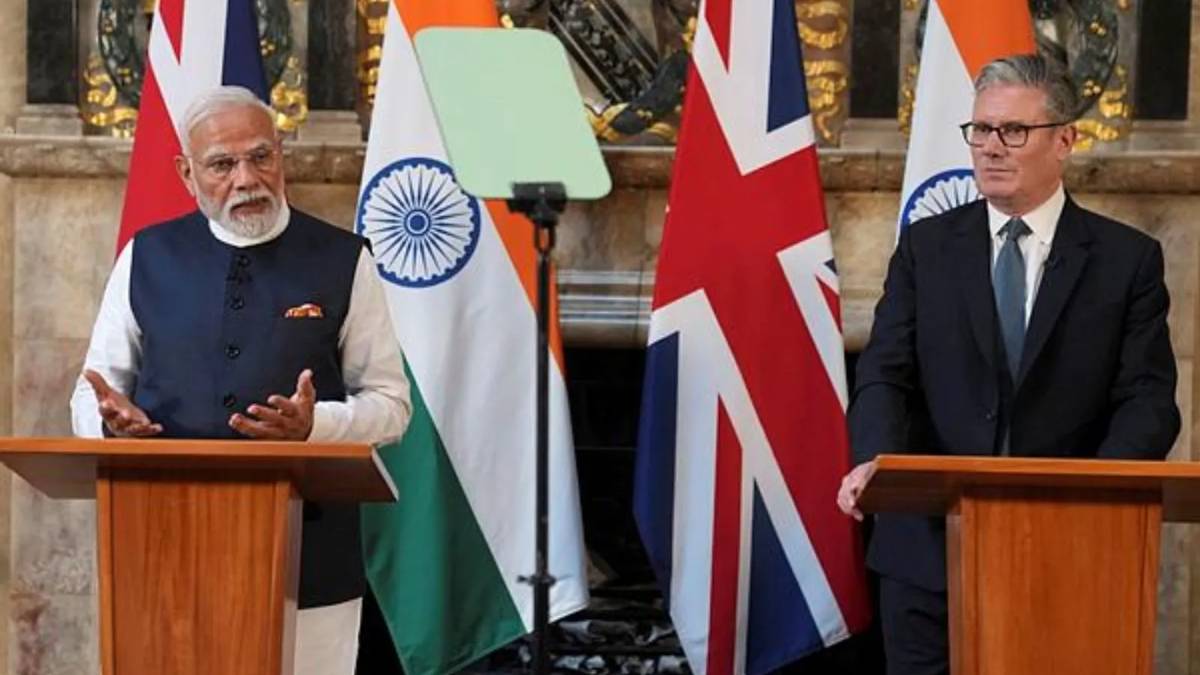
The agreement was finalised after 14 rounds of negotiations. It was formally signed in London on July 24, 2025, by India’s Commerce and Industry Minister Piyush Goyal and the UK’s then Secretary of State for Business and Trade Jonathan Reynolds. The signing took place in the presence of Prime Minister Narendra Modi and the UK’s outgoing Prime Minister Keir Starmer.
Many British products will become cheaper in India
The agreement gradually lowers import duties on several British goods over the next 10 years, although some benefits begin immediately.
- One of the biggest changes is for whisky and gin. India has reduced the import duty on UK whisky from 150% to 75% from the first day, and the duty will come down further to 40% by the tenth year. Gin will receive the same treatment.
- The agreement also lowers duties on several other premium alcoholic drinks, including cider, mead, sake, brandy, bourbon, rum, gin, vodka, liqueurs and tequila.
- The agreement also lowers duties on cars imported from the UK. Under a fixed quota, import duties that were as high as 110% will gradually fall to 10%. The lower duty will first apply to petrol and diesel vehicles before later extending to electric and hybrid vehicles as UK production shifts.
- However, electric, hybrid and hydrogen-powered passenger vehicles from the UK will get preferential access only from the sixth year of the agreement. This gives Indian electric vehicle manufacturers five years of protection before competition increases.
- Tariffs on fully built trucks will also be reduced. Within the approved quota, the existing 44% duty will come down to 8.8% by the fifth year.
- Indian consumers could also see lower prices for cosmetics and personal care products. Import duties on products such as soaps, shaving cream, face cream and nail polish will either be removed immediately or gradually over the next decade.
- The duty on perfumes and eau de cologne, which currently stands at 22%, will be cut by half after the phased reduction is completed.
- Several food and beverage products are also covered. Chocolate, gingerbread, sweet biscuits and soft drinks will become tariff-free after the full 10-year transition period.
- Another important change is for lamb, as the existing 33% import duty on British sheep meat will be removed.
According to the UK government, 64% of tariff lines will become eligible for duty-free imports into India from the first day. This includes products such as aircraft parts and scientific measuring instruments. After the full 10-year implementation period, 85% of tariff lines, covering around 66% of current UK exports to India, will be duty-free.
Some Indian sectors stay protected
While the agreement opens up trade in many areas, India has decided to keep some sensitive sectors outside the deal. According to the UK government’s summary, sugar, milled rice, pork, chicken and eggs are not covered under tariff reductions.
- India’s Ministry of Commerce has added that dairy products, cereals, millets, edible oils, oilseeds, apples, several vegetable products, gold bars and smartphones will also remain protected.
- The UK has also excluded products such as meat items, egg-based products, semi-milled and fully milled rice, and solid-form cane and beet sugar, among others.
According to the Global Trade Research Initiative (GTRI), Britain is expected to benefit the most in sectors such as precious metals, aerospace, premium automobiles and alcoholic beverages.
High-purity silver bars are among the biggest winners under the agreement, while Britain’s aerospace industry is also expected to gain significantly.
Indian exports get nearly duty-free Access to the UK
The Ministry of Commerce says the UK has agreed to provide zero-duty access on around 99% of India’s tariff lines. This will cover almost the entire value of India’s exports to Britain.
Several sectors are expected to benefit from the removal of UK import duties.
- Processed food products will see tariffs of up to 70% removed. Marine products will benefit from the removal of duties of up to 21.5%.
- Engineering goods and auto components will receive tariff relief of up to 18%, while leather and footwear products will see duties of up to 16% removed.
- Textiles and clothing exports will benefit from tariff cuts of up to 12%, while chemicals and pharmaceutical products will receive relief of up to 8%.
UK companies can bid for Indian Government contracts
India has opened its central government procurement market to eligible UK businesses.
For the first time, around 40,000 high-value contracts issued by central ministries and departments in sectors such as transport, green energy and infrastructure will be open to UK bidders.
Companies meeting the requirement of 20% UK content may also qualify as Class 2 Local Suppliers under the agreement.
No change to India’s emergency patent rights
According to the Global Trade Research Initiative (GTRI), India did not agree to extend patent terms or provide pharmaceutical data exclusivity under the agreement.
India accepted stricter rules for enforcing intellectual property rights but continued to recognise voluntary licensing as the preferred approach.
Importantly, the agreement does not stop India from using compulsory licensing, which allows the government to make life-saving technologies available during emergencies.
Relief for Indian IT companies
The UK has offered one of its widest market access packages so far, covering all major service sectors and 137 sub-sectors that are important for India. These include IT and IT-enabled services, financial services, professional services, healthcare, education, engineering, telecommunications and consultancy.
Both countries have also brought the Double Contribution Convention into force. Under this agreement, Indian employees sent to work temporarily in the UK, along with their employers, will not have to pay social security contributions there during their posting.
The exemption period has been increased from three years to five years in the final agreement.