




China has moved its artificial intelligence contest with the United States beyond laboratories, semiconductor factories and technology companies. It is now building an international institution around its competing vision for how AI should be developed, governed and distributed.
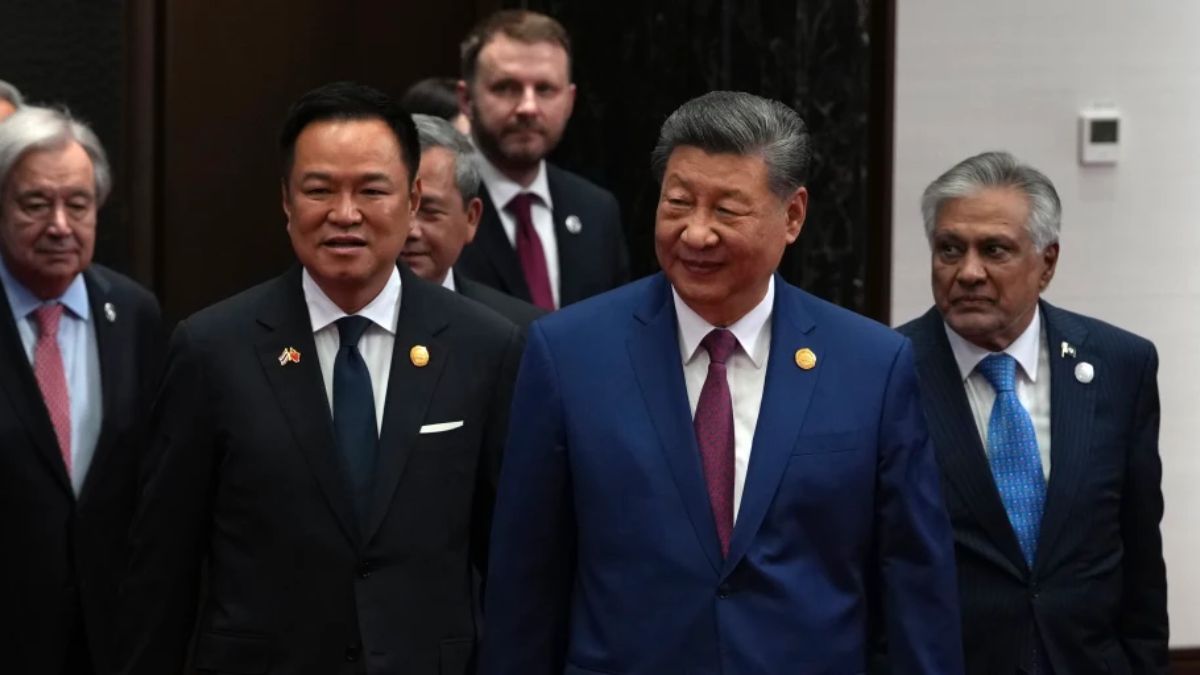
President Xi Jinping on Friday formally backed the World Artificial Intelligence Cooperation Organization, or WAICO, at China’s flagship AI conference in Shanghai.
The organisation, headquartered in the Chinese financial city, has been established by 29 countries as what Beijing describes as the first intergovernmental body dedicated to AI cooperation.
As per analysts interviewed by Reuters, the larger message was difficult to miss. China wants to position itself not merely as a producer of competitive AI systems, but as a rule-maker offering developing economies an alternative to a technology order still dominated by American chips, cloud platforms and proprietary models.
China turns AI access into diplomacy
Xi pledged 5,000 AI training and seminar opportunities for developing countries over the next five years. China will also establish application cooperation centres with countries including India, Russia that are a part of multilateral organisations like BRICS, ASEAN, SCO (Shanghai Cooperation Organisation) and the African Union.
As per the formal statement put by the Chinese embassy in Azerbaijan, these commitments turn AI cooperation into a development proposition covering skills, public services and technology deployment rather than limiting it to diplomatic statements on responsible use.
Decoding this move, analysts interviewed by Reuters explained that global AI power rests on four layers: access to computing chips, the ability to train models, access to the latest finished models, and influence over the standards governing their use. At present, the United States remains dominant across a good proportion of the stack.
Experts interviewed by Reuters believe that with this move China is aiming to accelerate its influence in the sector by offering lower-cost and open-weight models while building an institutional coalition around access and capacity-building.
WAICO also emerges as a counterweight to Pax Silica, the US-led initiative focused on trusted supply chains spanning critical minerals, semiconductors, AI infrastructure and advanced systems.
India joined Pax Silica in February as part of a wider technology and supply-chain partnership with Washington.
Chips remain the hard currency of AI
China’s argument that national security is being stretched to restrict technological access is primarily directed at Washington’s semiconductor controls.
Ever since the public debut of OpenAI’s ChatGPT in 2022, the US has progressively restricted China’s access to advanced processors and the equipment required to manufacture them.
This pattern became particularly pronounced in 2024 when the US brought additional controls on multiple categories of semiconductor-manufacturing and chip-design equipment critical for building large language models.
These measures do not simply slow the import of a particular Nvidia processor. They target the complete production chain making it harder for Chinese companies to either purchase cutting-edge computing power.
Not just for China: Frontier models and export controls
2026 recently saw a big jump to that logic when export controls were no longer limited to physical chips but had also moved on to AI services delivered through the cloud.
On June 12, the US government applied export controls to Anthropic’s latest Claude Fable 5 and Claude Mythos 5 models.
Anthropic said it was required to restrict access for foreign nationals, including those located inside the US. As the company could not immediately verify users’ nationality, it temporarily suspended access more broadly.
The controls were lifted on June 30 and Fable 5 was restored for global users. Mythos 5, a less-restricted system designed for advanced defensive cybersecurity work, continued to be available only to approved organisations.
The episode marked an important shift. Export controls are no longer limited to machines that can be stopped at a port. Governments can also restrict access to frontier AI models and technology.
As per analysts interviewed by Reuters, the episode also sparked a fear among certain categories of business of optimising flows around certain AI models that may not even be available in the near future.
Openness, but on Beijing’s terms
It becomes important to note here that China’s vision is not just that of a borderless AI ecosystem. Xi simultaneously called for stronger laws, monitoring systems, emergency mechanisms and safeguards to ensure that AI remains “secure and controllable”.
The conference statement supported traceable data, guardrails for frontier models, defined boundaries for AI agents and new international trade rules for AI supply chains.
Beijing is consequently offering an alternative model of technology governance with wider access and cooperation across countries and not an absence of regulation.
Speaking about the importance of such an initiative, Chinese president Xi said the world should “jointly oppose overstretching the national security concept in the field of AI or placing one country’s security over that of others”.
While American companies such as OpenAI and Anthropic still dominate the global AI ecosystem, China is making inroads with its own set of models, such as DeepSeek.
At the same conference, Chinese start-up Moonshot AI unveiled a new model, Kimi K3, which it described as the world’s largest open-source model.
The company acknowledged that Kimi K3 trails Fable 5 and OpenAI’s GPT 5.6 Sol in overall performance but claimed that it consistently outperformed other tested models, such as Claude Opus 4.8 and GPT 5.5, demonstrating that Chinese AI models are rapidly catching up with their Western counterparts despite export controls.
In yet another sign of China’s rapid advancement, AFP noted that the country has filed more generative AI patents than any other nation. Between 2024 and 2025, China recorded more than 43,000 such filings.


