




Chief Minister Rekha Gupta-led Delhi government has committed itself to a big target.
Thirty per cent of the city’s vehicle fleet must be electric by March 2030, a target the government has backed with purchase incentives, road tax waivers, scrapping bonuses and a phased ban on registering new petrol and diesel three-wheelers and two-wheelers.
The policy was notified on June 30 and came into force the following day, running to March 2030.
What the policy does not contain is a number for whether the chargers work.
Delhi Transco Limited, the nodal agency, is required to ensure that public charging and battery-swapping infrastructure remains operational, and to develop and notify service level benchmarks for performance, uptime and reliability. DTL is separately directed to draw up standard operating procedures covering technical standards, approval processes, timelines, service level benchmarks and monitoring mechanisms.
Closer look at the fine print and it misses out on details
There is no minimum uptime requirement in the document. There is no date by which the benchmarks must exist. There is, in the public text, no consequence for an operator whose charger sits dead for a month. The policy has not set a standard. It has assigned somebody to set one.
Experts argue that simply increasing the number of chargers will not necessarily improve the EV ownership experience. Instead, they say it’s important to introduce strict operational uptime standards to ensure chargers remain functional.
Randheer Singh, CEO of ForeSee Advisors and former Director (Electric Mobility) at NITI Aayog, says both metrics matter, but the focus now needs to shift towards reliability.
“Both are important. Density is important in the build out phase, but now DTL is required to establish uptime and service quality standards. I think guidelines should have a hard norm of 95 to 97 percent with real time reporting. A broken charger is a stranded asset for the operator, a broken promise for the consumer. Uptime means trust, Count tells you coverage.”
V.G. Ramakrishnan, Managing Partner at Avanteum Advisors LLP, echoed similar concerns, improving charger uptime is more of an execution challenge than a technological one.
“The next issue is uptime of chargers and existing infra. This is easier problem to fix. With IOT devices available it is easier to find out downtime of chargers. As I see solutions are available. Commercial deployment is an issue.”
Ground reality: Chargers exist, but not all of them work
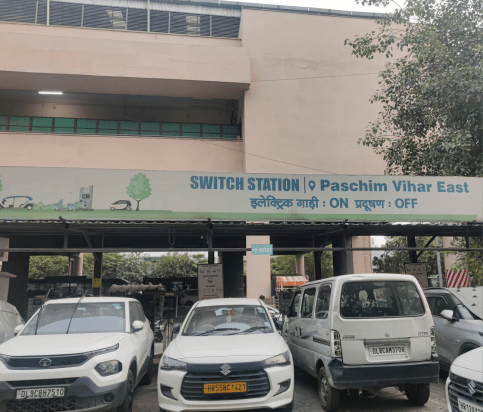
Ground reporting by Financial Express also found that several gaps are visible at public charging stations across Delhi.
“I’ve reached charging stations only to find that some chargers were not working. At busy locations, you often have to wait because all charging points are occupied. Even after getting a charger, the charging process itself takes time, unlike refuelling a petrol or diesel vehicle. Range anxiety isn’t the only issue anymore—charger reliability and waiting time are equally frustrating.”

Jatin Narwal, who owns an MG Windsor EV, said unreliable charging infrastructure remains one of the biggest concerns despite the growing charging network.
While the policy promises to install more than 30,000 public charging points by 2030, the current charging ecosystem continues to present practical challenges.
During ground reporting, Financial Express visited 5 charging stations in Inderlok and Paschim Vihar, where three charging points were found to be non-functional.

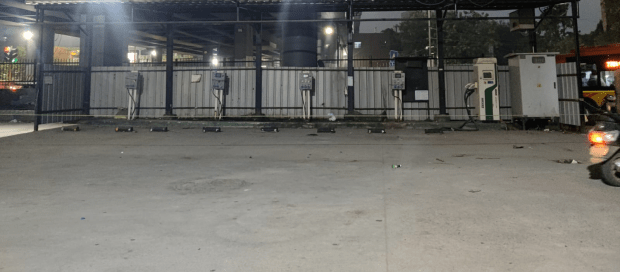
At another location, EV owners were seen waiting in queues before they could access available chargers, highlighting the gap between planned charging infrastructure and the actual user experience.
Can Delhi’s power grid handle a rapid rise in EV charging?
One of the biggest questions surrounding Delhi’s EV rollout is whether the city’s electricity infrastructure is ready for concentrated charging demand.
EV charging today is approximately 2.6% of peak load, and the projected 375 MW, is roughly 4% and constitutes under half a per cent of Delhi’s annual consumption.
The policy proposes time-of-day (TOD) electricity tariffs to encourage off-peak charging, as many commercial vehicles require fast charging when electricity demand is already high. This raises concerns over whether local transformers and distribution infrastructure could face stress in high-demand areas.
Randheer Singh believes the policy anticipates this challenge by making grid planning a prerequisite before charging stations are installed.
According to Singh, the objective is to prevent localised grid stress by planning charging infrastructure alongside electricity capacity instead of expanding chargers without assessing network readiness.
However, “the current limitation is the ability of discoms to install TOD smart meters,” Ramakrishnan noted.
Can Delhi solve the residential charging challenge?
Perhaps the biggest long-term challenge lies in residential charging. Although the policy mandates EV-ready parking in new developments, much of Delhi’s existing housing consists of DDA flats, apartments and dense colonies where residents neither have dedicated parking nor private charging points.
Rather than relying solely on home chargers, Singh believes Delhi will require multiple charging models.
“The answer is layered, since the vast majority of Delhi’s housing stock will not work with a private wall box model. RWAs must enable community charging at the locations where the vehicles are parked. Battery swapping eliminates the need for 2 and 3 wheelers to stay overnight. Low cost AC points at streetlights, markets and metro stations facilitate charging during day time. The design principle is equity of access not ownership of a chargepoint.”
His suggestion points towards a combination of community charging, battery swapping and public AC chargers instead of individual home charging.
Ramakrishnan believes parking availability and not electricity could become Delhi’s biggest bottleneck.
“The core issue that will affect the adoption in future is availability of parking space as EV’s in slow charge take about 5-8 hours time to charge. A large part of Delhi’s vehicles are parked on the street. Core issue for future is Parking availability. Unless this issue is sorted out at multiple levels mass adoption of EV’s are not feasible.”
Will dealership charging stations work in the long run?
Another notable provision of the policy requires every Original Equipment Manufacturer (OEM) dealership in Delhi to install at least one public charging station.
While the move could quickly increase charging availability by using existing dealership infrastructure, questions remain over whether showrooms are the right long-term locations for public charging or whether they could result in fragmented infrastructure.
Singh views the requirement as a transitional measure rather than a permanent solution.
“A bridge, not a destination. Dealerships have existing power uptake, trained staff, and are spread throughout the city, so deployment is fast and cheap. The concern on fragmentation is valid and the guardrail is that these stations are within DTL uptime & service standards on the unified platform. The architecture of oversight is more important than the mandate.”
According to him, the success of the dealership model will depend less on the location itself and more on whether those chargers operate under common monitoring and service quality standards.
The policy’s success may ultimately depend on execution
Delhi’s EV Policy 2.0 sets ambitious targets backed by purchase incentives, tax exemptions, charging infrastructure, battery recycling, scrapping incentives and phased electrification of multiple vehicle categories.


