




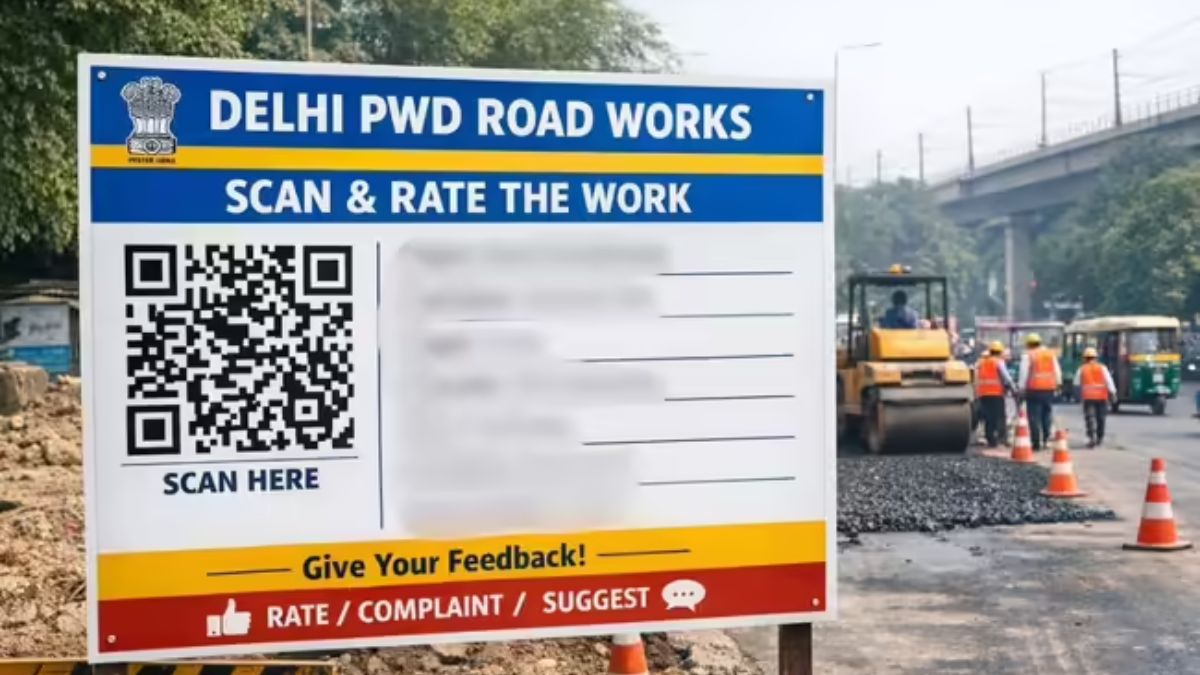
In a notable development, Delhi residents can now track the status of roads in the city with the help of a QR code. The quick-response code allows residents to check when roads were last repaired, identify the officials responsible for its upkeep and report potholes directly from their phones.
The Delhi Public Works Department (PWD) is preparing to launch its ‘Know Your Road’ project across the national capital. Unique QR codes will be displayed at prominent locations along every PWD-managed road, according to an announcement by the department on Thursday.
PWD Minister Parvesh Verma said the department had completed most of the groundwork for the project. The initiative is aimed at making information on road construction and maintenance publicly accessible, while creating a direct channel between commuters and the engineers responsible for each stretch.
What will the QR code show?
Scanning the code will take users to a citizen portal carrying the road’s name and length, date of construction, last repair date and maintenance history.
The portal will also display the name of the agency or contractor handling the road and the contact details of the executive engineer and other officials responsible for its upkeep. Citizens will be able to register complaints related to potholes, waterlogging, damaged surfaces and other maintenance problems and subsequently track their status.
As per the government body, the portal would serve multiple functions unlike a general complaint portal. The proposed system will link each grievance to a specific road and administrative division.
The platform is expected to be available in English, Hindi and Punjabi. An administrative dashboard and analytics tools will allow PWD officials to track complaints, repair work and response times.
Around 2,500 codes across 1,400 km
The department plans to install around 2,500 QR codes, including signboards on both sides of major roads, across its roughly 1,400-km network.
Delhi’s Economic Survey 2025-26 places the department’s road network at 1,386 km, comprising 26.28 km of national highways and 1,359.9 km of other roads.
The initiative will cover the network managed by the PWD and not necessarily every road falling within Delhi’s geographical limits.
PWD had earlier floated bids and earmarked nearly Rs 96 lakh for the implementation, operation and maintenance of the QR-based system.
The amount covers development of the citizen portal and administrative dashboard, installation of codes and subsequent technical support.
Five-road launch, followed by 100-road pilot
The implementation plan provides for a phased rollout to be completed within 60 days of the bids being awarded. It will begin with digitisation of road records, followed by platform development, pilot implementation, citywide deployment and finally, operations and maintenance.
During the first two weeks, the selected agency will digitise existing road records and map road IDs, zones, divisions, engineers and contractors. The system is expected to initially go live on five roads.
The pilot will then be expanded to around 100 roads during the third week. Officials will test the speed of QR scans, complaint registration workflow, dashboard reporting and grievance-tracking mechanism before making further changes.
Between the fourth and eighth weeks, parallel field teams will install the remaining codes across the city and make the citizen portal fully operational. The longer-term plan includes live updates to maintenance records, monthly monitoring reports and annual road-health audits.
The launch has been positioned by the incumbent Delhi government “as a part of the wider push to change how road repairs are monitored.” The real test for the QR-code project, however, will be whether complaints recorded through the portal translate into time-bound repairs.
Public access to maintenance records can identify responsibility, but accountability will depend on how consistently the department updates the data and closes grievances.


