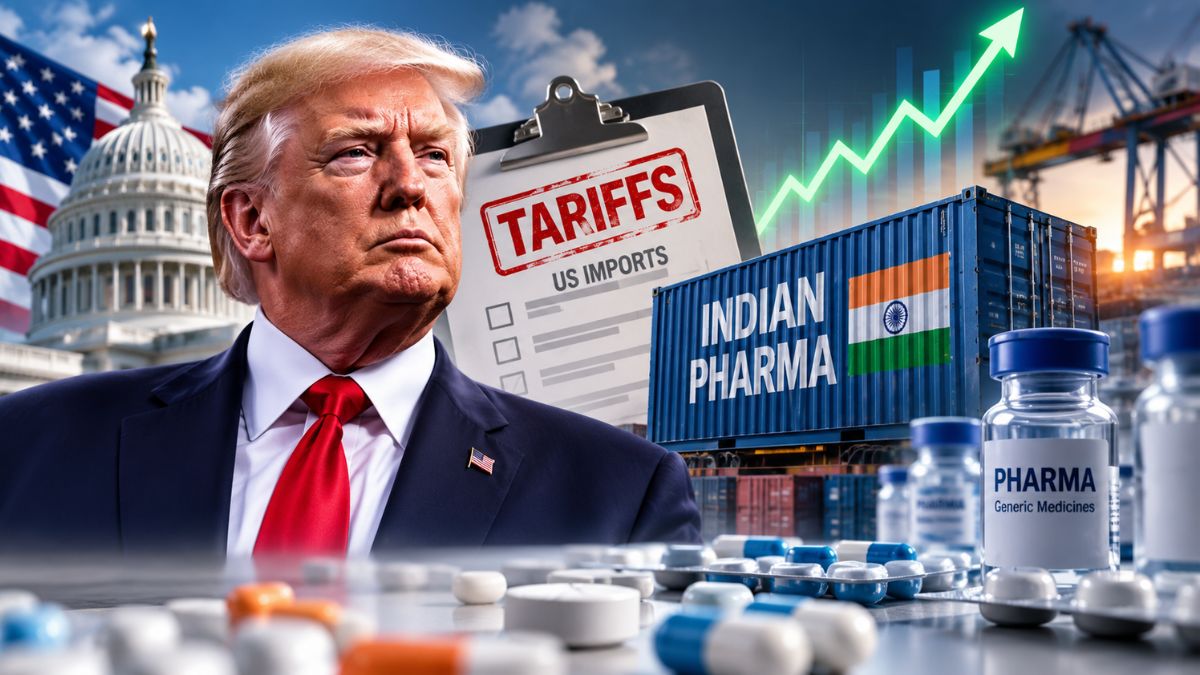
US President Donald Trump’s proposal to impose tariffs of up to 200% on generic medicines imported into the US is unlikely to cause lasting damage to large Indian pharmaceutical companies, according to Bernstein.
The brokerage believes the proposal is primarily a negotiating tool rather than a durable policy change and argues that India’s leading generic drugmakers remain better positioned to benefit than suffer, even if tariffs are eventually implemented.
The report comes after Trump said on July 21 that generic drugs entering the US would face a 100% tariff from August 2028, rising to 200% from 2029.
The brokerage said its coverage universe is more likely to benefit than be harmed by the proposal.
Bernstein says the tariff proposal is largely political
Bernstein said it views the announcement as part of a broader trade negotiation rather than a definitive policy decision.
The brokerage noted that similar tariff proposals during the US-China trade dispute were eventually delayed, diluted or partially exempted once the implications for US companies and consumers became clearer.
According to Bernstein, generic medicines have become a convenient pressure point in wider trade negotiations, making the proposal more of a negotiating lever than a lasting policy shift.
Indian drugmakers already have a roadmap for shifting production
Bernstein said relocating production from India to the US is neither unprecedented nor scientifically complex for many generic medicines.
The brokerage estimates that 70% to 80% of generic drug applications today involve ordinary solid oral tablets and capsules.
For immediate-release tablets, Bernstein said transferring manufacturing from an Indian facility to a US plant generally requires comparison-of-dissolution testing, a few trial batches and stability data. It estimates the process costs about $1 million to $1.5 million and can typically be completed within a year.
For extended-release tablets, however, the process is considerably more demanding, requiring a fresh human bioequivalence study, three stability batches and regulatory approvals before commercialisation. Bernstein estimates such transfers cost around $2 million to $4 million and take 18 to 30 months.
The brokerage added that large Indian pharmaceutical companies already operate manufacturing facilities in the US and supply about 65% of US generic drug volumes, putting them in a stronger position to expand capacity if required.
Higher US manufacturing costs remain the biggest hurdle
Bernstein said the economics of manufacturing generic medicines in the US remain challenging, even under a potential 100%-200% tariff regime.
According to the brokerage, labour costs in the US are several times higher than in India, while utilities, GMP compliance, quality assurance, maintenance and batch-release requirements further increase operating expenses.
Bernstein estimates that a scaled US oral-solid manufacturing facility carries annual operating costs of about $25 million to $40 million before profit after tax (PAT).
For sterile ophthalmic manufacturing, annual operating costs could rise to about $55 million to $70 million, excluding utilisation risk.
The brokerage said tariffs may alter the economics of supplying oral generic medicines to the US, but they do not make US manufacturing competitive unless generic drug prices rise materially or the tariff proposal is diluted.
As a result, Bernstein believes Indian pharmaceutical companies are more likely to use US manufacturing selectively for strategic products, while continuing to manufacture high-volume generic medicines in India.
Bernstein expects limited near-term impact on Indian pharmaceutical companies
Bernstein said the most likely outcome involves a combination of court stays, changes to the scope of the tariffs, geographical dilution and higher selling prices to support domestic US manufacturing.
The brokerage concluded that the near-term implications for large Indian biopharmaceutical companies remain limited and said its coverage universe appears more likely to benefit than be harmed.
Conclusion
Bernstein believes concerns over proposed US tariffs on Indian generic medicines may be overstated.
While the brokerage acknowledged that tariffs could change the economics of supplying some products to the US, it argued that manufacturing costs remain structurally higher in the US.
Large Indian drugmakers already possess the manufacturing footprint and operational flexibility needed to respond. It therefore expects the proposal to create uncertainty in the near term without fundamentally altering the long-term outlook for major Indian pharmaceutical companies.
Disclaimer: The views, insights, and analyst commentary referenced in this article are derived strictly from brokerage research reports (Bernstein) and are provided for informational and educational purposes only. They do not constitute financial, legal, or investment advice, nor an endorsement or solicitation to buy, sell, or hold any security.
Forward-looking statements and tariff estimates carry inherent market and regulatory risks. Stock markets are subject to macroeconomic volatility, geopolitical changes, and regulatory shifts. Readers and prospective investors must conduct their own due diligence, assess their individual risk profiles, and consult a qualified SEBI-registered financial advisor before taking any positions in the market.