




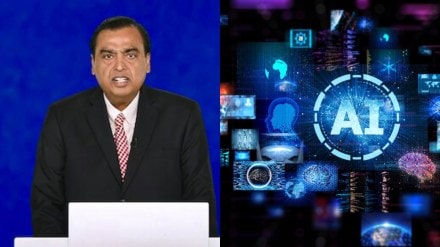
Mukesh Ambani on Tuesday unveiled a draft artificial intelligence manifesto for Reliance Industries, setting out an ambition to transform the group into an AI-native deep-tech enterprise while targeting a ten-fold improvement in productivity across its workforce of more than 600,000 people and a 10x impact on the economy and society.
Mukesh Ambani on Artificial Intelligence
Calling artificial intelligence “the most consequential technological development in human history”, Ambani said the conglomerate intends to lead India’s AI shift much as it did the country’s digital transformation over the past decade. The stated objective, he said, is to deliver “Affordable AI for every Indian”, with AI embedded across Reliance’s businesses while remaining safe, trusted and accountable.
“At Reliance, we have embarked on a path to transform ourselves into an AI-native deep-tech company with advanced manufacturing capabilities,” Ambani said in a detailed message to employees. “To pursue this resolve, we have prepared a draft of the Reliance AI Manifesto. This draft is a guide to an action plan.”
Decoding Reliance’s AI manifesto
The draft manifesto is divided into two parts. Part I focuses on internal transformation, positioning AI not as a standalone technology programme but as a new way of working across the organisation. Part II extends the vision to how Reliance’s businesses and philanthropic initiatives can help catalyse India’s broader AI transformation.
Detailing the internal agenda, Ambani said Reliance will reorganise work around outcomes rather than functions, with end-to-end workflows redesigned and supported by common digital platforms and tighter governance. Core processes such as procure-to-pay, order-to-cash, hire-to-retire and plant-to-port will be re-engineered to eliminate manual handoffs, close “digital breaks” and enable real-time visibility and decision-making.
“This is not a technology project. This is a new way of working,” he said. AI and agentic automation, he added, will be used to remove friction, cut repetitive manual effort and improve the quality and speed of decisions, while retaining clear human accountability. “It is not about replacing people. It is about raising standards and releasing our organisation’s collective potential.”
A common 12-layer digital functional core blueprint will standardise data, integration, security and controls across the group, while allowing individual businesses ownership of their platforms. Governance, audit trails and human-in-the-loop controls will be embedded by design to ensure that faster execution and greater autonomy do not compromise safety, compliance or trust.
Execution will be driven by small, cross-functional “pods” with single ownership and clearly measurable goals. These teams will move from experimentation to scaling and then stable operations, supported by continuous data, operations, governance, learning and automation flywheels.
Ambani said the same logic of AI-led productivity could be applied beyond the group. “Just as we can drive a 10x improvement in velocity, efficiency, quality and outcomes by AI-transforming our workflows, we can also achieve a 10x impact on India through our businesses and philanthropic initiatives,” he said.
The manifesto invites employees to contribute ideas on deploying AI across Reliance’s portfolio, ranging from telecom and retail to energy, materials, life sciences, financial services, media and philanthropy. Ambani pointed to the potential to leverage platforms such as Reliance Jio, with over 500 million subscribers, and the country’s largest retail network to expand AI access and adoption at scale.
He also flagged opportunities in AI-powered discovery of new materials, green energy solutions, healthcare and education breakthroughs, and more inclusive financial services. Indigenous AI hardware, robotics and energy-efficient systems were highlighted as areas where Reliance could contribute to technological self-reliance while improving efficiency and sustainability.
The group’s philanthropic arm, Reliance Foundation, will also be part of the push, with Ambani asking how AI could further enhance its work in healthcare, education, rural transformation, disaster mitigation, culture and conservation.
Ambani has invited employees to submit suggestions between January 10 and January 26, after which the manifesto will be finalised.


