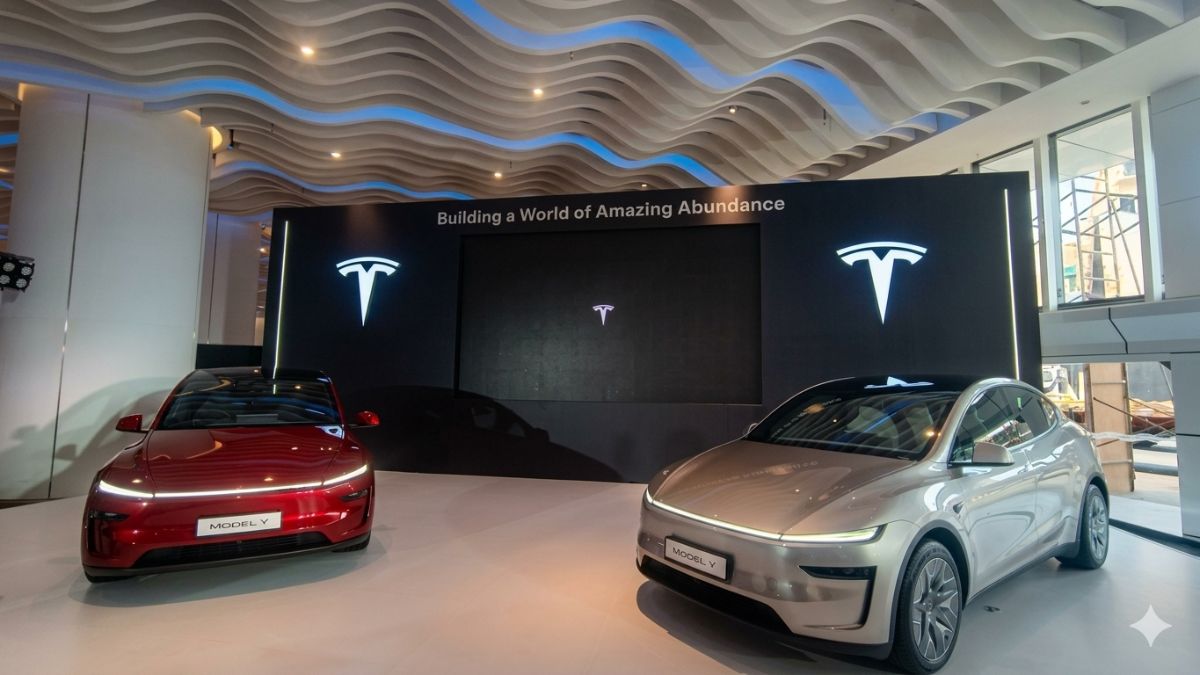
India’s electric car market is on the rise, but the world’s most recognisable EV maker is struggling to ride the wave. A year since its much-awaited India debut, the Elon Musk-led Tesla has registered just 486 cars in the country, according to Vahan data till 5 pm on Tuesday.
In June, Tesla registered just 35 cars, according to data from the Federation of Automobile Dealers Associations (Fada). In comparison, BMW and Mercedes-Benz sold 486 and 234 EVs, respectively. In the luxury EV market, Tesla’s share stood at 4.4%, against BMW’s 60.8% and Mercedes-Benz’s 29.1%.
According to industry experts, the challenges for Tesla in India are manifold — higher price point, single-model portfolio, limited sales and service points, and the absence of local assembly. Tesla formally entered India on July 15, 2025, opening its first experience centre in Mumbai and launching the Model Y (priced at Rs 59.89 lakh).
Deliveries began in September. The carmaker has since expanded to Delhi, Gurugram, Bengaluru and Hyderabad, installed superchargers and rolled out the six-seat Model Y L (at Rs 61.99 lakh). Yet, monthly registrations have remained below 75 units.
The muted uptake is despite India’s EV sales more than doubling — with 31,823 units registered in June alone — and penetration touching 7.7% from 4.8% a year earlier. For Tesla, the challenge is that India’s EV boom is playing out largely below its price point — in the Rs 8-30-lakh range — according to experts. Tesla has since cut the Model Y’s starting price by Rs 9 lakh to Rs 50.89 lakh, but yet to make any headway.
Tata Motors, Mahindra and JSW MG Motor are expanding across the Rs 8-30-lakh market along with newer entrants like Vinfast and even Maruti or Hyundai. Imported from China as completely built units, Tesla’s cars face steep import duties. At its current prices, Tesla runs into established premium rivals.
The BYD Sealion 7 starts at Rs 49.40 lakh, while the locally assembled BMW iX1 LWB competes in a similar price band. Buyers spending Rs 50-60 lakh also expect premium interiors and a well-established luxury ownership experience, according to industry experts.
Also, Tesla remains essentially a one-model brand in India. The absence of an offering in the Rs 20-40-lakh segment limits its addressable market. Introducing the Model 3 could lower the entry point to the brand.
Tesla’s online-first, direct-to-consumer model faces another India-specific test. Car sales here continue to depend on multiple test drives, sustained dealer follow-ups, financing, exchange programmes and local activations. Tesla’s limited physical presence means fewer customer touchpoints.
Its service and proprietary charging footprint also remains concentrated in major metros. For premium buyers undertaking inter-city journeys, limited workshop access, roadside assistance and charging remain key considerations. The absence of local assembly compounds these challenges. Imports keep prices high even as rivals increasingly use localisation to sharpen their offerings.
For Tesla, cracking India may require a different playbook: a cheaper model, wider portfolio, deeper sales and service reach, stronger ground-level marketing and, eventually, localisation. Until then, India’s EV boom looks set to accelerate largely without Tesla.