




The Massachusetts Department of Public Health announced on Wednesday that it had confirmed a single case of monkeypox virus infection in a man who had recently travelled to Canada. Moreover, the US Centers for Disease Control and Prevention (CDC) said on Wednesday that its labs confirmed the infection to be monkeypox. Meanwhile, the state health officials have started carrying out contact tracing. After this case was reported, the Public Health Agency of Canada late on Wednesday issued a statement stating that it is aware of the monkeypox cases in Europe and is closely monitoring the current situation, adding no cases have been reported at this time.
According to doctors and health experts, Monkeypox mostly occurs in West and Central Africa. It is a rare viral infection similar to human smallpox, though milder. It was first recorded in the Democratic Republic of Congo in the 1970s. However, the number of cases in West Africa has increased in the last decade.
Countries like Spain and Portugal have detected over 40 suspected cases of monkeypox and the outbreaks concentrated in the Madrid and Lisbon areas, officials said Wednesday, as reported by the news agency AFP. This comes days after the British health authorities said they had detected seven cases so far this month, with the World Health Organization (WHO) working with the government to investigate the outbreak.
Last week, WHO warned that the virus is spreading in sexual networks. Health officials have also noted that some of these infections may be through sexual contact — in this instance among gay or bisexual men — which would be a new development in understanding how the virus is transmitted. In Madrid, health authorities issued a statement and said they had detected “23 possible cases of monkeypox” and all of them were believed to have been transmitted through sexual activity. They also informed that the reported cases were all among males, the majority of them young and had ulcerated lesions.
What is Monkeypox?
According to WHO, Monkeypox is a sylvatic zoonosis with incidental human infections that usually occur in forested parts of Central and West Africa. It is caused by the monkeypox virus which belongs to the orthopoxvirus family. Monkeypox can be transmitted by droplet exposure via exhaled large droplets and by contact with infected skin lesions or contaminated materials.
“Monkeypox is basically a viral disease caused by the monkeypox virus. And it is supposed to be a relatively smallpox virus and the symptoms are quite similar, but the main difference is that in monkeypox there is lymph node enlargement,” Dr. Sulaiman Ladhani, Consulting Chest Physician MD Chest and Tuberculosis, Masina Hospital, Mumbai told Financial Express.com.
WHO has revealed that there are two clades of monkeypox virus: the West African clade and the Congo Basin (Central African) clade. “Although the West African clade of monkeypox virus infection sometimes leads to severe illness in some individuals, the disease is usually self-limiting. The case-fatality ratio for the West African clade has been documented to be around 1%, whereas, for the Congo Basin clade, it may be as high as 10%. Children are also at higher risk, and monkeypox during pregnancy may lead to complications, congenital monkeypox, or stillbirth,” the global health agency said in a statement on Wednesday.
Although vaccination eradicated smallpox across the world in 1980, monkeypox continues to occur in countries in central and west Africa. It is a disease that is transmitted from infected animals to humans. According to the WHO, cases occur close to tropical rainforests inhabited by animals that carry the virus. Monkeypox virus infection has been detected in squirrels, Gambian poached rats, dormice, and some species of monkeys. The health agency also maintained that human-to-human transmission is quite limited.
“Transmission, when it occurs, can be through contact with bodily fluids, lesions on the skin or on internal mucosal surfaces, such as in the mouth or throat, respiratory droplets, and contaminated objects,” WHO stated.
Symptoms and treatment
According to CDC, monkeypox begins with a fever, headache, muscle aches, backache, and exhaustion. It also causes the lymph nodes to swell (lymphadenopathy), which smallpox does not. The WHO underlines that it is important to not confuse monkeypox with chickenpox, measles, bacterial skin infections, scabies, syphilis and medication-associated allergies.
“Lymph nodes which are present in the neck and in the body gets swollen and the infected person has pre rough fever or plus a slowly progressive rash on the body, which normally begins from the face and, they are eruptive rashes. It is spread from person to person by maybe respiratory droplets, and close contact with body fluids. And it is also speculated to directly pass through sexual contact. But studies are still underway to confirm the same,” Dr. Ladhani told Financial Express.com.
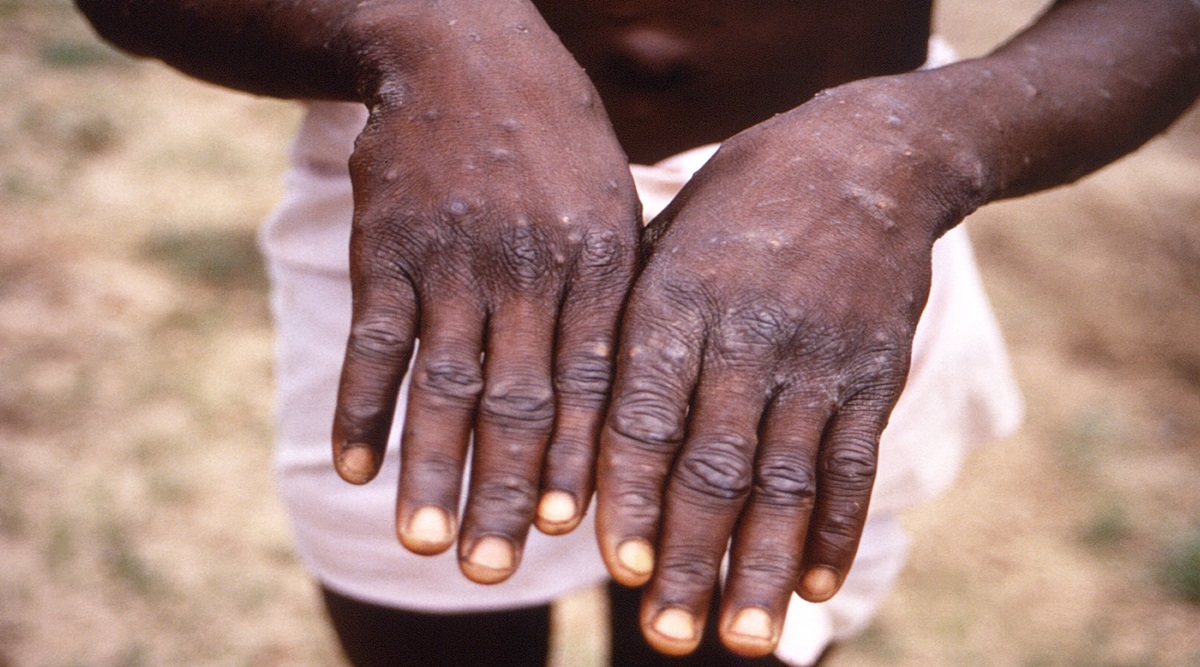
According to WHO, the incubation period for monkeypox is usually 7-14 days but can range from 5-21 days. Generally, within a day to 3 days of the onset of fever, the patient develops a rash that begins on the face and spreads to other parts of the body. Moreover, the skin eruption stage can last between 2 and 4 weeks, during which the lesions harden and become painful, fill up first with clear fluid and then pus, and then develop scabs or crusts.
According to the WHO, the proportion of patients who die has varied between 0 and 11 percent in documented cases and has been higher among young children. There is no safe, proven treatment for monkeypox yet. The WHO recommends supportive treatment depending on the symptoms. Awareness is important for the prevention and control of the infection.
The first occurrence of Monkeypox
According to CDC, the monkeypox infection was first discovered in 1958 following two outbreaks of a pox-like disease in colonies where monkeys were kept for research and this led to the name ‘monkeypox’. Meanwhile, the first human case was recorded in 1970 in the Democratic Republic of the Congo (DRC) during a period of intensified effort to eliminate smallpox. According to the WHO, 15 countries on four continents have so far reported confirmed cases of monkeypox in humans.
Locally acquired cases have been confirmed in the DRC (which has the largest incidence of infection in the world), Central African Republic, Republic of the Congo, Gabon, Cameroon, Nigeria, Côte d’Ivoire, Liberia, and Sierra Leone. Meanwhile, imported cases have been found in South Sudan and Benin in Africa, and in the United States, UK, Israel, and Singapore.


