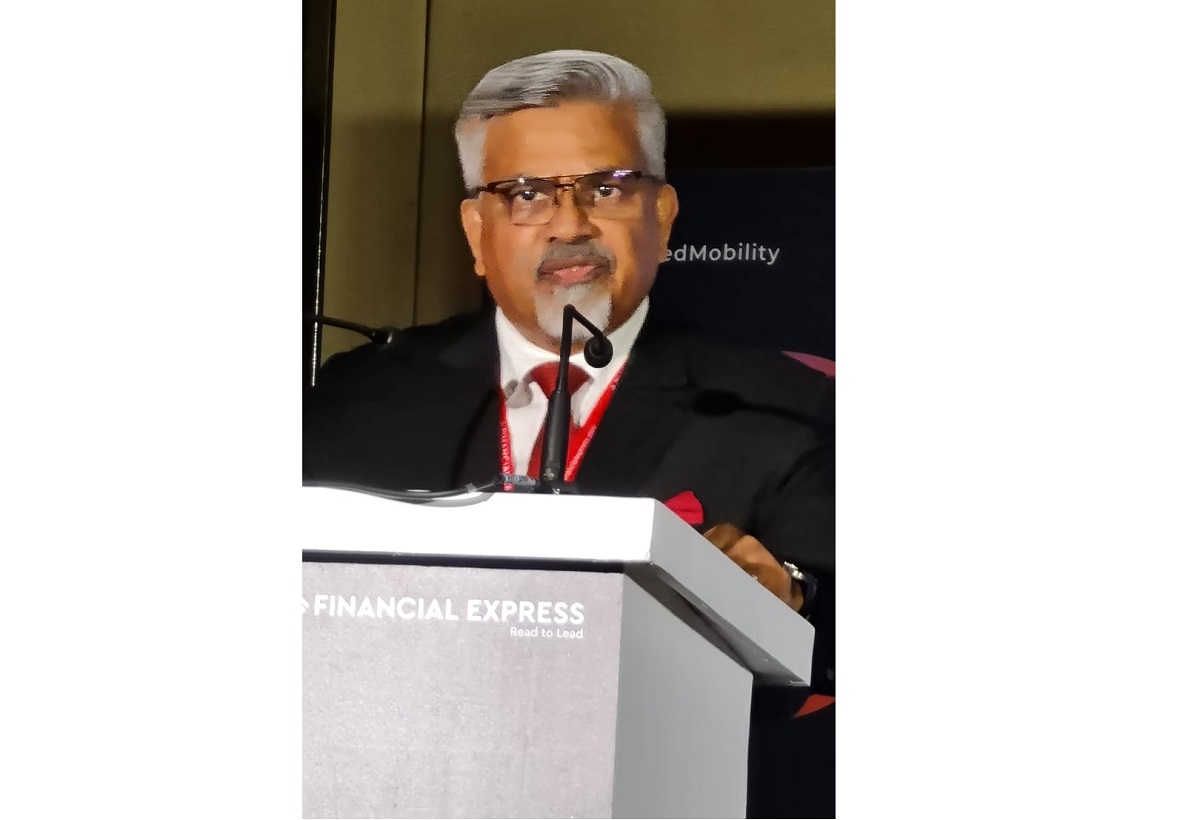
“Customers don’t want products and services, they want solutions. It is the starting era of partnerships and collaborations,” said, Kamal Bali, President & MD, Volvo Group India. He was delivering a special address at The Financial Express Mobility Summit 2022 on August 25, in Bengaluru.
He set the tone of the discussion by highlighting that the world is “being run by a twin engine. One engine: Pollution, congested cities, resource scarcity. And the other engine being the never-ending opportunities in terms of sustainability and technology. The aim is to bridge and connect the two engines through technology, innovation, and collaboration.”
Talking about the challenges, he mentioned that in the last two years the industry has seen unprecedented hardships, which proves that “Uncertainty is a new reality. The pandemic was not the first challenge, and definitely, it will not be the last.”
According to Bali, going forward, organisations that are agile and adaptable will be the only ones to last in the challenging times and the industry will need to build to adapt to these new realities.
There is growing awareness and demand globally for holistic sustainable solutions, which are not just eco-friendly but economically affordable and morally acceptable. Pointing out what it means for India, he said, “At present, India accounts for only 3% of the global manufacturing. If India grabs 20% of manufacturing, we will have manufacturing at $1.2 trillion (Rs 94,68,000 crore), which will contribute 25% towards India’s GDP,” shared Bali.
He further highlighted the third important trend is that of new emerging technologies that are disruptive in nature and forcing the industry to change and evolve. The Volvo India Chief believes that the era of accelerated innovation is here to stay. It is now all about perform or perish, which is supported by the startup ecosystem.
He gave an instance of how Volvo and Daimler who traditionally have been stiff competitors are now working together in different aspects, for instance, to create the charging infrastructure in Europe.
“Partnership and collaboration will be the future. Skillsets are changing, and knowledge is available on demand, but the skill gap is worrying. One needs to unlearn and learn to be relevant for the current and future scenario,” explains Bali.
Elaborating on his perspective on the future he says the demand for mobility will only grow, it may double and triple. It will be driven mainly by emerging countries; electric vehicles and alternative fuel vehicles. While autonomous vehicles are far away their autonomous functions can be implemented in select scenarios.
He however cautioned that technology needs to be used to solve problems and not just for the sake of using it.
Giving an example of the commercial vehicle segment Bali says “More than 50% of the time, trucks are not moving cargo, this is a huge opportunity to monetise. Drones will take over last-mile connectivity. Almost 40 percent of global R&D work is done in India, and the future is not just about competition but also about collaboration.”