




India’s June inflation print has done exactly what headline numbers tend to do – it has grabbed attention.
Retail inflation accelerated to 4.38%, moving above the Reserve Bank of India’s 4% target after remaining comfortably below it in recent months. Predictably, the immediate question across financial markets is whether this changes the RBI’s interest rate trajectory.
The short answer is: Probably Not.
A central bank may not react simply because inflation crosses a numerical threshold. It is rather likely to respond to the nature of inflation, its persistence and, more importantly, whether monetary policy is capable of influencing the underlying drivers.
Judged on those parameters, June’s inflation print appears to be driven more by supply-side factors than by the beginning of a broad-based inflation cycle.
The largest contribution came from food prices. Seasonal increases in vegetables – particularly tomatoes – along with higher milk prices pushed food inflation meaningfully higher. Fuel inflation also strengthened as the full impact of the earlier increase in retail petrol and diesel prices flowed through the data.
Neither of these developments necessarily points to stronger consumer demand or an economy operating beyond its productive capacity…
This is critical because monetary policy is fundamentally a demand-management tool. Higher interest rates may moderate credit growth, consumption and investment, but they cannot produce a better harvest, ease supply-chain bottlenecks or lower global crude oil prices. Hence, responding aggressively to temporary supply-side shocks may risk slowing growth without addressing the underlying source of inflation.
This is why the composition of inflation matters far more than the headline itself.
Core inflation, which excludes food and fuel, edged higher in June, prompting concerns that underlying price pressures may be building. However, a closer examination paints a more nuanced picture.
Gold and silver prices have rallied significantly over the past year, and since precious metals form part of India’s core CPI basket, they have mechanically lifted core inflation.
Excluding these components as well reveals a much more benign picture. This “core-core” measure remains relatively subdued, suggesting that underlying domestic demand continues to be soft- a far more relevant indicator of persistent inflationary pressures.

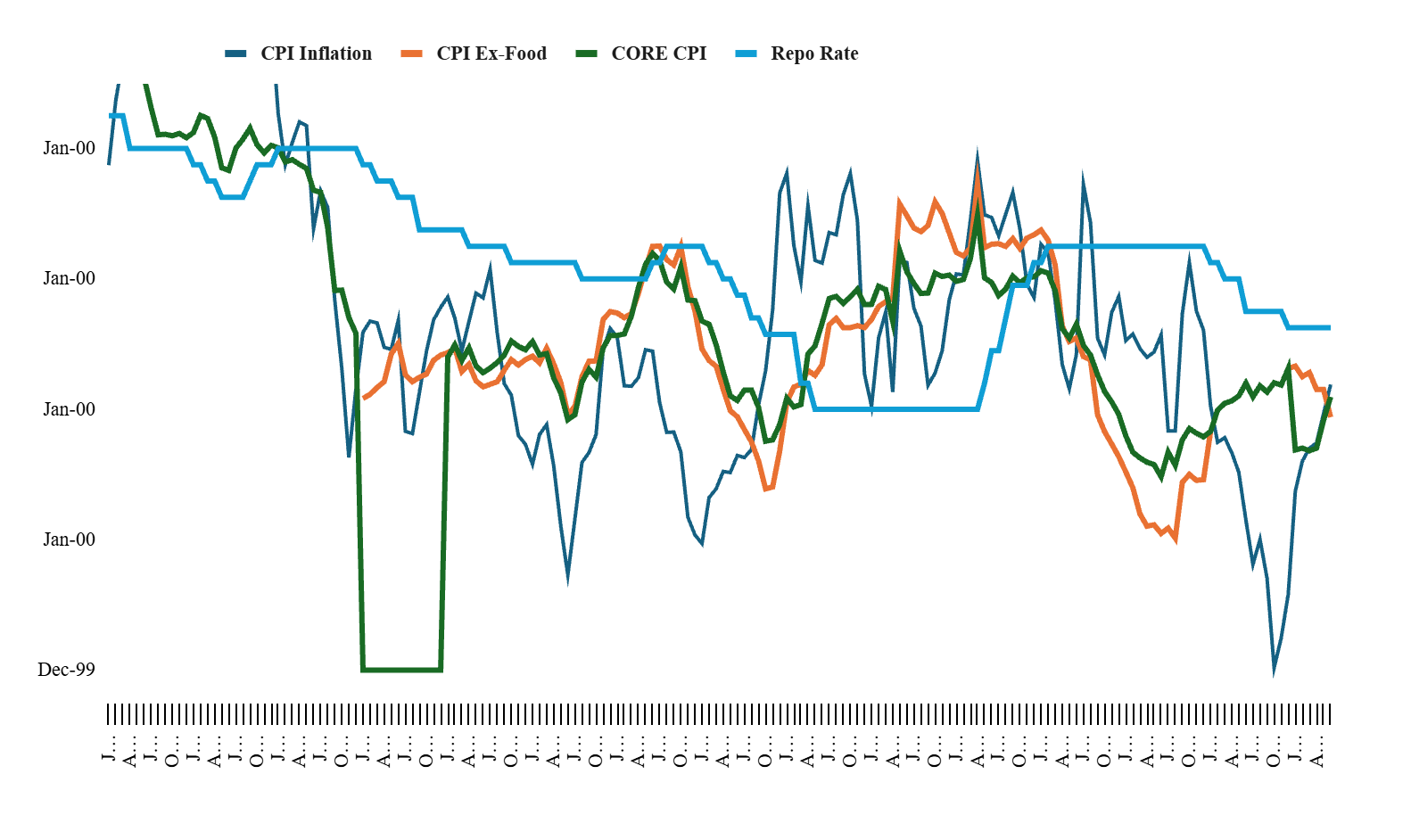
Inflation driven by volatile food prices or imported commodity costs warrants patience and careful monitoring. Inflation arising from broad-based demand pressures requires a monetary policy response. At present, the evidence appears to support the former rather than the latter.
That explains why the broad consensus among economists continues to favour an extended RBI pause despite the higher headline inflation print.
We believe the central bank is unlikely to overreact to a single month’s data, particularly when broader indicators suggest that demand-led inflation remains contained.
This does not mean inflation risks have disappeared and our outlook remains watchful. In line with the RBI’s own projections, headline inflation could move closer to the upper end of the tolerance band of around 6% by the fourth quarter of FY27.
Our FY27 CPI inflation estimate stands at 4.8% year-on-year, with risks tilted to the downside. Accordingly, we do not expect the RBI to raise policy rates through Q3 FY27.
Two uncertainties deserve particularly close attention.
The first is crude oil. Geopolitical developments in West Asia remain fluid, and a sustained rise in crude prices would eventually feed into transportation costs, production expenses and inflation expectations. Unlike the current base effects, a prolonged increase in oil prices could evolve into a more persistent inflation challenge.
The second is the progress of the southwest monsoon. Rainfall has been uneven in several regions, raising questions around kharif sowing and the outlook for food prices later in the year. While India’s food inflation has become less sensitive to monsoon fluctuations than it was a decade ago – supported by better buffer stocks, improved irrigation and more efficient supply-chain management – agriculture remains an important swing factor. A weaker-than-expected harvest could keep food inflation elevated for longer.
These are genuine risks, but they remain prospective rather than immediate. Monetary policy is generally more effective when responding to sustained inflationary pressures than to temporary volatility.
For fixed income investors, this distinction is particularly important. Bond markets often react sharply to headline inflation numbers, but durable movements in yields are shaped by expectations of future monetary policy rather than a single month’s data. If inflation is being driven primarily by food and fuel while underlying demand remains contained, the probability of an immediate policy tightening remains limited. That argues for focusing on the evolving macroeconomic landscape rather than reacting to every monthly inflation surprise.
The current environment reinforces the importance of flexibility. Inflation will largely hinge on two variables that policymakers cannot control – crude oil prices and the monsoon. With both remaining uncertain, taking an aggressive one-way view on interest rates may be premature.
Markets often treat a move above the RBI’s 4% inflation target as a psychological milestone. But for policymakers and bond investors the headline is only part of the story. The more important question is whether inflation is becoming broad-based and demand-driven. June’s data suggest it is not. The inflation print deserves attention, but not alarm.
For debt investors, this underscores the case for active duration management. In an environment where the interest rate outlook can shift with incoming macro data, the ability to dynamically adjust portfolio duration while maintaining high credit quality can be more valuable than making a static call on the rate cycle. Flexibility, rather than conviction alone, is likely to remain the key differentiator in navigating the months ahead.
Source : Bloomberg,Reserve Bank Of India
Sneha Pandey is Fund Manager for Fixed Income and Multi-Asset Allocation Funds at Quantum AMC
Disclaimer, Statutory Details & Risk Factors:
The views expressed here in this article are for general information and reading purpose only and do not constitute any guidelines and recommendations on any course of action to be followed by the reader. Quantum AMC / Quantum Mutual Fund is not guaranteeing / offering / communicating any indicative yield on investments made in the scheme(s). The views are not meant to serve as a professional guide / investment advice / intended to be an offer or solicitation for the purchase or sale of any financial product or instrument or mutual fund units for the reader. The article has been prepared on the basis of publicly available information, internally developed data and other sources believed to be reliable. Whilst no action has been solicited based upon the information provided herein, due care has been taken to ensure that the facts are accurate and views given are fair and reasonable as on date. Readers of this article should rely on information/data arising out of their own investigations and advised to seek independent professional advice and arrive at an informed decision before making any investments.
Mutual Fund investments are subject to market risks, read all scheme related documents carefully.


