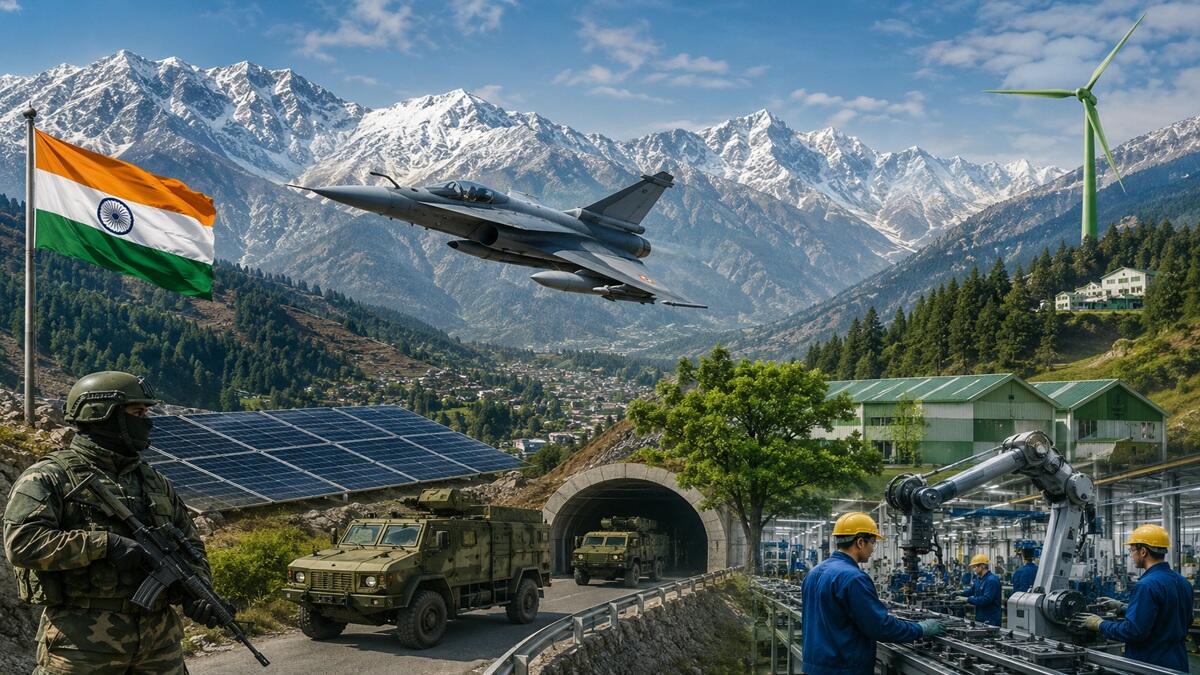
Himachal Pradesh is preparing a new industrial policy that will prioritise dedicated defence industrial corridor, green industries, local product-based manufacturing and even a food processing unit while discouraging power- and water-intensive units such as steel, ethanol and some chemical plants. Industries Minister Harshwardhan Chauhan said the policy is almost ready and is designed to attract cleaner investment, generate more employment, and raise state revenue.
HP Minister Chauhan told news agency ANI that the state is actively exploring a dedicated defence industrial corridor because defence manufacturing is a clean sector with strong job-creation potential. He said several companies have already approached the government seeking land for defence projects, and that such units would need large, relatively isolated parcels of land, making Himachal suitable for a corridor-based model.
Green industry, food processing and local products in Himachal
Harshwardhan Chauhan said the government’s “thrust is on green industries” and sectors that generate maximum employment, while industries that consume excessive electricity and water will be discouraged under the new policy. He added that the policy will promote environmentally sustainable infrastructure, stricter environmental norms, and clean manufacturing over polluting or chemically intensive production.
Along with defence, the policy will push food processing and enterprises based on Himachal’s local products. Minister Chauhan said the government also wants to strengthen market expansion for indigenous goods, a direction consistent with the state’s focus on Geographical Indication (GI)-tagged products and the “One District Three Product” initiative.
Power tariffs and private sector role
Chauhan said Himachal also plans to open industrial area development to the private sector, instead of relying only on the Industries Department and agencies such as Himachal Pradesh Housing and Urban Development Authority (HIMUDA) and Himachal Pradesh State Industrial Development Corporation (HPIDC). He said the policy will provide support for this shift, while incentives will be tied more closely to production so that industries contributing more to manufacturing and jobs are rewarded.
The minister said the government is examining further reductions in industrial electricity tariffs to improve Himachal Pradesh’s competitiveness. He noted that industrial power tariffs in the state are already slightly lower than in Punjab and Haryana, but the administration wants to make the state more attractive for fresh investment.
4.5 lakh jobs, major GST contributor and Rs 8,000 crore in electricity receipts
Chauhan said industries employ about 4.5 lakh people in Himachal Pradesh, including roughly 3 lakh ‘Himachalis’, and remain one of the state’s biggest employment generators. He also said the industrial sector is a major contributor to GST, fuel-related taxes, and electricity sales, adding that the Himachal Pradesh State Electricity Board earns around Rs 8,000 crore annually, of which nearly Rs 5,000-5,500 crore comes from industrial consumers.
The minister said Himachal Pradesh is already one of India’s major pharmaceutical manufacturing hubs, with nearly 30 per cent of the country’s pharma production taking place in the state. He also pointed to the state’s strong industrial ecosystem despite its mountainous geography, including large cement plants and limestone reserves that contribute significantly to mining revenue.
Harshwardhan Chauhan said the previous industrial policy expired in March and has been extended for three months, while the new policy is nearly complete. He said the larger goal is to attract fresh investment, support balanced industrial growth in a hill state with logistical disadvantages, and increase revenue through cleaner, more employment-intensive sectors.
In separate remarks in July to ANI, Minister Chauhan also highlighted Himachal’s export growth and pushed for a Directorate General of Foreign Trade (DGFT) satellite office in the Baddi-Barotiwala-Nalagarh corridor, saying it would strengthen export promotion and import substitution. He also urged faster work on the Chandigarh-Baddi rail corridor, underscoring the state’s broader effort to improve connectivity and industrial logistics.