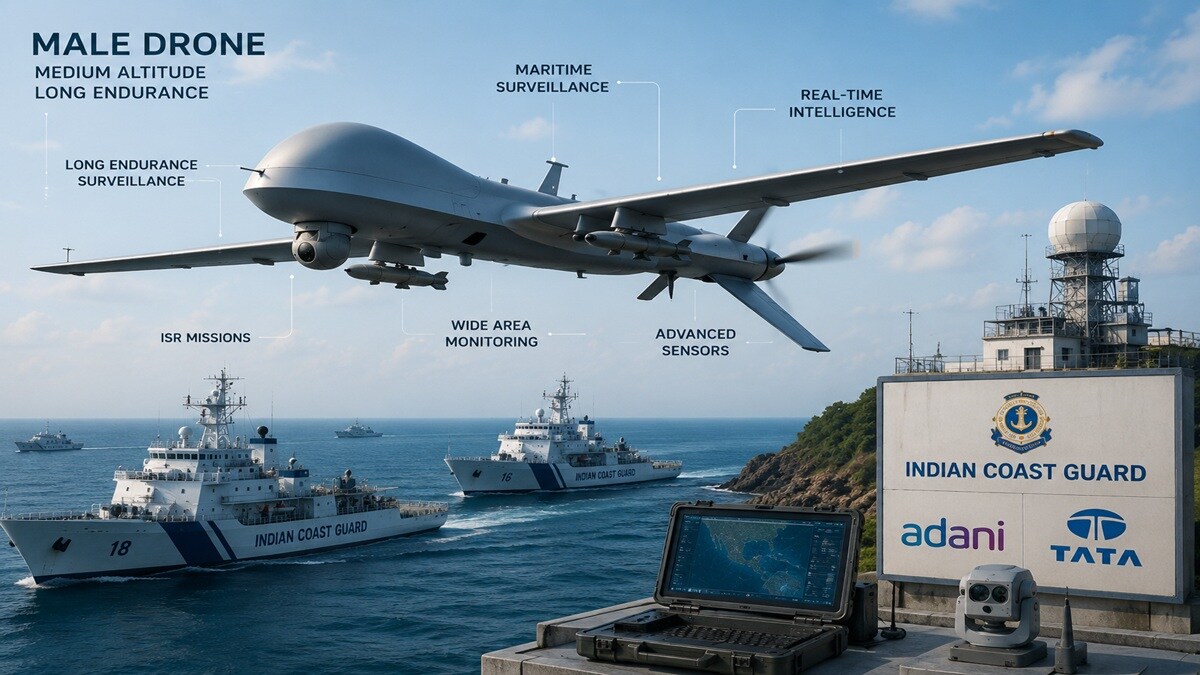
The Ministry of Defence has initiated a Rs 2,000 crore procurement process to acquire 10 Medium Altitude Long Endurance (MALE) unmanned aerial vehicles for the Indian Coast Guard, marking the force’s first major foray into high-end drone-based maritime surveillance, according to news agency ANI.
In a Request for Information (RFI) issued around July 15, the Ministry said that it “intends to procure 10 Medium Altitude Long Endurance (MALE) Remotely Piloted Aircraft (RPA) for use by Indian Coast Guard.” The move formally launches a competitive tender that is expected to attract major Indian defence companies.
What are MALE drones?
Medium Altitude Long Endurance (MALE) drones are large unmanned aerial vehicles designed to fly at medium altitudes (roughly 10,000–30,000 feet) for very long durations, often beyond 24 hours, to provide persistent intelligence, surveillance and reconnaissance over wide areas, and in some cases carry precision weapons for limited strike roles.
The project, valued at approximately Rs 2,000 crore, is expected to significantly enhance the Coast Guard’s surveillance capabilities compared to its current fleet of fixed-wing aircraft and helicopters. The tender will follow a single-stage, two-bid process under the Defence Acquisition Procedure, with technical and commercial bids evaluated separately before final negotiations with the lowest bidder.
Adani, Solar, Tata seen likely key contenders, says report
Citing industry sources, the ANI report said that Adani Defence, Solar Industries, and Tata Advanced Systems could be among the leading Indian companies expected to bid for the Rs 2,000 crore contract. These firms are already active players in the country’s indigenous MALE drone ecosystem and are well-positioned to offer mature, long-endurance UAV platforms tailored for maritime operations.
The Coast Guard’s tender is likely to draw synergies from the much larger ongoing tri-services programme for 87 MALE drones, valued at Rs 30,000–32,000 crore. That project has already seen interest from major players including Hindustan Aeronautics Limited (HAL), Adani Defence, Solar Industries, Raphe MPhibr, and Larsen & Toubro.
With several companies competing in both programmes, the Coast Guard acquisition could help strengthen India’s domestic UAV manufacturing base and bring down costs through economies of scale and greater commonality in platforms and support systems.
Mission profile: EEZ and SAR coverage up to 1,000 NM
The Defence Ministry’s RFI specifies that the MALE drones are intended for deployment by the Coast Guard’s Aviation Wing to provide search and rescue (SAR) support and enhance safety and security for mariners operating in India’s Exclusive Economic Zone (EEZ), which extends 200 nautical miles from the coastline.
In addition, the platforms will be tasked with coverage of the Indian Search and Rescue Region (ISRR), which in some sectors stretches up to 1,000 nautical miles into the Indian Ocean, significantly beyond the practical reach of current manned patrol patterns.
The Indian Coast Guard has so far relied mainly on Dornier maritime surveillance aircraft and helicopters for aerial monitoring and SAR duties. The introduction of SATCOM-enabled MALE UAVs capable of beyond-line-of-sight (BLOS) operations will allow persistent surveillance along the entire maritime perimeter, including sensitive stretches such as the Pakistan-facing Gujarat coast, the eastern seaboard and the island territories of Andaman & Nicobar and Lakshadweep.
What are the technical expectations: Long endurance, SATCOM and advanced sensors
MALE drones typically operate between 10,000 and 30,000 feet and can remain airborne for 24–48 hours, making them ideal for continuous maritime surveillance, tracking suspect vessels and supporting complex search operations. The Coast Guard’s requirement emphasises SATCOM-enabled BLOS capability, which allows remote pilots to control and receive sensor feeds well beyond radio line-of-sight, a critical feature for covering large oceanic areas.
Although the RFI text is not fully public, similar MALE programs have specified payload suites including electro-optical/infrared turrets, maritime search radar or synthetic aperture radar, AIS (Automatic Identification System) receivers, secure communication systems and potentially signals or communications intelligence packages.
The tender also mandates long-term product support, spares and maintenance tools, ensuring that the Rs 2,000-crore investment is backed by robust lifecycle logistics within India.
Complementing Rs 32,000-crore tri-services MALE programme
The Coast Guard’s Rs 2,000-crore tender sits alongside a much larger Rs 30,000–Rs 32,000 crore programme to procure 87 indigenous MALE drones for the Indian Army, Navy and Air Force, cleared by the Defence Acquisition Council (DAC) in August 2025. Under that scheme, the order is to be split between two Indian manufacturers in a 64:36 ratio, creating dual production lines and anchoring a long-term indigenous UAV ecosystem.
Officials and analysts note that the relatively smaller Coast Guard project may leverage designs and technologies developed under the tri-services programme, accelerating timelines and reducing risk. Together, the two programmes signal a coordinated push to mainstream MALE drones across India’s maritime and land borders, with the Coast Guard’s Rs 2,000-crore acquisition filling a critical gap in non-military, law-enforcement and SAR-oriented domains.
Strategic rationale: Pakistan frontier, illegal maritime activity
The Coast Guard has historically played a crucial role in monitoring India’s maritime boundary with Pakistan in the Gujarat sector, including interdiction of smuggling, infiltration attempts and suspicious fishing activity. It also keeps a watch on illegal activities along the eastern seaboard — such as contraband trafficking and unregulated fishing — and across the strategic island chains of Andaman and Nicobar and Lakshadweep, where porous waters require sustained surveillance.
By investing Rs 2,000 crore in MALE drones tailored for these missions, the government aims to provide the Coast Guard with persistent ISR (intelligence, surveillance and reconnaissance) capability that complements manned platforms and naval assets.