




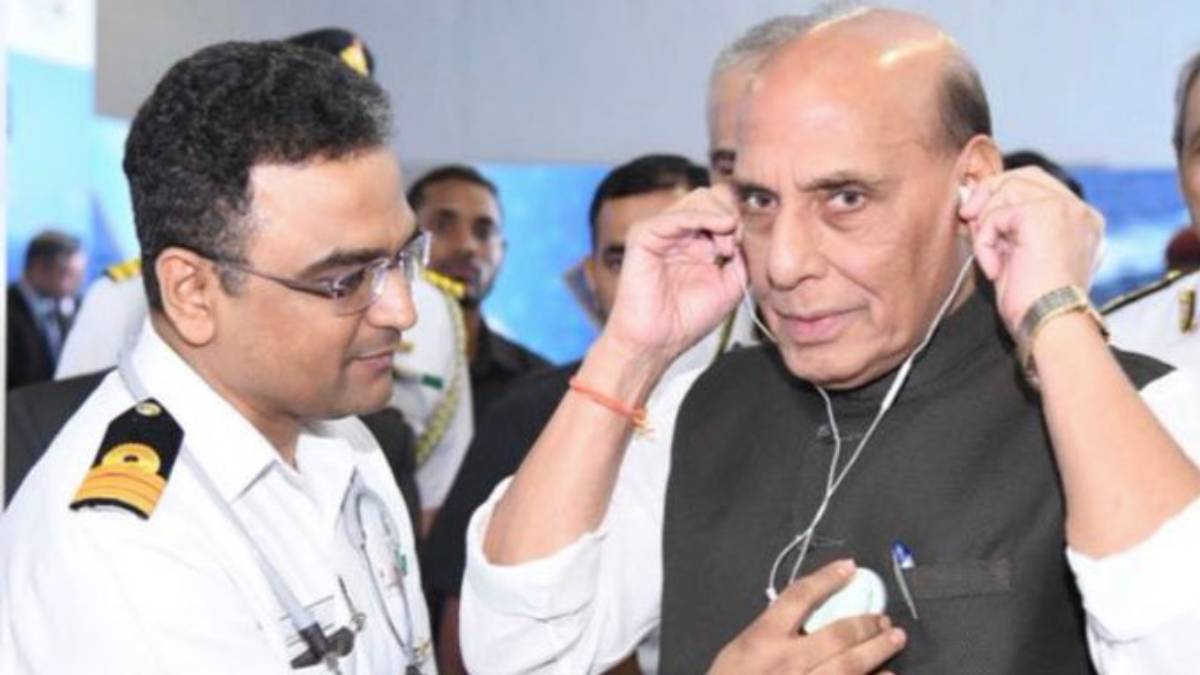
In another first, Indian Navy’s Surgeon Commander Dr Arnab Ghosh and his PhD guide, Prof Rohit Srivastava from the Nanobios Lab at IIT Bombay, have made remarkable strides in medical technology, addressing critical issues faced by healthcare professionals and patients alike. Their journey as innovators began during Dr Ghosh’s tenure as a faculty member at the Armed Forces Medical College (AFMC) in Pune back in 2017.
Challenges faced
“Dr Ghosh encountered a significant challenge while teaching medical cadets. Examining a patient over 40 times to demonstrate to each student in a batch was not only cumbersome but also impractical for real-time learning. Driven by his profound interest in physics and electronics, envisioned a solution where the sound from a stethoscope could be transmitted in real-time to multiple students simultaneously,” explained sources in the defence and security establishment.
“This idea led to the creation of an FM stethoscope in 2018, which he used for training purposes. The license for this stethoscope has been given to Yashraj Biotech Ltd and is now available in the market under the name AusKey,” they added.
Intellectual Property Right (IPR)
Despite this innovative leap, the Indian Navy Commander was unaware of IPRs at the time and missed the opportunity to file a patent. However, this setback did not deter his inquisitive spirit. He diverted his focus from hardcore clinical practice to biomedical engineering, leading to an impressive portfolio of over 60 innovations and 63 intellectual property rights (IPR) filings in the past three years, with seven patents already granted.
Among their notable inventions is India’s first breathable personal protective equipment (PPE) named NavRakshak. Developed during the early phase of the COVID-19 pandemic, this highly protective yet breathable PPE was devoid of any plastic coating or seam tape, addressing the issue of PPE fatigue among healthcare workers.
The Indian Navy facilitated the technology transfer to six MSMEs through the National Research Development Corporation (NRDC), leading to widespread adoption and the creation of thousands of jobs. NavRakshak received accolades from healthcare workers, with testimonials highlighting its comfort and protective efficiency.
In addition to these achievements, Prof Srivastava and Dr Ghosh tackled the global problem of needlestick injuries in healthcare settings. This issue affects both patients and healthcare workers, underscoring the need for effective preventive measures. Existing solutions, including safety-engineered devices and awareness campaigns, face challenges such as cost, resistance to change, and usability.
In response, the duo developed the ‘NavRakshak Needle Guard,’ a user-friendly and cost-effective solution. This innovative device features a reusable attachable needle cap with a sliding mechanism, ensuring secure locking and activation. The cap covers the needle during usage and after disposal, significantly reducing the risk of needlestick injuries.
A patent has been submitted, and a scale-up plan under the ‘NavRakshak’ brand is in progress. The problem statement for this invention was initially proposed by a team of medical cadets from AFMC, Pune, under the guidance of Prof TVSVG.K. Tilak, an eminent onco-physician, highlighting the collaborative approach of Prof Srivastava and Dr. Ghosh.
Their work extends beyond immediate inventions, contributing significantly to translational research, especially in remote patient monitoring and digital health domains. Their efforts in developing advanced remote monitoring systems and digital health solutions are paving the way for future healthcare, where patients can receive timely and effective care without geographical constraints. These innovations are set to revolutionize how healthcare is delivered, ensuring better outcomes and enhanced patient safety.
According to sources quoted above, the duo’s contributions are transforming healthcare safety and efficiency, benefiting millions of patients and healthcare workers globally. Their dedication to innovation and their ability to bridge the gap between medical practice and engineering make them true pioneers in the field. As they continue to develop new solutions, their work sets a benchmark for future medical technologists and underscores the importance of fostering a culture of innovation in healthcare.
NIIO And iDEX
The Indian Navy has been on the forefront of innovations and indigenisation.
The emphasis by the Indian Navy on channelling in-house innovation through the Naval Innovation Indigenisation Organisation (NIIO) is showing results, said former Indian Navy Commodore Arun Golaya on the social media.
He went on to add that ‘Mission Raksha Gyan Shakti’ was launched by defence minister Rajnath Singh.
In Nov 2018 to spur creativity and set up an enabling framework for creation of IPR initially focused on DPSUs, Services were added later.


