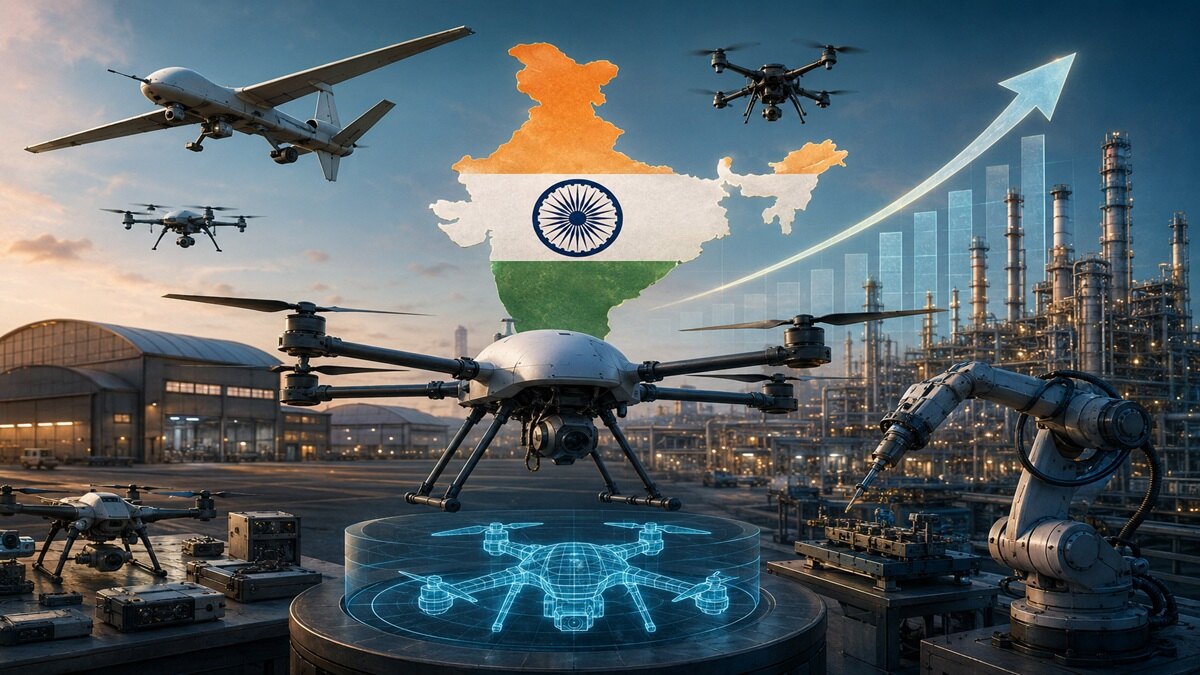
The global military drone market is undergoing a major expansion, and currently India is expected to be one of the biggest growth stories in the segment. According to an assessment by Kotak Institutional Equities, the worldwide market could rise to US$75 billion by 2029 from $30 billion in 2024. India alone is projected to spend $25-30 billion on drones and another $4-5 billion on counter-drone systems over the next decade.
Drones reshaping the economics of war
Drones are no longer just support tools; they are reshaping the economics of war itself. The traditional model of military power rested on expensive jets, helicopters, tanks and warships, but the Russia-Ukraine conflict has shown how low-cost commercial drones can inflict outsized damage on high-value assets. In this new battlefield environment, affordability has become a weapon, and the cost-exchange ratio has shifted dramatically against legacy platforms.
Ukraine’s “Operation Spider’s Web” has become a defining example of this shift. In that operation, more than 100 truck-launched drones reportedly costing under $500,000 caused roughly $7 billion in damage to Russian airbases, highlighting a massive cost-impact multiplier. The lesson for militaries worldwide is clear: offensive drone capabilities matter, but counter-drone systems are now just as critical because defending against drones has become central to modern warfare.
From strategic priority to multi-billion-dollar opportunity
India has already recognised drones as a strategic defence priority and is rapidly scaling investments across surveillance, strike and loitering systems. At present, the Indian armed forces spend an estimated $250-300 million per year on drones for defence and security, but Kotak expects this to expand sharply as procurement, domestic manufacturing and export ambitions gather pace.
India’s defence drone ecosystem takes -off
The brokerage says India’s drone market is still at a nascent stage, but it is poised to become a multi-billion-dollar industry in the coming years. That growth will be driven not just by military induction, but also by India’s push to manufacture drones locally and eventually build an export presence in the global market. A major signal of that ambition is the planned US$3.5 billion procurement of 31 MQ-9B Predator drones from the US, which underscores how seriously the armed forces are treating the category.
India’s $35 Billion Drone Blueprint: Defence & Aerospace Boom Tracker
| # | Item | Category | Value | Key Detail |
|---|---|---|---|---|
| 1 | Global Military Drone Market | Market Size | $30 Bn (2024) → $75 Bn (2029E) | Kotak Institutional Equities assessment |
| 2 | India Drone Spend Projection | Market Size | $25-30 billion | Over the next decade |
| 3 | India Counter-Drone Spend | Market Size | $4-5 billion | Over the next decade |
| 4 | Current Annual Spend | Market Size | $250-300 million/year | Indian armed forces, present-day baseline |
| 5 | MQ-9B Predator Procurement | Market Size | $3.5 billion / 31 drones | From the US; signals scaling ambition |
| 6 | Operation Spider’s Web | Battlefield Case Study | $7 Bn damage / <$500K cost | 100+ truck-launched drones vs Russian airbases |
| 7 | Solar Industries | Indian Beneficiary | Nagastra-1 loitering munition | Combat-proven in ‘Operation Sindoor’ (May 2025); exports incl. Congo |
| 8 | Bharat Electronics (BEL) + DRDO | Indian Beneficiary | Archer SRUAV | Cost-competitive alternative to Bayraktar TB2 |
| 9 | Adani Defence | Indian Beneficiary | Unmanned systems ecosystem | Expected beneficiary as force integration expands |
| 10 | Turkey Export Share | Global Competition | ~65% | Bayraktar TB2 sold to 30+ countries at $2-5M/unit |
| 11 | China Export Share | Global Competition | ~26% | Second-largest combat drone exporter |
| 12 | US Export Share | Global Competition | ~8% | Third-largest combat drone exporter |
| 13 | India Export Share | Global Competition | Limited (improving) | Growing credibility via battlefield validation |
Drones as force multipliers: ISR, logistics and counter-UAV operations
Drones have become a force multiplier for India’s security services, with the Army, Navy, Air Force, BSF and state police deploying them for intelligence, surveillance and reconnaissance (ISR), logistics and counter‑drone operations across the country’s 15,000 km land border and 7,500 km coastline.
The Indian Army and CAPFs use medium‑altitude, long‑endurance UAVs such as Heron Mk‑II and Searcher Mk‑II for round‑the‑clock monitoring along the Line of Control and the Line of Actual Control, while indigenous DRDO platforms like Rustom‑2/Tapasya and smaller tactical drones extend coverage into Ladakh, the Northeast and other difficult terrain.
The Indian Navy is inducting its first indigenously manufactured naval UAVs to boost Maritime Domain Awareness, enabling persistent tracking of vessels, anti‑piracy patrols and coastal surveillance without risking pilots. Beyond ISR, drones are increasingly tasked with resupplying forward posts—replacing mules and helicopter sorties in high‑altitude sectors—as well as crowd monitoring, search‑and‑rescue, disaster assessment and inspection of critical infrastructure.
In parallel, the security establishment has rolled out layered “detect‑deter‑destroy” (D4) anti‑drone systems and handheld/vehicle‑mounted jammers, especially along the Indo‑Pak border, to neutralise hostile UAVs used for smuggling, reconnaissance or terror strikes, making drones integral to both offensive and defensive dimensions of India’s internal and external security architecture.
Which are the key Indian beneficiaries?
Kotak has highlighted Solar Industries, Bharat Electronics (BEL) and Adani Group company, Adani Defence as the main Indian beneficiaries of the drone boom. Solar Industries is emerging as a major player in loitering munitions through Nagastra-1, which Kotak says was combat-proven during ‘Operation Sindoor‘ in May 2025 and has since drawn interest from markets in Africa and south-east Asia, including orders from Congo’s military.
BEL and Defence Research and Development Organisation (DRDO) are also being positioned as important domestic contenders through the Archer SRUAV, which Kotak describes as a cost-competitive alternative to Turkey’s Bayraktar TB2. The Bayraktar has been widely exported, sold to more than 30 countries at roughly US$2-5 million per unit, and India’s ability to field comparable systems at competitive cost could prove important for both domestic adoption and future exports.
Adani Defence is another name expected to benefit as India’s unmanned systems ecosystem expands. As drone procurement moves from isolated purchases to broader force integration, companies that can supply platforms, components, payloads, sensors, counter-drone solutions and system integration are likely to see the strongest revenue tailwinds.
Export ambitions and competition
Globally, combat drone exports are still dominated by a few major players. Turkey leads with about 65% share, followed by China at 26% and the US at 8%, while India’s export footprint remains limited for now. Even so, Kotak expects that India’s position is improving as indigenous platforms mature and battlefield validation builds credibility.
The competition is not only about hardware, but also about doctrine, reliability and cost. Countries looking for affordable battlefield systems are increasingly open to alternatives that are less expensive than Western platforms and less politically constrained than some Chinese options. That is why India’s push for self-reliance in unmanned systems is strategically important: it is not just about meeting domestic needs, but about carving out a place in a global market that is expanding fast.
Conclusion
The broader takeaway is that drones are moving from the margins of defence planning to the centre of military strategy. For India, that means the coming decade could reshape both national security procurement and the structure of the domestic defence industry. If the current trend holds, drones and counter-drone systems will become a major investment theme, not just for the armed forces but also for private industry.
Kotak’s projection of $25-30 billion in drone spending and $4-5 billion in counter-drone spending points to a market that is still early but already enormous in potential. With policy tilted toward indigenous manufacturing, the next phase will likely be defined by faster procurement, deeper Research and Development and stronger export ambitions, making drones one of the most important defence growth stories in India.