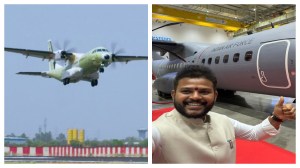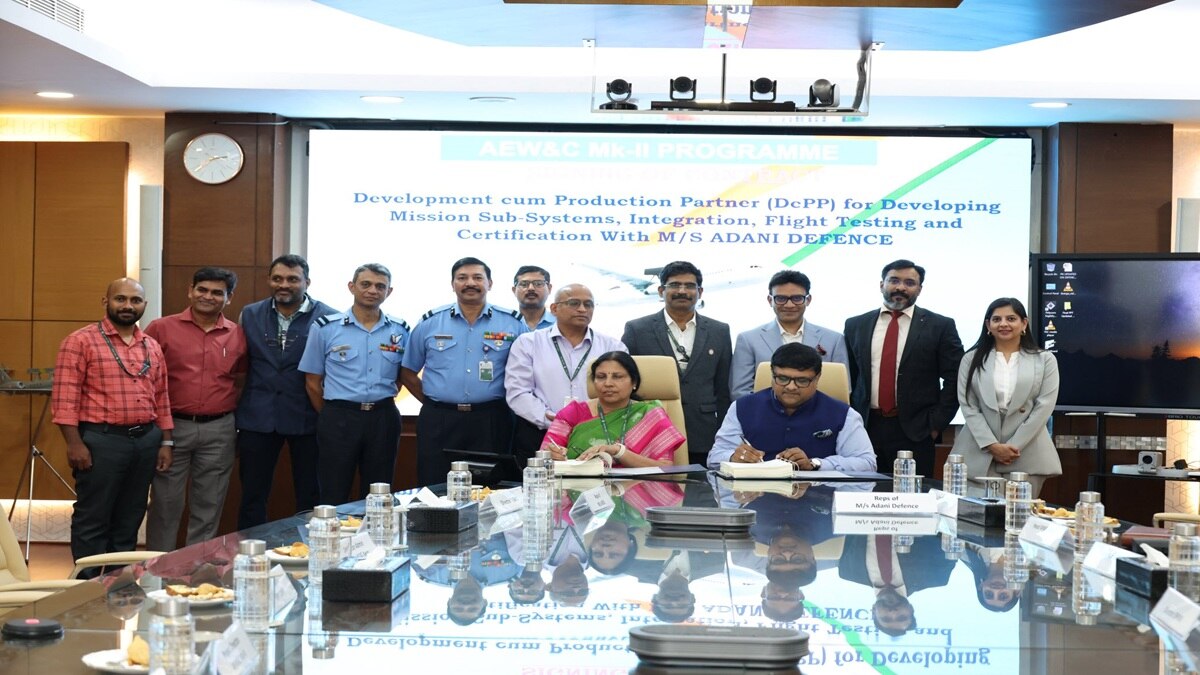
The Defence Research and Development Organisation (DRDO) has signed two major agreements with AI Engineering Services Limited (AIESL) and Adani Defence Systems and Technologies Ltd (ADSTL) for the development and production of the Airborne Early Warning & Control (AEW&C) Mk-II programme. The contracts were signed in New Delhi in the presence of Defence Secretary and DRDO Chairman Rajesh Kumar Singh, they mark a significant step in strengthening India’s indigenous defence ecosystem under the ‘Aatmanirbhar Bharat’ push.
Under the first agreement, AIESL will convert six Airbus A321 aircraft from commercial configuration into “green” configuration, creating the base platforms for the AEW&C Mk-II fleet. The second contract makes ADSTL the development-cum-production partner for the mission systems that will be integrated into these aircraft. DRDO’s Centre for Air Borne Systems (CABS), the nodal laboratory for the project, will lead the programme and oversee system integration on the modified aircraft supplied by Airbus Defence & Space.
Strengthening India’s defence ecosystem through indigenous Innovation, DRDO today entered in partnership with M/s AI Engineering Services Ltd( AIESL) and M/s Adani Defence Services & Technologies Ltd ( ADSTL) for development and production of Airborne Early Warning and Control… pic.twitter.com/2RO8Zsi7bE
— DRDO (@DRDO_India) July 22, 2026
India’s AEW&C Mk-II to give IAF next-generation ‘eyes in the sky’
Officials said the AEW&C Mk-II platform is designed to give the Indian Air Force a major leap in airborne surveillance, secure communications, endurance, command-and-control capability and situational awareness. Often described as the “eyes in the sky,” AEW&C aircraft can detect threats at long range, track aerial activity in real time and function as flying command centres for faster operational decisions. The platform is expected to improve the IAF’s ability to monitor hostile movements, coordinate air assets and respond more effectively across extended ranges.
Adani-led AEW&C Mk-II programme to strengthen India’s networked air defence by 2032–33
The programme is also being seen as a landmark for private-sector participation in India’s defence sector. Adani Defence & Aerospace will play a central role not only in mission-system development and integration but also in lifecycle support, including logistics, maintenance, repair and overhaul, and technical assistance for up to 30 years. This makes it the first private Indian company entrusted with the development, integration and long-term support of an airborne mission platform of such scale and complexity.
Proud to partner with @DRDO_India for the AEW&C MKII programme. As the first private Indian company entrusted with the development, integration and 30 years of lifecycle support for an airborne mission platform, we are advancing #AatmanirbharBharat. 🇮🇳 pic.twitter.com/eUe6I72FMg
— Adani Defence and Aerospace (@AdaniDefence) July 22, 2026
The AEW&C Mk-II system will also be integrated with the Indian Air Force’s Integrated Air Command & Control System (IACCS), the nationwide command-and-control network that connects surveillance, air defence and operational assets in real time. Once linked to this system, the aircraft will strengthen decision-making, battlespace coordination and operational responsiveness, adding another layer to India’s air defence architecture. The programme is expected to enter induction around 2032-33, placing India among a select group of countries with indigenous AEW&C capability.
AEW&C Mk-II to boost India’s self-reliance with faster threat response and advanced defence capabilities
CABS and ADSTL will work with the Indian Air Force on flight testing to secure certification from the Centre for Military Airworthiness and Certification and the Directorate General of Aeronautical Quality Assurance. Defence officials said the two contracts reflect the government’s broader intent to deepen domestic innovation, research and manufacturing in advanced military systems. The programme is therefore not just about adding a new aircraft but about building a long-term national capability in airborne surveillance and control.
The AEW&C Mk-II marks a major shift in how India is building complex defence platforms, with research, production and lifecycle support increasingly being shared between the public and private sectors. By combining DRDO’s systems expertise with industry capability, the programme aims to create a more self-reliant and resilient aerospace supply chain. It also signals India’s intent to reduce dependence on foreign surveillance platforms while expanding indigenous high-end military manufacturing.
In practical terms, the platform will help the IAF respond faster to airspace threats, especially in a two-front security environment where early warning is critical. Better surveillance, quicker reaction times and tighter integration with command networks can significantly improve operational readiness in both peacetime monitoring and wartime scenarios. The project is also likely to generate deeper technical know-how in mission systems, airborne integration and long-term support, which could benefit future aircraft programmes as well.